Skip to content
Live
Mar 5Thu
  1. Anthropic Research

    Anthropic has released a new metric observed exposure to evaluate AI replacement risk.

    Anthropic introduces a new metric, observed exposure, to quantify AI replacement risk, combining LLM theoretical capabilities with actual usage data, focusing on automated work scenarios; the study finds that current AI coverage is only a fraction of the theoretical value, high-risk occupations are mostly highly educated, high-income women, and unemployment rates have not significantly increased since the end of 2022, but hiring for exposed occupations among young workers has slowed.


Mar 1Sun
Feb 10Tue
  1. Prime Intellect Blog

    Prime Intellect Lab: An end-to-end platform for training custom models

    Prime Intellect Lab releases an end-to-end model training platform that integrates Environments Hub, hosting training and hosting evaluation, supporting large-scale agent reinforcement learning, reasoning, and evaluation without managing GPU clusters or algorithm details. The platform is built based on environments, including task datasets and executors, and has completed over 3000 reinforcement learning runs through private testing.

Jan 10Sat
  1. Berkeley AI Research

    Berkeley AI research proposes an information-driven imaging system design framework

    Berkeley AI research proposes an information-driven imaging system design framework, which quantifies the object's discrimination capability through mutual information measurement. It has been validated in four fields: color photography, radio astronomy, lensless imaging, and microscopy that information estimation can predict decoder performance. The optimized mutual information design scheme achieves end-to-end optimal results while reducing memory and computational load.

Oct 16Thu
Jul 1Tue
  1. Dify Blog65

    Dify building secure AI applications on Azure AI Content Safety Container Extension

    The Azure AI Content Safety Container Plugin has been launched on the Dify Plugin Marketplace, capable of automatically detecting and filtering harmful content in user inputs and AI outputs to ensure application security and compliance. The plugin supports real-time content review, multi-layered protection (covering hate speech, violence, pornography, self-harm, etc.), and allows for local container deployment to meet privacy and compliance requirements. The latest version v0.0.2 provides unified review, custom configuration, text blacklists, combined result output, and detailed violation information.

May 11Sun
  1. Prime Intellect Blog

    INTELLECT-2 Released: The first 32B parameter model trained through global distributed reinforcement learning

    INTELLECT-2 is the first 32B parameter model trained using global distributed reinforcement learning, employing fully asynchronous RL across dynamic heterogeneous computing contributor groups to train reasoning language models. It has open-sourced the training framework PRIME-RL and components such as TOPLOC and SHARDCAST, while improving the GRPO training recipe and data filtering techniques, enhancing QwQ-32B performance on mathematical and coding tasks.

Nov 29Fri
  1. Prime Intellect Blog

    INTELLECT-1 Released: The First Global Jointly Trained 10B Parameter Model

    INTELLECT-1 is released, the first 10B parameter language model trained through global collaboration, based on the Llama-3 architecture, completing 1T token training on 112 H100 GPUs across 5 countries and 3 continents, with the PRIME framework achieving a 400x reduction in communication bandwidth, 96% computational utilization, supporting sequence lengths of 8192 and a vocabulary of 128256, with the model code and data open-sourced.

Sep 13Fri
Aug 16Fri
Jul 11Thu
  1. Prime Intellect Blog

    OpenDiLoCo: An open-source global distributed low-communication training framework

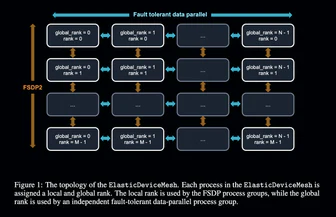
    OpenDiLoCo successfully replicated and extended DeepMind's DiLoCo experiment to a 10B parameter model scale, achieving cross-continent, three-country distributed training through Hivemind and PyTorch FSDP, maintaining 90-95% computational resource utilization. The framework is based on the open-source implementation of Hivemind, supporting dynamic resource joining/leaving and fault-tolerant training, significantly reducing communication requirements by 500x while maintaining performance on 1.5B parameter models.

Mar 15Fri