Skip to content
Live
Nov 13Fri
Nov 12Thu
  1. Claude · YouTube42

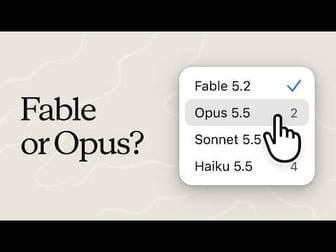
    Claude Code's use case selection between Fable 5.2 and Opus

    Claude Code released Fable 5.2, requiring users to select Opus 5.5, Fable 5.2, Sonnet 5.5, or Haiku 5.5 based on task type, or distribute tasks across models. The availability and usage restrictions of each model vary depending on the subscription plan. Guidelines suggest using the corresponding model for complex coding and knowledge work, open-ended technical tasks, and low-cost limited tasks, respectively.

    Same story · 2 outlets

    How the accounts differ:TechCrunch states the input price of Fable is reduced to $8 per million tokens; others do not mention the price.

Nov 11Wed
  1. Google DeepMind87

    Google DeepMind releases the Gemini 4 Carbon cutting-edge model

    Google DeepMind has opened Gemini 4 Carbon to developers, enterprises, scientists, and consumers, claiming it has reached cutting-edge levels in network security capabilities and long-range intelligent agent workflows.

    Why it matters: The official provides the positioning division of roles between Carbon and Argon, multiple benchmark rankings, and cost comparisons per task to help determine when to use a heavier model.

Nov 10Tue
  1. AWS Machine Learning Blog

    Anthropic launched Claude Fable 5.2 and Claude Mythos 5.2 on AWS

    Anthropic Launches Claude Fable 5.2 and Claude Mythos 5.2 on AWS, Fable 5.2 is its most powerful general model for coding and scientific fields, supporting unsupervised operation for days; Mythos 5.2 is provided through a validation program and performs more reliably in cybersecurity and life science fields.

    Same story · 2 outlets

    How the accounts differ:TechCrunch states the input price of Fable is reduced to $8 per million tokens; others do not mention the price.

  2. Claude · YouTube75

    Anthropic released Claude Fable 5.2

    Anthropic released Claude Fable 5.2, stating that it has improved in coding, reasoning, and vision, targeting the most complex and open-ended technical work. The official recommendation is to start most coding and knowledge tasks from Opus 5.5, and Fable 5.2 has been launched in the Pro, Max, Team, and Enterprise packages.

    Same story · 2 outlets

    How the accounts differ:TechCrunch states the input price of Fable is reduced to $8 per million tokens; others do not mention the price.

  3. Claude · YouTube75

    Anthropic released Claude Fable 5.2

    Anthropic releases Claude Fable 5.2, designed for the most challenging technical challenges, with improvements in coding, reasoning, and vision, suitable for the most ambitious open-ended technical work. The official recommendation is to use Opus 5.5 for most coding and knowledge tasks, and Fable 5.2 is now available in the Pro, Max, Team, and Enterprise packages.

    Same story · 2 outlets

    How the accounts differ:TechCrunch states the input price of Fable is reduced to $8 per million tokens; others do not mention the price.

    Why it matters: The official statement explains the positioning and applicable scenarios of Fable 5.2, and provides a choice suggestion between Opus 5.5, making it easier to decide which model to use.

Nov 9Mon
Nov 7Sat
  1. Claude · YouTube42

    How Salesforce leverages Claude Code to improve AI coding efficiency and output quality

    Salesforce expanded Claude Code to thousands of engineers, doubling effective output and reducing the number of bugs per line of code. The 'effective output' scoring system, co-built by the company's engineering leadership and Stanford researchers, measures AI coding ROI, and the intelligent agent maturity curve guides engineers from simple prompts to fully autonomous agents.

Nov 6Fri
Nov 5Thu
  1. ByteDance Seed · Hugging Face new models

    ByteDance-Seed/Qwen3-30B-A3B-MoE-SAE released

    ByteDance-Seed/Qwen3-30B-A3B-MoE-SAE is released, containing TopK sparse autoencoders (k=100, 2^20 latent variables) trained on layers 4, 30, and 46 of the Qwen3-30B-A3B model. Each SAE is approximately 17.2 GB, with reconstruction variance unexplained scores of 12.6%, 25.1%, and 7.6% respectively.

  2. ByteDance Seed · Hugging Face new models58

    ByteDance-Seed/Cross-Layer-TopK-CLT released: a Cross-Layer Transcoder designed for Qwen3-8B-Base

    ByteDance-Seed released the Cross-Layer Transcoder (CLT) for Qwen3-8B-Base, which includes 36 layers × 32,768 latent variables, with 94.2B parameters, a total size of 377 GB, supporting fp32 inference, encoding by jointly scoring the top 360 activated latent variables across all layers, and reconstructing the original MLP output during decoding.

Nov 4Wed
  1. OpenAI News60

    OpenAI announced the acquisition of Pierre Computer Company.

    OpenAI announced its acquisition of Pierre Computer Company to expand the tool capabilities of Codex in code construction, understanding, and review. The original text did not disclose the transaction amount, timeline, or specific arrangements for the team and products after the acquisition.

    Why it matters: Official disclosure of the acquisition move, readers can understand Codex's reinforcement direction in code construction and review tools.

Nov 3Tue
Nov 2Mon
Oct 30Fri
  1. Meta Engineering66

    Meta rolls out JiTTesting to production: Use LLM to generate tests and catch bugs before code merge

    Meta announced that Catching JiTTests has been put into internal production, using LLM to automatically generate executable tests for diffs to be merged, exposing behavioral differences before the code is landed

    Why it matters: Meta has disclosed the production deployment details and quantitative results of JiTTests, available for evaluating the implementation of LLM-generated tests in ultra-large-scale codebases.

Oct 29Thu
  1. Mistral AI82

    Mistral releases open-source model Mistral Large 4 (Le Chonk) with trillion parameters

    Mistral releases open-weight version of its flagship trillion-parameter native multimodal model Mistral Large 4 (Le Chonk), which has been in public preview for three weeks.

    Why it matters: The official provides data on the encoding, security, and inference efficiency of the trillion-parameter open-source model, as well as weight downloads and self-hosting paths.

  2. ByteDance Seed · Hugging Face new models

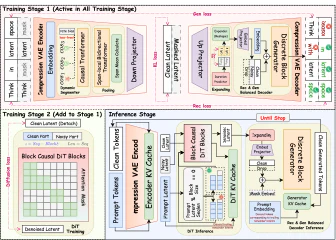
    ByteDance-Seed/GenFirst releases: A generative pre-reconstruction method for stable end-to-end latent generation modeling

    ByteDance-Seed/GenFirst trains a latent VAE and combines it with a generative prior to avoid latent collapse, which usually makes end-to-end training unstable. The two-stage plan of this method is used for prior and entropy weights: the first stage lets the prior shape the latent geometry, and the second stage reduces both weights tenfold, allowing the decoder to recover details.

Oct 28Wed
  1. Databricks Blog

    Databricks improves document extraction accuracy through ai_extract and MLflow Prompt Registry

    Databricks improves document extraction accuracy by building a document extraction process that includes a review step, using ai_extract combined with JSON schema and global instructions, and leveraging MLflow Prompt Registry for versioned configuration. Finally, it validates the improvement effect on a fixed set of manually labeled data, enhancing the overall performance of the system.

Oct 24Sat
  1. Hugging Face Blog

    LitPivot: Developing research ideas through dynamic context in the literature landscape

    LitPivot helps researchers adjust their research direction by reading previous literature, dividing research ideas into problems, contributions, and evaluation plans, and providing literature-based criticism and revision suggestions for each section. In a laboratory study involving 17 researchers, domain experts rated the literature foundation of novel ideas developed using LitPivot better than ideas developed using text editors and AI chat tools. Participants also reported stronger literature comprehension and improved understanding of the novelty and practicality of their ideas.

Oct 23Fri
  1. Anthropic Research82

    Anthropic research: LLMs make large-scale formal software verification feasible.

    Anthropic partnered with Theorem to complete formal verification of the RISC-V assembly layer for 239 entry points in 123 OSS-Fuzz open-source libraries using Claude. The verification proves that these programs will not crash with any input less than 64 MB, with the proof code consisting of about 180 million lines of Rocq.

    Why it matters: Anthropic used Claude to formally prove the RISC-V assembly layer for 123 open-source libraries and provided cost and reuse data, which can be used to determine whether this method can enter the daily development process.

Oct 22Thu
  1. Hugging Face Blog

    How to reduce inference cost by 77% in real-world applications using a specialized SLM vocabulary list.

    Qwen3-4B's specialized vocabulary list VocabX reduces inference cost by 77% by focusing on the cost of each token rather than frequency, without changing the base model. This method for the Portuguese essay scorer reduces the output layer vocabulary from about 152,000 lines to about 65,000 lines, significantly reducing the computational overhead of token splitting and unused vocabulary items.