Skip to content
Live
Oct 14Wed
  1. Google DeepMind

    Google DeepMind collaborates with the Singapore government to develop a fine-tuned AI model for fraud detection

    Google DeepMind partnered with the Singapore government's tech agency, GovTech Singapore, to fine-tune the privacy-preserving device-side fraud detection model Gemma to combat over half of the crime in Singapore (over 4 billion SGD in losses). The model issues real-time warnings by analyzing conversation patterns on the device, and as it runs on the device side, user privacy is not compromised.

  2. Claude · YouTube

    Detailed Explanation of Claude Code Cloud Chat Function

    Claude Code's cloud sessions run on cloud virtual machines, allowing offline continuous operation, supporting phone startup, and parallel processing. Suitable for scenarios requiring continuous operation or remote collaboration, supporting GitHub connection and environment configuration. This feature is included in the Pro, Max, Team plans, as well as enterprise advanced or Chat + Claude Code seats, counted towards plan limits with no additional compute costs.

Oct 13Tue
  1. GitHub Blog · AI & ML

    GitHub Copilot Application Introduction: How to Teach Copilot to Understand Your Codebase

    GitHub Copilot can allow users to convey project rules, encapsulate repeatable processes, provide professional guidance, and connect external tools to improve collaboration efficiency through custom instructions, proxy skills, custom agents, and the Model Context Protocol (MCP) server. Custom instructions define code standards, proxy skills encapsulate repetitive tasks, custom agents handle complex work, and MCP servers extend Copilot functionality.

Oct 8Thu
Oct 7Wed
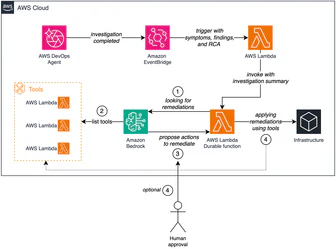
  1. AWS Machine Learning Blog

    AWS Design Six-Week Plan helps non-technical professionals build AI prototypes to bridge the AI knowledge and capability gap

    The AWS Design Six-Week Plan helps non-technical professionals build AI prototypes to bridge the AI knowledge and capability gap. Four non-engineering background customers' professionals developed the first-place WealthWise multi-agent AI financial advisory tool within six weeks using this plan. The plan employs pair mentoring and production-level tools like Amazon Bedrock, requiring participants to follow five principles: prioritize learning over winning, hold daily stand-ups, start with a minimum viable product (MVP), actively seek guidance, and maintain fun.

Oct 6Tue
Oct 2Fri
  1. GitHub Blog · AI & ML

    AI is changing the way developers work, these three skills are worth strengthening

    Developer workflows are changing due to AI, with skills beyond coding—such as guiding AI, evaluating outputs, communicating trade-offs, and making technical decisions—becoming increasingly important. Three key skills developers should strengthen are learning to guide AI rather than just using it, not trusting AI's first answer and evaluating it, and leveraging AI to solve broader problems.

Sep 26Sat
Sep 23Wed
  1. Together AI Blog

    How to train your own Jev model for $17

    Together AI released a guide on how to fine-tune the Jev classification model using the Qwen3.5 4B model and a Hugging Face dataset of 38,340 items, with a training cost of about $17 and a duration of about 25 minutes; after deployment, it can be used for inference via an API endpoint (e.g., ENDPOINT_NAME), suitable for scenarios such as intent recognition for e-commerce customers.

Sep 14Mon
  1. LangChain Blog71

    How to build paid media agents with LangChain

    LangChain publicly shares its construction method for paid media intelligence agents, which run on Slack, summarize ad platform and warehouse data weekly, and generate reports. Paid media increased from contributing 0 to 20% of the marketing pipeline within 6 months, and the cost per qualified lead decreased by 30% from June to August.

    Why it matters: LangChain publicly shares the complete engineering details of its paid media intelligence agents, including context hierarchy, on-demand tool discovery, and sub-agent isolation, which can serve as a reference for building long-running intelligent agents.

Sep 9Wed
  1. Mistral AI

    Mistral AI helps European energy operators migrate 40,000 lines of Fortran 77 code to C++

    Mistral AI helps European energy operators migrate 40,000 lines of Fortran 77 code to C++, the physics-intensive reservoir simulator lacks a test suite and centralized documentation. The project verifies the numerical correctness of the migrated code by building a consistency test harness, and uses an AI agent to organize documentation, ultimately adopting a human-supervised agent workflow to achieve modular migration, significantly improving code quality.

Jun 17Wed
  1. LangChain Blog50

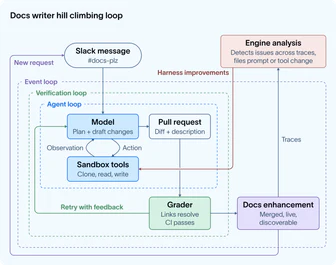
    LangChain explores the art of circular engineering

    LangChain enhances agent efficiency through four levels of circularity: basic loops for task execution, verification loops for quality assurance, event-driven loops for background operations, and climbing loops for self-analysis and optimization. Primitives like LangChain's create_agent, Grader, LangSmith Deployment, and Engine support the construction of each level, while emphasizing human review at critical nodes to supplement AI judgment.

Apr 16Thu
Apr 18Fri
  1. Anthropic Research62

    Anthropic releases Claude Code best practices for intelligent agent coding

    Anthropic releases Claude Code best practices covering CLAUDE.md configuration, tool permission management, MCP access, common workflows, and multi-Claude parallelism. The article suggests exploring and planning with sub-agents before writing code and provides specific processes such as test-driven development, screenshot iteration, and headless mode automation. This article has been moved to the official documentation, and the original blog is no longer maintained.

    Why it matters: Anthropic's official system has organized the configuration, workflows, and multi-instance parallel methods of Claude Code, which can be used as a reference for setting up intelligent agent coding processes.

Mar 11Mon
  1. LangChain Blog

    How does Dosu improve the reliability of large language models through evaluation-driven development?

    Dosu enhances the reliability of large language models through evaluation-driven development (EDD), using LangSmith to monitor and search activities to address challenges brought by growth. The team adopts the EDD process to improve core logic, models, or prompts, ensuring maintenance of performance and improvement of weak points. The LangSmith SDK provides the necessary fine-grained control and customization, supporting the management of prompts as code and tracking metadata.