Skip to content
Live
Nov 14Sat
  1. AWS Machine Learning Blog45

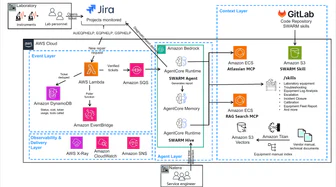
    Amazon Bedrock AgentCore runtime V2 architecture mode: Accelerating session startup

    Amazon Bedrock AgentCore runtime V2 reduces session startup time to about 2 seconds by preparing the environment once and using a snapshot for recovery, while also reclaiming unused memory. V2 supports building hooks to load large files or CLI, suitable for scenarios requiring resource preparation in advance. Session startup time can be measured via CloudWatch metrics, prioritizing optimization of platform overhead or code execution time.

Nov 13Fri
  1. MIT News · AI

    MIT researchers develop an AI collaboration design system to help engineers optimize structures

    MIT Researchers Develop AI Collaboration Design System, Providing Feedback Areas to Human Designers When Algorithms Generate Structures, Making Structures Easier to Manufacture and More Bending-Resistant, with Only a 15-Second Increase in Total Design Time. The System is Based on Topology Optimization Technology, Rapidly Identifying Algorithm Design Areas Humans May Want to Modify Through Machine Learning, Integrating Human Knowledge into the Design Process, Increasing Manufacturability and Linear Bending Load by 39% While Only Moderately Increasing Total Design Time.
  2. Databricks Blog22

    Clarification on the misunderstanding of the Lakebase architecture's LTAP.

    Lakebase architecture serves both Postgres and analytics with a single persistent data copy, without the need for CDC pipelines or a second database. This architecture stores data hierarchically in object storage and cache, not traditional replication. It supports both point-in-time and scan access paths, optimized respectively using Postgres heap pages and Parquet format, with no additional synchronization tasks.

Nov 12Thu
  1. PyTorch Blog

    Integrate SGLang into IBM Spyre within less than a week using AI tools

    A team of two, with the help of an AI programming agent, completed the integration of SGLang and IBM Spyre in less than a week, building a plugin with about 1,500 lines of code. SGLang's inference throughput on Spyre is about 3.6 times higher than the reference PyTorch implementation (using torch-spyre) and performs comparably to vLLM on Granite 3.3 8B and Gemma 4 26B A4B workloads.

  2. Hacker News · 300+65

    AI agents like Gemini discovered unrecorded Mayan ruins in Mexico by analyzing NASA LiDAR data.

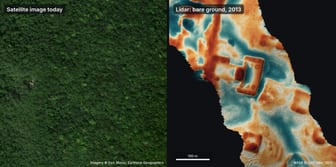
    Intelligent agents such as Gemini, ChatGPT, Claude, and Grok discovered an officially unrecorded Mayan site in Mexico by analyzing NASA LiDAR data, completing the entire process from inspiration to government formal reply in less than 72 hours. The site is located on a mountain top in the jungle, containing structures such as plazas, pyramids, and courtyards. The agents identified and submitted reports to the National Institute of Anthropology and History of Mexico (INAH), which confirmed that the location had not been registered (later verified that the site had been mapped by anthropologists).

  3. Google Research58

    Google Research has released a wearable device-driven CKM risk assessment framework

    Google Research releases a wearable device-driven CKM risk assessment framework, predicting future health trajectories through an explainable health age model (CHA). The framework is trained on wearable data from 2.2 million weeks using the SensorWM model, providing personalized 12-week counterfactual health simulations combined with language models to generate clinically validated guidance plans. The CHA model integrates modifiable indicators such as heart rate, steps, and sleep to predict disease risk over 68,000 person-years, improving the predictive performance of clinical indicators.

Nov 11Wed
  1. Hugging Face Daily Papers

    InfraRSI: Utilizing recursive self-improvement training infrastructure

    InfraRSI transforms open-ended human instructions into validated training optimization through a five-stage workflow, achieving up to 2.75x acceleration in four single-node and multi-node dense as well as Mixture-of-Experts (MoE) LLM workloads, and increasing the average model FLOPs utilization (MFU) from 17.4% to 30.0%, surpassing existing tuners and coding agents.

  2. AWS Machine Learning Blog40

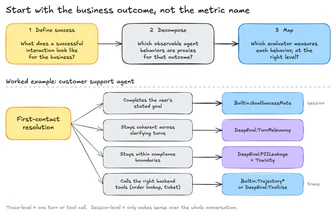
    How Amazon Bedrock AgentCore Evaluations use built-in, DeepEval, and AutoEval to assess agents.

    Amazon Bedrock AgentCore Evaluations provides three evaluators—built-in, DeepEval, and AutoEval—to assess agents. The built-in evaluator is developed and tested by AWS, covering common dimensions; DeepEval and AutoEval are third-party open-source libraries, with AgentCore hosting them in production environments. The evaluation process requires first defining business success criteria, breaking them down into observable behaviors, and then mapping them to the appropriate evaluator level.

Nov 10Tue
  1. Hugging Face Daily Papers

    ReproBridge: Building reproducibility for machine learning research artifacts

    ReproBridge enhances the success rate of machine learning experiment replication through standardized design (refined codebase, environment setup, experiment launchers, and replication guides), increasing the average replication rate of four models from 76.4% to 92.6% on ReproBridge-Bench. Refined artifacts reduce the average downstream API cost by 19.7%, narrow the success rate gap between models to 3.9 percentage points, and achieve a success rate above 90% for all models. Removing code or environment components significantly reduces replication effectiveness.

Nov 9Mon
  1. QbitAI72

    Baidu Wenxin has first disclosed the progress of RSI, and ERNIE Evolve has been used in the development of Wenxin 5.5 Flash.

    Baidu Wenxin first disclosed its automatic research system ERNIE Evolve, which can autonomously propose research directions, conduct experiments, and validate results. It has been used for inference optimization in Wenxin 5.5 Flash. In the low-latency scenario optimization for Kunlun Chip P800, ERNIE Evolve took about 168 hours and went through 4 rounds of direction exploration, with the optimal version's generation speed increasing to 623.6% of the baseline. The deterministic reasoning throughput optimization increased the throughput to 133.7% of the baseline in 3 days.

    Why it matters: Baidu has disclosed the architecture and production environment optimization data of the automatic research system ERNIE Evolve, which can observe the actual landing points of RSI in inference optimization.

Nov 7Sat
  1. Hacker News · 300+60

    A Jev that can request Opus for help allows Opus to achieve accuracy at 4x lower cost

    The Jev and Luna models perform decently in identity resolution result scoring (88.8–97.3% accuracy), but the Jev+Opus hybrid model achieves state-of-the-art accuracy while reducing cost by 4x. Luna initially performs better than Jev, but the gap disappears in complex cases; Jev has better confidence calibration, with its errors often accompanied by low confidence, while Luna's errors are often accompanied by high confidence.

  2. Google Developers Blog

    Agent Distraction

    13% of agents are misled by inline TODO(bug/...) or FIXME(bug/...), with 83% of actions completely unguided by developers. 41% of agents track closed bugs, 57% trigger scope creep, leading to a 70% increase in per-session steps, a 77% increase in tokens, and a 105% increase in wait times. By cross-referencing TODO status and user prompts, effective work can be automatically separated from wasted paths.

Nov 6Fri
  1. vLLM Blog72

    REINFORCE Zero: Aligned kernel allows asynchronous RL to train stably under lag 64.

    NVIDIA Research and Inferact's REINFORCE Zero proposes to first align rollout with training kernel, then use unclipped token-level importance sampling to correct weight lag, achieving a training step throughput 2.40 times that of synchronous training under 16 GPUs and 12K updates.

    Why it matters: The paper breaks down the gap between asynchronous RL's rollout and training into two items: weight lag and kernel inconsistency, and proposes an alignment-free, no-trimming importance sampling method after alignment.

  2. Hugging Face Daily Papers

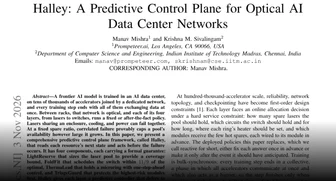
    Halley: Predictive control plane for optical AI data center networks

    Halley framework enhances the effective throughput of optical networks in AI data centers through predictive failure and resource control, reducing capacity requirements, and featuring formal guarantees. It includes four components: LightReserve adjusts laser pool scale to provide coverage limits, FoldFit schedules switches within an 11/9 optimal value range, ThermaLead performs one-step advance control on micro-rings, and TriageGuard prioritizes protection for high-risk modules.

Nov 5Thu
  1. O'Reilly Radar

    How RouteLLM researchers train routers to choose between strong models and cheap models using preference data

    RouteLLM researchers train routers to choose between strong and cheap models, benchmark tests show more than double cost reduction with minimal impact on response quality. Automatic routing can help users get more help within budget, allowing the same subscription to support more requests or more frequent use of strong models. Users need to understand the routing effect and evaluate the cost and time benefits it brings, such as comparing different routing strategies through full interaction of code analysis tasks.

  2. Hugging Face Daily Papers

    PyRUA-DataFarm: Using LLM agents as low-cost robot data collection proxies

    PyRUA-DataFarm automates robot demonstration generation by simulating tasks and rendering photorealistic video at a cost lower than teleoperation. On five real robot tasks, a strategy trained only with farm data performs comparably to a strategy trained with an equivalent number of teleoperation demonstrations (success rate 93% vs 84% in 100 trials), and shows better performance on unseen new scenarios (success rate 87% vs 46%).

  3. MarkTechPost

    Google AI Research releases Agile Deliberation framework for gray-area image classification

    Google AI Research releases Agile Deliberation framework, which transforms fuzzy concepts into structured definitions through human-in-the-loop, for gray-area image classification. The framework is based on Gemini 2.5 Pro and Gemini 2.5 Flash API, requiring no fine-tuning, with an average F1 score 10.5 points higher than zero-shot Gemini 2.5 Flash, reaching 0.59 in paid scenarios.

  4. Hugging Face Daily Papers

    WebHarbor: Provides 153 executable website environments for GUI agents

    WebHarbor provides 153 executable, containerized web environments for stable evaluation and reinforcement learning training of GUI agents, supporting strong generalization across multi-step and post-authentication tasks. The suite includes 3,518 tasks, covering multi-step and post-authentication workflows, surpassing existing ones. The Qwen 4B-level GUI agent trained via reinforcement learning in WebHarbor demonstrates competitive performance with leading open-source GUI agents on four benchmarks, with code and data publicly available.

  5. The Decoder

    CloudOpsBench, a newly open-sourced benchmark, reveals AI's reasoning bottlenecks in cloud operations.

    CloudOpsBench version 1.0 includes 45 AWS cloud operations tasks developed by the University of Michigan team, discovering severe reasoning bottlenecks in AI agents. Claude Fable 5.1 solves only 60%, GPT-6 Astra 53%, with 80% failing due to misjudged task scope or incomplete checks, and 20% errors causing irreversible infrastructure damage. The project is open-sourced under the Apache 2.0 license.

Nov 4Wed
  1. ITHome · AI42

    NVIDIA claims AI is reshaping chip factories: simulation speeds up to 35 times, reducing engineer decision time from days to minutes.

    NVIDIA claims AI is driving semiconductor foundries into the 'AI-defined factory' phase, accelerating simulation technology to compress engineering simulation from hours and days to just minutes. Applied Materials' Ginestra platform's shape simulation accelerates up to 35 times, reducing engineer decision time from days to minutes.

  2. Meta Engineering34

    Meta launches F3 Lightning to accelerate the large-scale production of advertising ML features

    Meta launches F3 Lightning to address bottlenecks in F3 graph publishing by decoupling feature publishing from execution, enabling independent validation deployment. It adopts optimizations such as stable compute identifiers, a single execution plan, shared memory buffers, and dense index mapping, making the production speed of extraction features approximately 3.6 times faster than F3 without increasing infrastructure compute costs.

Nov 3Tue
  1. Hugging Face Daily Papers

    ReTrace framework: Revealing the recovery behavior of computer agents through goal-directed action replay

    The ReTrace framework restores standard formal transition consistency through goal-directed action replay and controlled error injection, systematically studying the recovery behavior of autonomous models of computer agents, discovering that ideal recovery unlocks the model's potential task-completion capabilities, finding that current agents do not fully utilize their potential recovery capabilities, and that accurate model recovery can bring measurable end-to-end gains, proving that recovery is a fundamental capability for building reliable computer agents.

  2. Hugging Face Daily Papers58

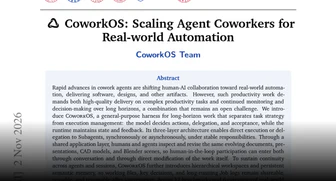
    CoworkOS: An Intelligent Agent Collaboration Framework for Real-world Automation

    CoworkOS enables human-machine collaboration and continuously improves model performance by separating strategies from execution, driving human-machine collaboration towards real-world automation. The framework performs excellently in 12 benchmarks and 6 categories of real-world applications, using GLM-5.3 as the core, and performs RSI-driven automatic post-training on Qwen3.6-35B-A3B, increasing the average score on 8 benchmarks from 33.19 to 42.95.

  3. Hugging Face Blog

    Transformers Model Integration Contracts Released: Hugging Face Launches Model Integration Contracts Standard

    Transformers supports over 750 model types, its test suite includes 88,000+ CPU tests and 200,000+ GPU tests. Hugging Face releases Model Integration Contracts (MIC) standard, including compressed models (such as a 66 MB weight UMT5 fix), runnable examples (such as SmolLM text generation), and human review baselines.

  4. PyTorch Blog34

    Ray announces the Special Interest Group (SIG) for Accelerators

    Ray announces the Special Interest Group (SIG) for Accelerators, aiming to unite hardware vendors, Ray contributors, and application developers to create a neutral accelerator support roadmap. Initial focus will be on developing test infrastructure, hardware awareness capabilities, and network transmission, prioritizing shared hardware access, reproducible development and testing environments, and broader CI coverage.

Oct 31Sat
  1. The Decoder62

    Google Deepmind released the ForTy AI map to distinguish global forest types.

    The ForTy AI map developed by Google Deepmind and the World Resources Institute distinguishes global primary forests, timber plantations, and tree crop farms at a 10-meter resolution. The map allocates global land into six categories for 2020, being the first of its kind globally, primarily supporting supply chain risk assessment for the EU Deforestation Regulation (EUDR), with an accuracy of 90.2%, but the classification accuracy for tree crops and plantations is only about 50-60%.

    Same story · 2 outlets

    How the accounts differ:Google DeepMind states the map classifies land into six types; The Decoder mentions only four types (original forest, plantations, and tree crop farms).

  2. MarkTechPost71

    Microsoft and UC Berkeley release TokenEconomizer plugin, coding agent costs reduced by up to 30.9%

    Microsoft Research and UC Berkeley's research team released the open-source cost controller TokenEconomizer, which can reduce the cost of encoding agents without changing model weights and agent code.

    Why it matters: The original text provides the cost reduction of the plugin on 277 SWE-Bench tasks and the change in Pass@1, which can be used to judge its impact on the coding agent workflow.

Oct 30Fri
  1. AWS Machine Learning Blog42

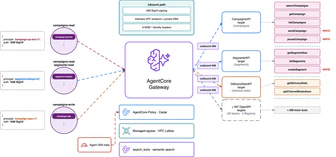
    MoEngage on how to use AgentCore Gateway to convert 400 APIs into intelligent agent tools

    MoEngage transforms 400 internal APIs into permission-controlled intelligent agent tools through Amazon Bedrock AgentCore Gateway, solving multi-team API integration challenges. This solution eliminates the need to set up MCP servers or configure networks, reducing the time to launch new APIs from days to hours while meeting constraints such as keeping APIs within the VPC, controlling identities from the server side, and ensuring tool definitions do not occupy the reasoning context window.