Live
All AI updates
ITHome · AI3535 36Kr · AI6565 US technology oversight project calls on the Democratic Party to tighten technology regulation and introduce new rules for AI and data centers.
The US technology oversight project calls on the Democratic Party to continue pressuring large technology companies to introduce legislation related to social media, artificial intelligence, and data centers, calling this midterm election the 'first AI and technology accountability election.' The founder of the organization, Sacha Haworth, said the Democratic Party should not let large technology companies act with impunity.
 n8n Blog
n8n decentralizes enterprise automation capabilities, allowing everyone to build
n8n believes future work should be built by everyone on automation capabilities, rather than relying on specialized teams; with built-in AI assistants (like n8n or MCP) lowering the barrier to entry, companies should transition to a platform model, empowering non-professionals through standardization and shared resources (templates, documents); n8n has already practiced this model internally, transforming its automation team into an organization similar to a 'guild', but faces pressure in maintaining workflows.
36Kr · AI6565 Zhang Yiming on ByteDance AI: as early as 2029 or 2030 to catch up with OpenAI and Anthropic
Zhang Yiming recently stated at a ByteDance AI all-hands meeting that ByteDance has the capability to compete with OpenAI and Anthropic, but catching up to the cutting edge technology may not be until 2029 or 2030. The most pressing issue for ByteDance's Seed series models currently is that the scale of their pre-training dataset is still smaller than that of top-tier AI companies overseas.
36Kr · AI6565 Anthropic: AI is expected to conquer difficult diseases like cancer within 10 years
Anthropic CEO Dario Amodei predicts that AI will be able to conquer difficult diseases such as cancer and Alzheimer's in 10 years. Anthropic has recently expanded its drug development business by acquiring several biotechnology startups and has launched internal new drug development efforts.
Hacker News · 300+3737 NVIDIA CEO Huang Renxun is reportedly involved with a senior executive who reports to him
Reports suggest that Huang Renxun has a relationship with senior executives who report to him, which has caused attention. The news comes from a hot discussion post on Hacker News.
36Kr · AI6565 Baidu founder Li Yannhong: Reasoning will be the main driving force for the long-term sustained growth of AI chips.
Baidu founder Robin Li stated at Baidu World 2026 that reasoning will be the primary driver of long-term sustained growth for AI chips. Current AI computing power demand has shifted from training-centric to a balance between training and reasoning, with the large-scale deployment of intelligent agents driving a surge in reasoning computing demand. Baidu's Kunlun Chip M100 is now on the market, with the M300 expected to be launched next year.
ITHome · AI6565 Guo Mingzhi talks about the Huang Renxun cheating scandal: NVIDIA might need to start planning for a successor.
Kuo Ming-chun believes Huang Renxun is crucial to NVIDIA, capable of transforming technology into products that the company invests in resources for, and driving supply chain investments. Huang Renxun seems unlikely to retire easily, and NVIDIA may need to reduce its decision-making reliance and plan for a successor.
 TechCrunch · AI6565
Will Jensen Huang be replaced? A highly unscientific list of successors
Jensen Huang's CEO position could be in jeopardy, with Kalshi analyzing his survival chances at just 30%, due to extramarital affair allegations and company crises; potential successors include AMD CEO Lisa Su.
36Kr · AISame story · 2 outlets6565 Li Yannhong: The next chapter of AI is the intelligent organization.
Baidu founder Robin Li stated at the Baidu World 2026 conference that the next phase for AI is intelligent organizations, where intelligent organizations are the new productivity hubs in the AI era.
Same story · 2 outletsITHome · AI3535 Baidu's Robin Li in conversation with Lenovo's Yang Yuanqing: AI still cannot replace CEOs going on business trips.
Baidu founder Robin Li discussed with Lenovo Group Chairman and CEO Yang Yuanqing at the Baidu World Conference 2026, stating that AI cannot replace CEOs on business trips. Yang Yuanqing revealed that Lenovo has been starting businesses around the AI era since 2024, using AI to transform its three major businesses: intelligent terminals, intelligent infrastructure, and intelligent solutions and services, and believes the importance of PCs is higher than before.
ITHome · AI6565 Amazon Web Services (AWS) CEO Matt Gammon discusses space AI computing power: difficult to be commercially feasible in the next 10 to 20 years.
Amazon Web Services (AWS) CEO Matt Gammon stated that space data centers will struggle to meet feasibility requirements in terms of economics and practical operation within the next 10 to 20 years. He believes that multiple obstacles, such as launch costs, payload capacity, cooling, and equipment maintenance, still need to be overcome, and even if technically feasible, the costs would be difficult to support large-scale applications.
ITHome · AISame story · 2 outlets6565 Baidu's Robin Li: Intelligent organizations will be the deepest moat for companies
Baidu founder Robin Li predicted at the Baidu World 2026 conference that the next act of AI is intelligent organizations, believing that the downstream of AI technology is organizational capability, calling on enterprises to let digital employees enter all business links, and proposed three principles: breaking down job boundaries, accumulating tacit knowledge, and designing process closed loops, claiming that organizational intelligence is the deepest moat of enterprises.
Same story · 2 outletsITHome · AI OpenAI CEO Altman proposed working with Samsung to create next-generation AI devices.
OpenAI CEO Altman proposed collaboration with Samsung to develop next-generation AI devices at a symposium, believing they will be the successor form of smartphones, where AI will proactively manage users' digital and real lives. He described the devices as centered around AI proactively acquiring information and managing users' lives, rather than the traditional app model, while emphasizing privacy protection and the need for social joint management.
36Kr · AI3535 Private equity worth hundreds of billions adds to positions, saying the long-term trend of AI remains unchanged
The private equity sentiment index rose to 83.10%, with contrarian investment in AI. Recently, the overseas AI sector has adjusted, with market concerns over the capital expenditures, computing power demand, and profitability of tech giants. However, many private equity firms with over 10 billion in assets believe that the long-term development trend of AI remains unchanged, and the short-term market is dominated by structural opportunities.
36Kr · AI6565 The CEO of Sixth Street remains cautious about the AI boom, warning that speculative behavior is prevalent
Alan Waxman, CEO of Sixth Street, expresses concerns about credit expansion and speculative behavior in the AI field, believing the economic efficiency of AI units is difficult to assess, and lending institutions have reduced financing for AI infrastructure projects.
 Databricks Blog
Interview with Alasdair Anderson: The Daily Work and Industry Insights of a Databricks Solution Architect
Alasdair Anderson, a Solutions Architect at Databricks, shared his daily work routine, covering technical construction and team coaching; he emphasized how platforms like Lakebase and Agentbricks help financial industry clients achieve second-level data processing and business process reshaping; 'Customer First' and 'Pragmatic Truth' in the company culture are reflected in practices such as analyzing industry reports and real-time risk modeling, while open and transparent internal collaboration also promotes global teams in efficiently solving complex challenges.
 OpenAI News
JioStar's Chief Architect Vijay Seshadri interprets AI discovery practices at a 5 billion user scale.
JioStar's Chief Architect Vijay Seshadri interprets AI discovery practices at a 5 billion user scale, emphasizing key experiences in evaluation metrics, security boundaries, and AI production deployment.
 Tessl Blog
 Discusses Three Cycle Models of a Software Factory: Maintaining Operations, Continuous Learning, and Exploring Innovation
Tessl Blog analyzes three cycles of the software factory: the "treadmill cycle" for maintaining operations, which accelerates daily tasks with AI but does not solve fundamental problems; the "learning cycle" for continuous learning, which uses AI to capture knowledge to improve guidelines and reduce repetitive work; and the "dream cycle" for exploring innovation, which leverages AI for small-scale experiments to push postponed improvements. AI tools need to have effective context and testing capabilities to transform knowledge accumulation into actual value.
 O'Reilly Radar
Where are the 'killer apps' for AI?
AI entrepreneurs and social media enthusiasts are mostly young, having experienced the first technological revolution but forgetting the excitement of owning personal computers in the late 1970s and the hardships of using mainframes in 'glass houses' at that time. They have witnessed that almost everyone can now generate code, yet they do not realize that this is similar to the experience of using BASIC instead of assembly language to write applications back then.








 a16z News
B2A Economy: A New Stage of the Internet Dominated by AI Intelligent Agents
AI agents have already dominated network traffic and content generation, but the business model for the B2A economy is still unclear. Shopify shows AI-driven traffic grew eightfold year-on-year, and human safety reports indicate a eightfold increase in agent browser traffic. Businesses need to treat agents as core customers, otherwise they may face threats.
ITHome · AI3535 "Anthropic CEO Amodei Predicts Cancer Will Be Conquered Within Ten Years, Aiming to Raise Medical Doubts"
Anthropic CEO Amodei predicts that diseases like cancer will become history within a decade, but medical experts question its optimistic expectations, pointing out that AI cannot bypass clinical trials and other stages. Vertex Pharmaceuticals tested 50 AI companies and none developed a usable drug, experts emphasizing that AI can only accelerate molecular screening and cannot replace biological validation.
ITHome · AI6565 Uber DoorDash executive says AI agents for ride-hailing and food ordering have only hundreds of orders
Uber and DoorDash executives disclosed that orders placed through AI agents like Meta Muse and Instinct amounted to only hundreds, far below the millions of regular orders placed daily. Uber completed 320 million orders in the last week of October, of which about 500 were Uber Eats orders processed by AI agents and only 4 were ride-hailing orders. Although consumers are interested in AI agents placing goods or tracking prices on their behalf, order errors and payment security concerns limit actual use.
36Kr · AI3535 Anthropic's century IPO may become the peak of the AI market trend, with a veteran in technology warning that a chain reaction could occur after the ban period expires.
Anthropic's initial public offering may become a peak in the AI market, and could trigger a chain reaction correction after the lock-up period ends. Jack Selby, head of venture capital firm Copper Sky, expressed this view.
Hacker News · 300+ Smart home devices should be able to work offline
Smart home devices should be able to work offline. Core devices need to operate even when offline, such as deploying MQTT middleware on ESP boards via Tasmota and implementing local automation on Raspberry Pi with Node-RED, retaining only Alexa and some AWS cloud services as auxiliary. Follow rules such as not removing old methods when adding new ones, keeping the system flexible, regularly checking automation logic, etc. Prioritize devices with battery life exceeding one year, and require cloud devices to have API logging functionality.
 Platformer00
The article title for Platformer does not provide a specific subject, making it impossible to generate a Chinese title based on the【Title Consistency Rule】
The article discusses the need for a response plan to AI backlash, the election war room of a cutting-edge laboratory, AI search issues with Google and Reddit, an unformed AI election, and OpenAI's deepfake policy and Anthropic's S-1 filing.
36Kr · AI6565 Federal Reserve Governor Bauman warned that if AI investments do not meet expectations, it could lead to a significant decline in stock market valuations.
Federal Reserve Governor Bauman warned that AI investment returns falling short of expectations could trigger significant stock market valuation corrections, while also mentioning the risk of a sharp rise in long-term private sector interest rates, stating that a decline in stock prices could weaken consumer spending resilience.
36Kr · AI6565 Famous tech analyst Dan Ives: If Huang Renxun leaves, NVIDIA's market value will plummet by a third
Famous tech stock bull Dan Ives believes Huang Renxun is worth about 30% of NVIDIA's total market value. If the head of this AI chip giant leaves, NVIDIA's market value could shrink by nearly a third, and the stock price might fall by 25% to 30%.
 Ars Technica · AI6565
Big Math: The Hidden Code That Runs Our World by Steven Strogatz and Alex Townsend explores the relationship between mathematics and AI.
Steven Strogatz and Alex Townsend explore the relationship between mathematics and AI in their new book 'Big Math: The Hidden Code That Runs Our World,' analyzing how mathematics has shaped modern life from social media algorithms to machine learning, and how large language models and quantum computing are making mathematics surpass human creators. The book combines Strogatz's interdisciplinary research in areas such as small-world networks, chaos theory, DNA geometry, and biological collective oscillators to discuss the future of mathematics.
Hacker News · AI hot posts6565 Vulnerability Analysis of AI Generated Code Repositories
AI-generated test cases are too simple, lacking coverage; the generated code is overly complex, increasing debugging difficulty; over-reliance on AI reduces human understanding of the code; AI speed leads to lower quality standards, accumulating technical debt over the long term. AI codebases are more prone to failures, with long recovery times, generating visible errors to users, resulting in poor user experience.
 Latent Space6565
Resend CEO Zeno Rocha discusses how to design email services for agents
CEO Zeno Rocha of Resend stated that Claude Code chose Resend as a priority 64 times out of 102 email recommendations, and the number of MCP server integration tools for Resend has increased from 20 to 80. Resend enhances the integration experience for AI agents through design optimizations such as an intuitive pricing page, a React Email template library, and custom tracking domains. CEO Zeno Rocha emphasized its $3M security commitment and free plan strategy.
 The Verge · AI6565
The independent game community is controversial about the use of AI.
Some judges at the Independent Games Festival (IGF) refused to vote for games using generative AI, while the developer of 'Big Walk' stated they used AI 'cautiously' in the later stages of game development to solve technical challenges, sparking intense community discussions about the impact of AI in game development, with no consensus yet.
 Tomasz Tunguz
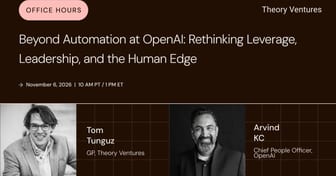
KC, the Chief Human Resources Officer at OpenAI, discussed the impact of AI on organizational change during Office Hours.
OpenAI's Chief Human Resources Officer KC states that terms like 'junior' and 'senior' are now meaningless because experience becomes outdated quickly. He believes AI models are like brains, needing to be combined with exoskeleton tools like Codex or Claude Code to achieve skills and cross-agent context management. When everyone can leverage AI to overcome their limitations, humans still rely on emotional intelligence and integrity as core competencies.