Google launches Gemini 4 Hydrogen and Orchestrator in Antigravity.
Google has launched Gemini 4 Hydrogen in Antigravity and added an Orchestrator model option, combining Hydrogen with stronger models like Gemini 4 Carbon for long-period tasks.
Google has launched Gemini 4 Hydrogen in Antigravity and added an Orchestrator model option, combining Hydrogen with stronger models like Gemini 4 Carbon for long-period tasks.
 Ars Technica · AIFeaturedSame story · 4 outlets8282
Google releases Gemini 4 Hydrogen, replacing Gemini 3.8 Flash in its own products, with access restrictions more relaxed than previous Argon and Carbon, available for use upon release
 The DecoderFeatured8585
Google DeepMind releases AlphaProof Code, an AI-powered mathematical proof software that meets security specifications, and completes the verification work usually requiring several years on the Signal encryption protocol in just four weeks.
 Google DeepMindFeaturedSame story · 5 outlets8787
Google DeepMind has opened Gemini 4 Carbon to developers, enterprises, scientists, and consumers, claiming it has reached cutting-edge levels in network security capabilities and long-range intelligent agent workflows.
Why it matters: The official provides the positioning division of roles between Carbon and Argon, multiple benchmark rankings, and cost comparisons per task to help determine when to use a heavier model.
 MarkTechPostFeaturedSame story · 4 outlets8282
Anthropic releases Claude Fable 5.2 and Claude Mythos 5.2, both based on the same underlying model. Fable 5.2 adds a classifier to intercept high-risk cybersecurity tasks and most biology research tasks, while Mythos 5.2 removes these restrictions and requires access through the Cyber Verification Program and Life Sciences Verification Program.
How the accounts differ:TechCrunch states the input price of Fable is reduced to $8 per million tokens; others do not mention the price.
Meta launches Muse Ember, its smallest and most efficient model designed for complex reasoning tasks, outperforming Claude Haiku 5.5 and GPT-6 Luna in smartness-to-cost ratio, with a cost of 0.10 USD per million input tokens and 0.50 USD per million output tokens, supporting a 1M context window and 512K output tokens.
Anthropic released the Claude Fable 5.2 model, achieving 49.1% programming capability in the FrontierCode 2.0 test, surpassing GPT-6 Astra's 42.8%; scoring 74.2% in the Humanity's Last Exam test, leading GPT-6 Astra's 57.2%. The model's output speed has increased by up to 30%, with a 20% cost reduction and API call fees lowered to $3/ million tokens.
How the accounts differ:TechCrunch states the input price of Fable is reduced to $8 per million tokens; others do not mention the price.
The DecoderMeta releases Muse Ember, its smallest and most efficient AI model to date, designed for handling the repetitive tasks of AI agents, such as calling tools, processing small-scale coding tasks, routing requests, extracting data, and processing long documents.
 Claude · YouTubeFeaturedSame story · 4 outlets7575
Anthropic released Claude Fable 5.2, stating that it has improved in coding, reasoning, and vision, targeting the most complex and open-ended technical work. The official recommendation is to start most coding and knowledge tasks from Opus 5.5, and Fable 5.2 has been launched in the Pro, Max, Team, and Enterprise packages.
How the accounts differ:TechCrunch states the input price of Fable is reduced to $8 per million tokens; others do not mention the price.
Claude · YouTubeFeaturedSame story · 4 outlets7575Anthropic releases Claude Fable 5.2, designed for the most challenging technical challenges, with improvements in coding, reasoning, and vision, suitable for the most ambitious open-ended technical work. The official recommendation is to use Opus 5.5 for most coding and knowledge tasks, and Fable 5.2 is now available in the Pro, Max, Team, and Enterprise packages.
How the accounts differ:TechCrunch states the input price of Fable is reduced to $8 per million tokens; others do not mention the price.
Why it matters: The official statement explains the positioning and applicable scenarios of Fable 5.2, and provides a choice suggestion between Opus 5.5, making it easier to decide which model to use.
 TechCrunch · AIFeaturedSame story · 4 outlets8282
Anthropic releases Mythos 5.2 and Fable 5.2, claiming new models have improvements in coding, reasoning, and vision, and communicate more clearly with users. Fable's input price drops from $10 per million tokens to $8, lower than major competitor GPT-6 Astra, with a 30% faster response speed, and can support zero data retention (ZDR) policies through Enterprise Frontier Safeguards.
How the accounts differ:TechCrunch states the input price of Fable is reduced to $8 per million tokens; others do not mention the price.
 Tencent Hunyuan · Hugging Face new models2222
Qwen3.8-27B-DSpine-b16 pre-trained model released by Mixue, featuring 27B parameters, b16 precision, 5 layers of Draft layers, and an 8,192 token sliding window, designed to improve efficiency during inference and must be used with the Qwen3.8-27B model.
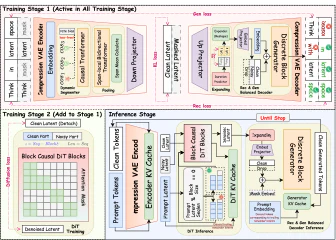
The DecoderSame story · 3 outlets6565ByteDance Seed · Hugging Face new modelsCola2 is a continuous latent language model that combines dynamic compression VAE, block causal diffusion Transformer (DiT), and cross-segment causal token decoder, dynamically grouping text into semantic segments, representing each segment with a compact continuous latent, generating latent blocks and implementing them as discrete tokens.
webAI Launches TwIL-8B Inference Model, Optimized for Math and Code Tasks Based on IBM Granite-4.2-8B, Scores Better than Gemma 4 31B in MATH-500 and AIME 2025 Tests, Best in LiveCodeBench Group, IFBench on Par with Gemma 4 12B. Model Inference Capability Reaches 88~93% of Frontier Models, Reduces AI Usage Costs but Has Limited Knowledge Base.
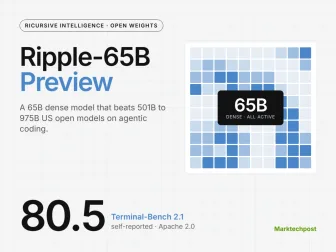
Ripple-65B Improves Computational Efficiency by Optimizing SFT and RL Schemes, Using Synthetic Data Pipelines and Quality Filtering, Employing a Hybrid RL Scheme with Truncated Importance Sampling, Score Centering, and Linear Length Penalty in a High-Quality Long-Term Synthetic Environment, Achieving a TerminalBench 2.1 Score of 80.5 with Only 1.4M Rollouts, 70 Times Fewer than Reflection Beam
ByteDance Seed · Hugging Face new modelsByteDance-Seed/Qwen3-30B-A3B-MoE-SAE is released, containing TopK sparse autoencoders (k=100, 2^20 latent variables) trained on layers 4, 30, and 46 of the Qwen3-30B-A3B model. Each SAE is approximately 17.2 GB, with reconstruction variance unexplained scores of 12.6%, 25.1%, and 7.6% respectively.
 Cognition Blog
SWE-2 Flash introduces a mid-training stage before reinforcement learning for the first time, significantly outperforming the baseline model Inkling-Small. Terminal-Bench 4.0 scores increased from 0.9% to 20.0%, and FrontierCode 2.0 improved from 3.2% to 24.0%, surpassing all US open-source models. This model is available in Devin Desktop and CLI, priced at one-fifth of SWE-2 and three times faster.
MarkTechPostSame story · 3 outletsRicursive AI has released Ripple-65B Preview, a 65B dense open-source model, scoring 80.5 on Terminal-Bench 2.1, becoming the highest-scoring open-source model in the United States. Its parameter size is 65B (active parameters), pre-training used 12T tokens, with a maximum context length of 1M, and is released under the Apache 2.0 license.
Meituan Longma has released the native multimodal model LongCat-2.5 for long-range intelligent agent tasks, with a total parameter count of 1.6 trillion, activating about 48 billion parameters per token, enhancing native visual understanding and intelligent agent programming capabilities based on LongCat-2.0.
Same story — showing the featured version《》
Megvii open sourced the SenseNova Loop-9B-Preview model, which uses the Looped Transformer architecture and matches the performance of 27B models with just 9B parameters, outperforming other models including surpassing Qwen3.5-27B in code generation, office scenarios, and intelligent agent tasks
The DecoderMistral has released its largest model, Mistral Large 4, which leads open-source competitors in coding tasks but still lags behind Chinese models in overall rankings. The model has approximately 100 billion parameters, with 52 billion parameters per step, requiring 8 Nvidia B300 GPUs to run.
 Mistral AIFeatured8282
Mistral releases open-weight version of its flagship trillion-parameter native multimodal model Mistral Large 4 (Le Chonk), which has been in public preview for three weeks.
Why it matters: The official provides data on the encoding, security, and inference efficiency of the trillion-parameter open-source model, as well as weight downloads and self-hosting paths.
Google has officially released the next-generation cutting-edge large model Gemini 4 Carbon, featuring top-tier cybersecurity capabilities and long-range task processing, ranking first with a score of 59 in the Artificial Analysis Intelligence Index v5.0.
MarkTechPostFeaturedSame story · 5 outlets8080Google DeepMind has launched Gemini 4 Carbon, describing it as a cutting-edge model for long-period intelligent agent coding and cybersecurity defense, ranking first with 59 points on the Artificial Analysis Intelligence Index v5.0.
Ars Technica · AISame story · 5 outlets6565Google has released Gemini 4 Carbon, reaching new thresholds in coding, agent tasks, and scientific analysis, but it has not yet been made available for use. The model significantly enhances vulnerability detection, validation, and repair capabilities in cybersecurity applications, with a 200% higher probability of generating bug-free code compared to Argon and a 10 times greater ability to generate high-quality patches compared to non-Google models.
 Artificial Analysis ArticlesFeaturedSame story · 5 outlets8585
Google's Gemini 4 Carbon ranked first with 59 points on the Artificial Analysis Intelligence Index v5, leading in four out of nine evaluation items: HLE-Diamond, Terminal-Bench-Science, AA-Omniscience, and AutomationBench-AA
Google DeepMindFeaturedSame story · 5 outlets8282Google DeepMind releases the Gemini 4 Carbon, claiming it has the strongest capabilities in cybersecurity and long-term tasks, ranking first with a score of 59 in the Artificial Analysis Intelligence Index v5.0
MarkTechPost6565Mirendil released its first AI model, Fern 0.1, supporting a context window of up to 10M-Tokens, equivalent to approximately 23 MB of code or 500,000 lines, achieving the first complete loading of a Megatron-LM level codebase.
The DecoderOpenAI releases GPT-6.1 Terra, pushing the cost-performance boundary to new heights, API prices halved compared to GPT-5.6 Terra to 1 dollar per million input tokens, 5 dollars per output token
MarkTechPost6060Nanbeige (Nanbeige) released the 33B parameter dense large language model Nanbeige4.3-33B, supporting a context window of 524,288 tokens, leading in 17 out of 20 benchmark tests, including scoring 80.9 on Terminal-Bench 2.1, but lagging behind Qwen3.8-27B in SWE-Bench Pro.
MarkTechPostSame event8383Moonshot AI has released the first model of the K3.1 series, Kimi K3.1 Pro, which adopts a MoE architecture with a total parameter count of 2.8T and an activation parameter count of 104B, supporting a context length of 1M tokens. It has been launched on Kimi.ai, Kimi Work, Kimi Code, and Kimi API. The API pricing is $2 per million tokens for input and $10 for output, lower than K3's $3 and $15.
Same story — showing the featured version《》
The DecoderFeatured8585Why it matters: The article uses third-party indices and multiple benchmarks to present the specific extent to which the gap between open-source weight models and closed-source cutting-edge models has narrowed.
The DecoderFeatured7474AI startup Recursive has released its first language model, Flint. During the development process, the AI system named Eureka Machine participated in proposing ideas, building, testing, and planning subsequent experiments.
Why it matters: Recursive publicly announces its first model developed with the assistance of an automated research system, allowing readers to observe how far AI-assisted R&D can go.
MarkTechPostRecursive releases the open-source 40B fuzzy model Flint, 2.5B active parameters, performs best among MoE models below 50B, supports inference and OpenAI compatible tool calls, 4-bit weights about 23GB, SWE-bench Verified 74.2%.
Ant Group inclusionAI · Hugging Face new models3535inclusionAI released the UBTree fine-tuned version of Ling-3.0-tiny, Ling-3.0-tiny-UBTree-B16, with 183.1M parameters, combining a five-layer DFlash backbone and a bigram selector, achieving 2.6-3.5 times speed improvement on benchmarks like GSM8K and MATH-500. This model needs to be used in conjunction with the target model. The UBTree adaptation for the open-source version of SGLang has not yet been released.
 Inception Labs Blog
Mercury 2 completes context compression tasks in just 150 seconds while maintaining the same quality as Sonnet 4.6, with a 5-fold speed increase and a 90% cost reduction. Augment Code uses it for enterprise-level coding AI agents, achieving an 82% reduction in compression latency and a 90% cost cut, and dynamically allocates tasks through the Prism model router, reducing total LLM expenditure by 30%.