Skip to content
Live
Nov 13Fri
  1. Google AI Blog82

    Google Search has integrated Gemini 4 Hydrogen and is now open to global users.

    Google Search has launched Gemini 4 Hydrogen, the largest model upgrade to date, now available to all global users. The company claims the new model can understand multi-part questions, spelling errors, and highly specific requests, and leverages stronger instruction following and tool calling capabilities to respond to each question individually. Hydrogen's reasoning ability also enhances query distribution, allowing it to retrieve multiple related subtopics simultaneously and provide more images, structured responses, comparison tables, and custom tools.

    Why it matters: Google's official statement on Gemini 4 Hydrogen explains changes in intent understanding, query distribution, and visual responses in search, which can be used to judge the direction of adjustments to the search experience.

Nov 10Tue
Oct 30Fri
  1. NVIDIA Blog58

    Breakthrough Listen introduces embodied AI agents to alien intelligence search

    Breakthrough Listen and the SETI Institute introduce embodied AI agents to alien intelligence search, achieving natural language request control of instruments, enhanced data calibration, and AI model processing of data streams at the Allen Telescope Array in California. The NVIDIA Holoscan platform processes sensor data, while the NVIDIA RTX PRO 6000 Blackwell GPU achieves 2.4TB data processing per second, completing real-time pulsar AI detection.

Oct 27Tue
Oct 20Tue
  1. Meta Engineering

    Meta introduces GenRecs Tokenization to reshape ad recommendations with a stable model vocabulary.

    GenRecs Tokenization enhances conversion rates by 0.35% for advertisers by representing items like ads and products with a stable semantic vocabulary, combined with Meta's Generative Ad Model (GEM) and adaptive ranking model. This technology leverages the world knowledge of pre-trained large models to enable recommendation systems to understand preferences of new items or users with no historical interaction, accelerates learning through shared concepts, achieves cross-activity transfer, and improves performance as large model scale increases, forming a feedback loop for performance improvement.

Oct 16Fri
  1. Google DeepMind

    How does Google Antigravity accelerate the discovery of antibacterial peptides?

    The Google Antigravity platform works through its intelligent agent workbench and ProtNLM model, helping biologists quickly discover, structure evaluate, and prioritize potential antimicrobial peptide targets, compressing searches previously scattered across multiple databases into a single session. The platform uses ProtNLM to predict protein function and supports researchers in scanning millions of uncharacterized proteins in the UniProt database. Researchers collaborate with AI agents on a shared 3D canvas, compressing the time required for the antimicrobial peptide discovery process from several days to a single session.

Oct 15Thu
  1. Apple Machine Learning Research

    Selection-Based Structured Reasoning: A framework for efficient multimodal search agents

    The Selection-Based Structured Reasoning (SSR) framework restructures reasoning into selection rather than open-ended generation, selecting the most likely solution from predefined reasoning candidates before each action, significantly reducing reasoning costs. Validated using 2B and 4B models on seven multimodal search benchmarks, SSR achieved average success rates comparable to leading search agents of the same scale, reducing single-step reasoning latency by 90% and total reasoning latency per task by 28-54%.

Oct 13Tue
  1. LangChain Blog

    LangSmith adds an AI search feature to optimize large language model agent debugging through behavior tracking

    LangSmith introduces an AI search feature that supports natural language queries for intelligent agent behavior tracking records. This feature can search for user inputs, agent reasoning, tool calls, and responses, helping teams discover specific behavior patterns, such as PII leaks or user frustration. The AI search combines SmithDB's data layer and decision models, achieving fast and efficient cross-SDK searches by analyzing standardized trajectories rather than raw long texts, prioritizing key information like user messages and agent responses.

Oct 7Wed
  1. Google Developers Blog

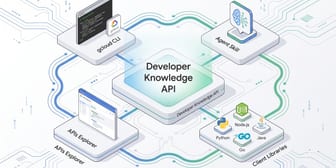
    The Google Developer Knowledge API ecosystem helps developers build AI tools efficiently.

    The Google Developer Knowledge API is Google's official developer documentation programmable source, providing semantic search, intelligent document chunking, and reliable Q&A capabilities for Google Cloud, Firebase, Android, and other Google ecosystems, reducing hallucinations in AI tools due to the expiration of LLM training deadlines.

Jan 29Thu
  1. LangChain Blog

    How does the LangChain Deep Agents SDK implement efficient context management?

    The LangChain Deep Agents SDK manages limited memory of AI agents through three compression techniques: offloading large tool results (>20,000 tokens) and inputs (>85% context window) to the file system, and using LLM to generate session summaries. The SDK triggers compression on Claude Sonnet 4.5 in terminal benchmark tests, retaining complete records through filesystem search and summaries, supporting frequent compression to optimize performance.