Recursive Flint 在 OpenHands 上发布:开源模型助力本地高效编码工作流
Recursive Flint on OpenHands: Open Models, Real Coding Workflows
Recursive Flint 发布,一款 40 亿参数的混合专家模型,专为本地高效推理设计,每 token 仅激活约 2.5 亿参数,在 M4 Pro MacBook Pro 上实现 125+ tokens/秒,NVIDIA RTX Spark 上达 150+ tokens/秒。OpenHands 作为其首发合作伙伴,支持该模型在本地硬件上运行,为开发者提供开源编码模型选项。
同一件事另外 1 家也报道了
- vLLM Blog··首发
- OpenHands Blog··+0 分钟·当前阅读
Recursive Flint 在 OpenHands 上发布:开源模型助力本地高效编码工作流
按发布时间排列 · 事件后续出现时自动追加
TL;DR: OpenHands is a day-zero launch partner for Recursive Flint, a new open-weight coding model built for fast, efficient inference on local hardware. Flint brings strong agentic coding performance to a 40-billion-parameter mixture-of-experts architecture, with only 2.5 billion parameters active per token. We’ve tested Flint with OpenHands and are supporting it from launch, giving developers another powerful option for running AI coding agents on their own terms.
Recursive Flint is now supported in OpenHands
OpenHands is a day-zero launch partner for Recursive Flint, a new open-weight coding model designed to deliver strong agentic coding performance with efficient local inference.
Flint uses a 40-billion-parameter mixture-of-experts architecture with approximately 2.5 billion parameters active per token. Combined with Recursive’s optimized inference engine, this makes it possible to run capable coding models on hardware such as Apple Silicon and NVIDIA RTX systems.
We’ve tested Flint with OpenHands ahead of its release and are supporting it from launch, giving developers another model option for software engineering workflows.
For developers building AI coding agents, that combination matters. Model performance determines what an agent can accomplish, while inference speed, cost, and deployment flexibility influence how practical it is to run those agents repeatedly.
OpenHands gives developers the flexibility to choose models that fit their workloads without tying their agent workflows to a single model provider.
Meet Recursive Flint: Strong coding performance, built for local execution
Recursive Flint is a new open-weight model designed specifically for fast, accurate coding on local hardware.
Built by Recursive in under four months, Flint uses a 40-billion-parameter mixture-of-experts (MoE) architecture that activates approximately 2.5 billion parameters per token. This sparse architecture significantly reduces the computation required during inference while retaining the capabilities of a much larger model.
In Recursive’s published evaluations, Flint delivers competitive results on agentic coding benchmarks, including SWE-bench Pro v2, Terminal-Bench 2.1, and SWE-bench Verified. Recursive reports that Flint performs particularly well against other sub-50B mixture-of-experts models, while remaining competitive with larger alternatives.
But what makes Flint particularly interesting isn’t just its benchmark performance. It’s the combination of coding capability, inference efficiency, and local deployment.
With Recursive’s optimized inference engine, Flint achieves:
-
125+ tokens per second on an M4 Pro MacBook Pro.
-
150+ tokens per second on a 64GB NVIDIA RTX Spark, with higher throughput under certain short-context configurations.
-
100+ tokens per second on RTX Spark with a 120,000-token context.
These results were reported by Recursive using its optimized inference engine under specific hardware and workload configurations. Performance will vary depending on the runtime, quantization, context length, and hardware.
Flint is also released under the commercially permissive Apache 2.0 license, giving developers the freedom to run, adapt, and deploy the model without being tied to a proprietary model provider.
That’s particularly relevant for organizations where source code, infrastructure access, and development workflows need to remain within controlled environments.
Recursive developed Flint with support from its Eureka Machine, an automated AI research system used to explore model architecture, training, and inference optimizations. That approach contributed to Flint’s focus on delivering strong coding performance with efficient inference.
As Graham Neubig, Co-founder and Chief Scientist at OpenHands, explains:
“Recursive’s new model shows real promise for coding and agentic workloads, combining strong capabilities with the speed needed for practical software engineering tasks. At OpenHands, we believe developers should have the freedom to choose the best models for their workloads, infrastructure, and cost requirements. We’re excited to offer day zero support for Recursive Flint and bring these capabilities to developers building with AI agents.”
Run Recursive Flint with OpenHands
OpenHands supports Recursive Flint as a model backend for software engineering agents.
Developers can use Flint with OpenHands to work on tasks such as investigating bugs, modifying code, running tests, and iterating on changes across a repository.
Depending on the supported configuration, developers can connect through a hosted model provider or run Flint using compatible local inference infrastructure.
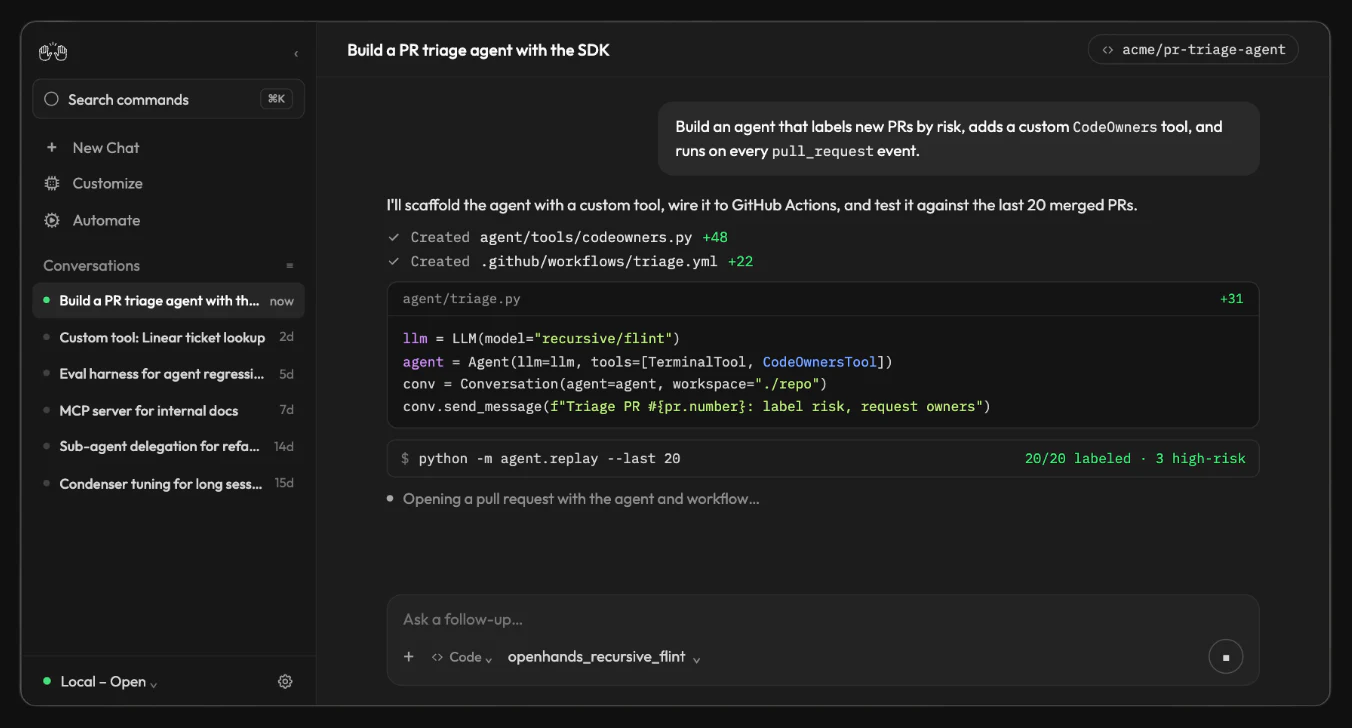
Once connected, Flint powers the model inference while OpenHands provides the agent workflow, tools, and execution environment needed to complete software engineering tasks.
Getting started
Option 1: Use Flint through OpenRouter
-
Configure an OpenRouter API key.
-
Select the supported Flint model identifier.
-
Start an OpenHands conversation.
Option 2: Run Flint locally
-
Install Recursive’s recommended inference runtime.
-
Download and serve the supported Flint checkpoint.
-
Configure OpenHands to use the local endpoint.
-
Start an agent workflow.
Better models need capable agent workflows
A coding model can generate code, but completing software engineering tasks requires more than inference. An agent needs to navigate repositories, use development tools, execute commands, run tests, interpret failures, and iterate on its work. OpenHands provides the agent framework and execution environment that make those workflows possible.
With Recursive Flint, developers have another open-weight model option for powering those workflows.
A developer might choose a frontier model for a complex architectural change, a smaller open model for routine maintenance, or a locally hosted model when deployment control matters. The underlying agent workflow shouldn’t need to be rebuilt every time the model changes.
That’s why OpenHands supports model choice across different inference providers and deployment environments. As organizations expand from individual agent use to repeatable automations, OpenHands Enterprise adds centralized governance and controls for operating agent workflows across teams.
The model determines what the agent can do. The surrounding system determines how that capability becomes useful engineering work.
Get started with Recursive Flint on OpenHands
Recursive Flint is available today under the Apache 2.0 license, with support for local inference on compatible Apple Silicon and NVIDIA hardware. Developers can also access Flint through OpenRouter.
We’ve tested Flint with OpenHands and are excited to support it from day one.
As models become faster, more capable, and easier to run locally, developers should have more freedom to decide how they build with AI agents, not less.
That’s the direction we’re building toward at OpenHands: an open, model-agnostic platform where developers can choose their models, run agents in their preferred environments, and turn individual coding tasks into repeatable engineering workflows.
Try Recursive Flint with OpenHands and start building with open models on your terms.
来源: OpenHands Blog · openhands.dev