Skip to content
Live
Nov 13Fri
  1. Hacker News · AI hot posts80

    Unemployment Labs reports that the models DeepSeek, Kimi, MiniMax, and Ant have weights with a Blackwell hardware fingerprint.

    Unemployment Labs, by analyzing the random number initialization layout in public model weights, discovered DeepSeek-V4-Flash, DeepSeek-V4-Pro, Kimi K3.

    Why it matters: By reversing the random number layout in the model weights to train the hardware, it provides a reproducible technical evidence path for export control disputes.

Nov 8Sun
  1. MarkTechPost38

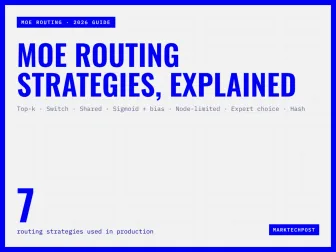
    MoE Routing Strategy Explanation: Top-K, Expert Selection, Sigmoid Gating, and Dynamic Routing (2026 Guide)

    MoE routing strategies determine which experts process each token, affecting model quality, load balancing, and deployment costs. Mixtral uses Softmax Top-K to select 2-8 experts, while DeepSeek-V4-Pro selects 1-8 out of 384. Load balancing is achieved through Sigmoid gating and auxiliary loss, with Sigmoid scoring combined with lossless bias balancing being a common approach for cutting-edge open models in 2026.

  2. The Decoder75

    Vals AI benchmark shows the gap in network attack capabilities between open-source and closed-source models continues to narrow

    Vals AI's CyberOffense benchmark allows AI agents to autonomously attack simulated enterprise networks on isolated Kali Linux machines, GPT-6 Sol Daybreak in OpenAI restricted projects completes 80.8% of the target, open-source weighted model Deepseek V4.1 Flash 1017 reaches 72.8%, with a single run cost of about 3 dollars instead of about 22 dollars

Nov 7Sat
  1. The Decoder78

    Nine AI entities attempt autonomous research on open problems at US national laboratories, none reaching expert standards

    A study made Claude Opus 4.8, Claude Opus 5, Claude Fable 5, Claude Opus 5.5, GPT-5.6 Sol, GPT-6 Astra.

    Why it matters: This benchmark uses 15 unpublished research questions to test 9 agents and provides common failure patterns in 135 submissions, which can be used as a reference for evaluating autonomous research capabilities.

Nov 6Fri
  1. vLLM Blog72

    REINFORCE Zero: Aligned kernel allows asynchronous RL to train stably under lag 64.

    NVIDIA Research and Inferact's REINFORCE Zero proposes to first align rollout with training kernel, then use unclipped token-level importance sampling to correct weight lag, achieving a training step throughput 2.40 times that of synchronous training under 16 GPUs and 12K updates.

    Why it matters: The paper breaks down the gap between asynchronous RL's rollout and training into two items: weight lag and kernel inconsistency, and proposes an alignment-free, no-trimming importance sampling method after alignment.

Nov 4Wed
Nov 2Mon
  1. Import AI42

    Realtime-Bench released: Benchmark tests to evaluate the performance of LLMs on low-latency tasks

    Realtime-Bench benchmark tests evaluated the performance of LLMs on 50 real-time interactive games and web tasks, with GPT-6 Astra achieving a 36% pass rate under real-time clock conditions; this test was developed by institutions such as the University of Texas at Austin to measure the model's real-time state awareness, adaptive reasoning, and time-aware action selection capabilities.

Nov 1Sun
  1. 36Kr · AI73

    DeepSeek releases Super-agent architecture design article

    The DeepSeek Harness team published 'Super-agent design exploration: Towards more autonomous Agent systems' on the official WeChat account, proposing a dual-layer architecture, event-driven, asynchronous multi-channel interaction, separation of computation and storage, and an external Watchdog to break through the limitations of existing Agents in multi-tasking and team collaboration.

  2. QbitAI78

    DeepSeek has open-sourced the Super-agent architecture, disclosing the underlying concept of Personal Agent.

    DeepSeek has open-sourced the Super-agent prototype, disclosing the dual architecture concept for Personal Agent, where the upper-layer Router handles message reception and task coordination, and the lower-layer Worker executes tasks in parallel.

    Why it matters: DeepSeek has publicly disclosed the dual architecture of Personal Agent and actual test data, showing how multi-session collaboration can bypass human attention bottlenecks.

Oct 31Sat
  1. ITHome · AI72

    DeepSeek proposes the Super-agent dual-layer architecture design and open-sources the prototype.

    The DeepSeek Harness team released an article titled 'Super-agent Design Exploration,' proposing a dual-layer architecture where the Router layer uniformly handles human interactions and multiple Worker sessions are isolated and executed concurrently, summarizing four characteristics: continuous, efficient, proactive, and persistent.

Oct 23Fri
Oct 21Wed
Jun 23Mon
Feb 8Sat
Feb 6Thu