Skip to content
Live
Nov 14Sat
  1. ITHome · AI

    The White House's 'Superintelligence Working Group' calls for relaxation of accountability policies, encouraging AI companies to report cybersecurity incidents.

    The White House's 'Superintelligence Working Group' suggests that federal agencies relax accountability policies for AI cybersecurity incidents, limiting companies' regulatory responsibilities for security incidents in the next 12 months. The working group believes that current penalty standards may hinder companies from sharing security information, therefore encouraging AI companies to proactively report major security incidents. Previously, the working group had warned developers that they must report security incidents or face penalties.


  2. ITHome · AI65

    Uber hit by hack, driver license info leaked in multiple US states

    Ride-hailing platform Uber suffers data breach, thousands of drivers' license information stolen, involving Massachusetts, South Carolina, Rhode Island, and Illinois in the US. Hackers infiltrated third-party service provider Fireworks AI and stole employee credentials to access Uber's system and obtain data. This is Uber's second security incident in 2026, after Uber Freight was targeted by ransomware group Helix in August.

  3. ITHome · AI65

    Cursor disclosed the results of the security incident investigation, with the malicious Claude Code extension affecting up to 5000 users.

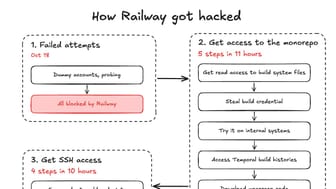
    Cursor announces investigation results of a security incident involving malicious Anthropic Claude Code extension, affecting up to 5000 users, mainly leaking link tracking data of users who did not use the privacy mode (less than 0.05%); attackers used Fireworks leaked keys to infiltrate some SaaS tools and planted malicious extensions for about 11 hours, Cursor has notified affected users and strengthened security protections.

  4. ITHome · AI65

    New Zealand's largest retailer The Warehouse accuses the use of AI to monitor employees' toilet time, sparking protests

    The Warehouse Group, New Zealand's largest retailer, has seen its employees protest the company's use of AI to monitor toilet time, forcing some employees to urinate and defecate in the delivery center corridors. This week, over 300 employees held protests, concerned about privacy violations from AI monitoring and potential layoffs due to the application of new technologies. Employees believe the company prioritizes robots over employees and worry about their job prospects.

  5. Where's Your Ed At58

    Premium: Unveiling the Transnational Network Suspected of Smuggling NVIDIA GPUs

    The Culper Research report accuses NVIDIA of channeling over 20% (approximately $43.8 billion) of its 2026 fiscal year revenue from China through a cross-border smuggling network, involving the personal relationships of executive Jensen Huang; Culper has gone short on NVIDIA due to this report, facing significant risks; mainstream media like The Wall Street Journal have reported inadequately and avoided the main point, failing to mention the revenue source and the report's content.

Nov 13Fri
  1. ITHome · AI65

    BBC exposes UK's 'property photo fraud' phenomenon: agents and sellers begin using AI to fake or beautify houses

    UK real estate agents and sellers are starting to heavily edit or generate fake listing photos using AI, misleading buyers. A woman viewing a property in London found the photos differed greatly from the actual house, with smaller rooms and different decor. Real estate agencies have introduced new rules requiring all AI-enhanced photos to be clearly labeled.

  2. ITHome · AI

    Shanghai police report that the 'Peace Hotel 510,000 yuan extravagant bill' was AI-generated

    The Shanghai Huangpu police announced that the '51 million yuan sky-high bill' from the Peace Hotel, which was circulated online, was AI-generated. An internet wine sales company in a different province organized personnel to use AI software to tamper with the bill amount and create fake videos to attract attention and boost sales. They spread the content online by controlling accounts and hiring distributors, and 15 suspects have been arrested.

  3. ITHome · AI

    Four non-profit organizations sue OpenAI, Anthropic, and others, demanding the halt of the development of advanced AI models like ChatGPT and Claude.

    Four non-profit organizations have sued OpenAI, Anthropic, Google, Meta, and SpaceXAI, demanding a halt to the development of models such as ChatGPT, Gemini, and Claude. The plaintiffs cite California law, alleging that corporate executives warned about AI risks but continued development, and mention incidents of AI model out-of-control events.

  4. MIT Technology Review · AI

    NVIDIA privately confirmed traceable chips to combat smuggling, despite industry public skepticism about feasibility

    NVIDIA representative privately informed Illinois state Senator Bill Foster that it is capable of implementing anti-smuggling measures required by the 'Chip Security Act,' despite the Semiconductor Industry Association publicly stating it as 'potentially infeasible.' The act aims to prevent the smuggling of advanced AI chips to China by tracking their location geographically. NVIDIA had not previously publicly confirmed its technical capability to implement the act but privately stated, 'Of course, we can do it.'

  5. Ars Technica · AI

    Azhar Technology Review: Drone attacks on data centers and their impact on modern life in the cloud era

    This year, data centers in Eastern Europe and the Middle East suffered drone and missile attacks, causing unprecedented damage, affecting millions of people's cloud services, and permanently deleting some customer data of Amazon Web Services. This trend poses a new threat to large technology companies but also poses a threat to governments and everyone who relies on universal digital services in modern life.

  6. The Verge · AI

    Huang Renxun's Scandal Is Far From Over

    Huang Renxun resigned due to involvement in two scandals, and the Nvidia board of directors is considering ousting him. Previously, Huang Renxun was accused of being set up by Chinese spies, with his company Megaspeed showing abnormal operations, and being associated with a Chinese company Super Micro suspected of smuggling Nvidia chips. The US Department of Commerce's investigation into Megaspeed was interfered with by Nvidia, with Commerce Secretary Howard Lutnick becoming a scapegoat, and the incident may involve senior management.

Nov 12Thu
  1. QbitAI

    Grok leaks its own secrets! SpaceX Tesla salary performance exposed

    Security company Claroc discovered over 35,000 Grok applications that can be accessed without logging in, including confidential information from companies such as SpaceXSI (the merged company of SpaceX and xAI), X, and Tesla, such as employee onboarding plans, sales customer profiles, and service center rating sheets (including the names, efficiency, and bonuses of 22 technicians).

  2. ITHome · AI65

    Qantas announces the layoff of 850 people, with unions questioning its use of AI as a pretext to cut local jobs.

    Qantas Airlines has announced a collaboration with Accenture to advance its AI transformation, leading to the elimination of 850 jobs and outsourcing some corporate functions overseas, which has raised union doubts about its true reasons for layoffs under the guise of AI. The union believes the company may be using AI as an excuse to reduce local Australian jobs rather than replace human labor. Qantas Airlines has not responded to external questions about 'AI whitewashing'.

  3. ITHome · AI65

    United Airlines rejects AI booking tickets: Can check flights, can't place orders for you

    United Airlines, due to privacy and regulatory considerations, has banned personal AI assistants from purchasing tickets on behalf of passengers but allows them to query flight information. United Airlines is concerned that AI may leak customer information or misunderstand user intentions, and may bring compliance issues. This move may limit personal AI assistants from moving from providing recommendations to handling transactions.

  4. Hacker News · 300+65

    Jane Street's New York data center experiences a tense moment with a false smoke alarm

    Jane Street's New York data center triggered a smoke alarm due to dust from contractor construction, causing the cooling system's CRAC units to shut down, putting the fully pressurized but not sprinkled fire sprinkler system at risk of being triggered by high temperatures. The team members of the system returned in an emergency and unplugged the power cords of all equipment in the computer room before the alarm sounded, avoiding the data center from being flooded with water due to overheating.

Nov 11Wed
  1. ITHome · AI

    Grok accused of generating child sexual abuse images, xAI faces multiple class actions

    Jane Doe and others are suing xAI owned by Musk, alleging its AI chatbot Grok altered ordinary photos into child sexual abuse material and published them on the internet. xAI emphasizes that it has banned such behavior and taken technical measures, but Grok's 'Spicy' mode once allowed the generation of NSFW content, leading to the creation of a large number of child sexual abuse images. Currently, xAI is facing multiple class actions, the involved images cannot be traced and removed, and victims suffer long-term psychological trauma.

  2. The Decoder78

    Claroc claims over 35,000 Grok generative applications can be accessed without login, including patient data and plaintext passwords

    Security company Claroc reported that out of 37,571 Grok-generated applications still online, 35,578 (94.7%) were accessible without login. The leaked content included ICU patient lab values, a list of over 3,500 employees from a hospital group, and 18 sets of plaintext account passwords from a time-tracking application source code; another 24 applications from SpaceXSI and X employees exposed internal sales area maps and advertising proposals.

    Why it matters: Security company finds Grok-generated apps default to public, revealing specific cases of corporate internal documents and patient data leakage.

  3. The Decoder

    US data brokers sold a $500 million reinforcement learning training environment to Chinese AI labs.

    A U.S. data company sold approximately 500 million U.S. dollars' worth of training data to a Chinese AI laboratory, including reinforcement learning environments, helping them save costs on model development. The Chinese laboratory purchased products that had previously been sold to Anthropic or OpenAI to bypass expensive internal development. Due to memory bottlenecks in Chinese chips, these savings are particularly valuable, and by using the output of U.S. models such as GPT or Claude as training examples, the Chinese laboratory can narrow the gap with fewer computing resources.

    Same story · 2 outlets

    How the accounts differ:ChinaTalk states the data is for enhancing model performance in specific fields like coding, networking, finance, law, and biology; The Decoder focuses on the cost-saving aspect and mentions using GPT or Claude outputs as training examples.

  4. ITHome · AI

    Grok Build has a security vulnerability that exposes SpaceXSI sensitive data

    Cybersecurity company Claroc discovered a security vulnerability in Grok Build, an AI programming tool under SpaceXSI, leading to the leakage of sensitive data of thousands of users, including SpaceXSI's own data. Application sharing links generated by Grok, with identifiers located in the domain name, can be publicly retrieved through passive DNS services, causing information leaks from institutions such as hospitals and fire departments, where only one application was password-protected. SpaceXSI later removed 24 applications exposing internal data but did not handle other publicly accessible applications.

  5. ChinaTalk

    US data company sells data worth about $500 million to Chinese AI labs, including reinforcement learning environments to help improve model performance in specific fields.

    US data company sold about $500 million data to Chinese AI labs, including reinforcement learning environments to help improve model performance in fields such as coding, networking, finance, law, and biology. These environments simulate the world to allow models to train repeatedly and use scoring standards to optimize output. Chinese labs can save over 70% of inference computing costs annually by purchasing the same RL environments as US companies like Anthropic and OpenAI.

    Same story · 2 outlets

    How the accounts differ:ChinaTalk states the data is for enhancing model performance in specific fields like coding, networking, finance, law, and biology; The Decoder focuses on the cost-saving aspect and mentions using GPT or Claude outputs as training examples.

  6. ITHome · AI

    UK regulator says AI makes it almost impossible for teachers to judge whether course assignments reflect students' true level

    The Student Affairs Office of the Higher Education Supervision Agency in England investigates that the widespread use of AI makes it almost impossible for university teachers to judge the authenticity of student assignments, and universities should adopt traditional exams and on-site presentations as assessment methods. It is common for students to use AI to complete assignments, with some students admitting that they used ChatGPT to write papers without being detected, and teachers report that assignments are highly similar and current assessment methods are ineffective.

  7. Ars Technica · AI

    Grok Build encoding agents leak a large amount of confidential information, some of which belongs to SpaceXSI.

    Grok Build leaked thousands of user data, including some confidential information of SpaceXSI itself, such as business plans, advertising proposals, employee information, etc. Security company Claroc's research shows that the leakage path was users sharing links to the app, due to design flaws allowing anyone to enumerate thousands of items. Among the 24 applications built by SpaceXSI, there are sensitive data such as confidential onboarding plans and sales area maps.

  8. Hacker News · AI hot posts

    Fireworks AI security vulnerabilities affect Notion and its customers.

    Fireworks AI has a security vulnerability that may affect less than 1% of Notion workspaces, and some unattributable chat sessions with Notion AI may be exposed. Notion has disabled the Insights feature of Fireworks AI and stopped providing open-weight models through it, and has notified all affected workspace owners that they can safely retrieve and review affected data.

  9. The Verge · AI

    The United States is leading in the AI race, but Huang Renxun's scandal may change the situation.

    Jensen Huang acknowledged an extramarital affair with a Chinese spy, causing shock and potentially damaging the U.S. AI industry, endangering national security, and weakening its technological advantage over China in the AI field. As a leader in advanced chips, Nvidia controls key resources for AI development, while U.S. companies are working to reduce their reliance on Nvidia. China has made the development of domestic alternatives a national strategic priority, but lacks Nvidia's most advanced chips, making it difficult to narrow the gap with the U.S.