Skip to content
Live

Companies & models

Microsoft / Copilot

Microsoft's AI strategy: Copilot suite, Azure AI infrastructure, and the ongoing tracking of the relationship with OpenAI.

9featured stories
8this month
31 Oct, 23:57Updated
Active this month

Major events

  1. Microsoft is gradually terminating its AI cloud computing power rental from Oracle. 2 sources

    After Microsoft decided not to renew the contract, it gradually phased out the AI computing power it rented from Oracle. Sources familiar with the matter said that this computing power was shut down because it no longer met the company's specification requirements, and the Oracle hardware used older-generation NVIDIA chips.

Latest stories

Oct 31Sat1–9
  1. ITHome · AI72

    Microsoft, Google, Oracle, and other five tech giants have pledged to invest more than 3 trillion US dollars in AI infrastructure.

    According to Bloomberg, Alphabet, Meta, Microsoft, Amazon, and Oracle have pledged to invest more than 3 trillion US dollars in data centers and other fields in the coming years, with a total of 1.3 trillion US dollars in lease payment commitments and a total of 1.9 trillion US dollars in other procurement commitments.

    Why it matters: The contract commitments of the five giants in terms of scale and scope are listed together, revealing the capital structure and recovery pressure of AI data center investments.


  2. MarkTechPost71

    Microsoft and UC Berkeley release TokenEconomizer plugin, coding agent costs reduced by up to 30.9%

    Microsoft Research and UC Berkeley's research team released the open-source cost controller TokenEconomizer, which can reduce the cost of encoding agents without changing model weights and agent code.

    Why it matters: The original text provides the cost reduction of the plugin on 277 SWE-Bench tasks and the change in Pass@1, which can be used to judge its impact on the coding agent workflow.

Oct 29Thu
  1. Microsoft Official Blog72

    Microsoft opens the Copilot harness through Foundry, supporting the development of multi-model intelligent agents

    Microsoft opens the GitHub team's Copilot harness built by GitHub through Microsoft Foundry, providing a fully managed way to build intelligent agents that can reason, call tools, and complete long tasks.

    Why it matters: Microsoft opens the multi-model harness supporting multiple Copilot products internally to Foundry, allowing readers to judge the trade-offs of building their own orchestration layer based on this.

Oct 27Tue
  1. Microsoft AI News67

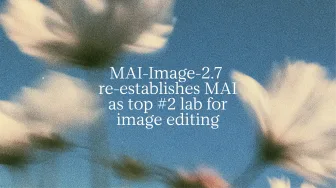
    Microsoft released the MAI Image 2.7 image editing model, ranking 3rd on Arena Edit and 2nd on Artificial Analysis.

    Microsoft AI released the image editing model MAI Image 2.7, launching as a preview version. It ranks 3rd in Arena Edit and 2nd in the Artificial Analysis image editing chart, making Microsoft AI the 2nd place lab.

    Why it matters: Microsoft announced the rankings of MAI Image 2.7 on two image editing lists and provided the improvement magnitude on 10 use cases compared to the previous generation.

Oct 26Mon
Oct 25Sun
  1. MarkTechPost80

    Microsoft Research open-sources Agensh: a multi-agent framework supporting 1024 agents

    Microsoft Research has open-sourced Agensh, a multi-agent framework without a central orchestrator, where each worker independently claims sub-tasks, shares discoveries, and merges code into the same Git repository.

    Why it matters: The original text provides scalability data for multi-agent frameworks without a central orchestrator on ProgramBench from 1 to 1024 agents, allowing for comparison with existing orchestration solutions.

Oct 23Fri
  1. Hugging Face Blog66

    Microsoft and Hugging Face use ThinkingBox database validation for RL reward training agents

    Microsoft and Hugging Face release ThinkingBox-Training, directly using ThinkingBox's deterministic verification of database final states as reinforcement learning rewards, training Qwen3.8-27B for 50 steps with GRPO

    Why it matters: Microsoft and Hugging Face directly use database final state verification as reinforcement learning rewards and have publicly released task filtering and training code, which can be transferred to other stateful intelligent agent training

  2. Microsoft AI News78

    Microsoft releases medical diagnostic system MAI-DxO and step-by-step diagnostic benchmark SDBench

    Microsoft's Health MAI team released the AI diagnostic system MAI-DxO and its accompanying benchmark SDBench, with the results published in Science. On 304 NEJM complex cases, MAI-DxO achieved an 83% diagnostic accuracy rate, with doctors achieving 36% with external information and 22% without; on MIMIC-IV-ED's emergency common cases, it was 80%, with doctors at 47%.

    Why it matters: The original text provides a step-by-step diagnostic benchmark and a quantitative comparison of multi-agent orchestration, allowing readers to understand the path of medical AI evaluation shifting from exam questions to interactive diagnosis.

Oct 7Wed
  1. Microsoft Research65

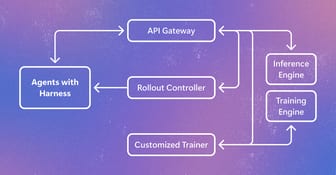
    Agent Lightning trains agents through their existing harness

    Microsoft Research's October 7 technical overview describes the rebuilt Agent Lightning v1.0: roughly 3,500 lines of control-plane code, agents running as Kubernetes jobs, and an LLM proxy that lets an existing harness participate in reinforcement learning. Its reported Qwen3.5-9B coding pipeline improved SWE-bench Verified Pass@1 from 41.8% to 56.4% using about 6,000 samples.

    Why it matters: Editorial takeaway: the training setup should resemble the deployed agent. Inspect the released workflow before adopting it; those results describe the authors' coding experiment, and running training still requires compute and infrastructure. This is a technical overview, not a claim that the framework first launched today.