AI Daily brief · Friday, 23 October 2026
STARHOT
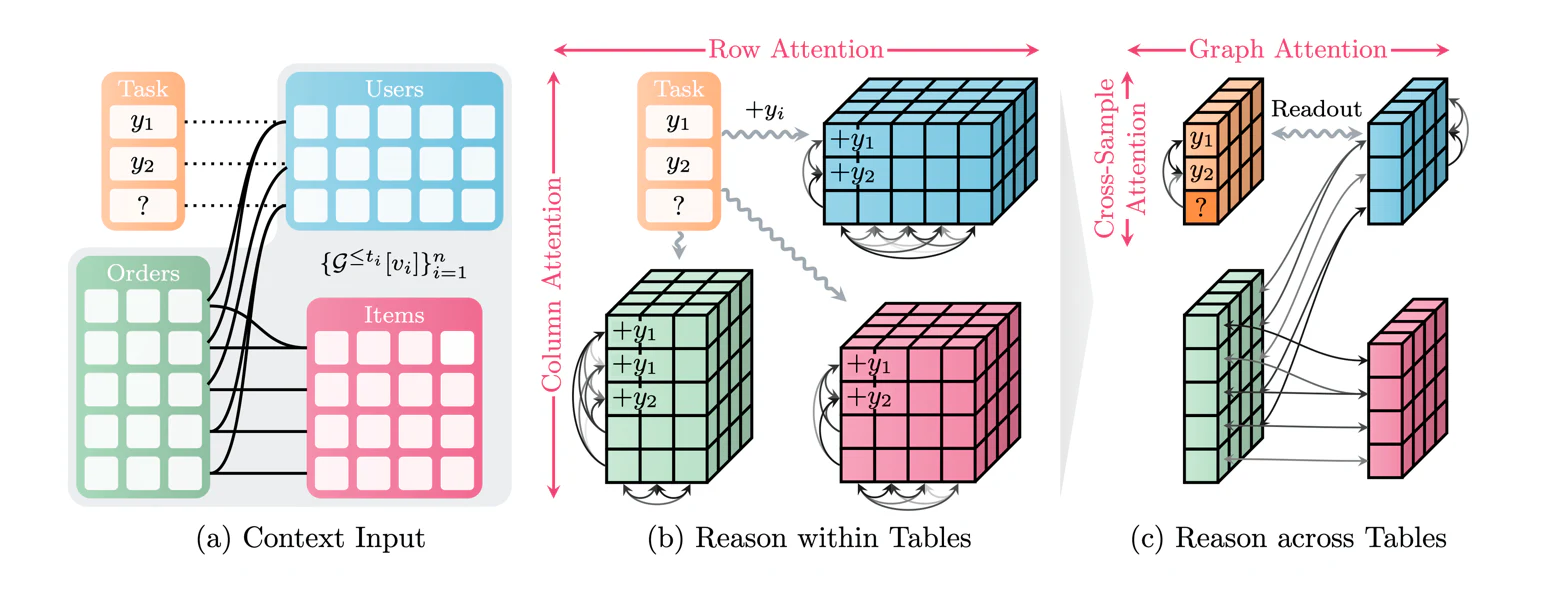
NVIDIA releases Kumo Relational relational foundation model, capable of prediction without training
NVIDIA releases pre-trained relational foundation model Kumo Relational, enabling direct prediction on enterprise databases without task-specific training, feature engineering, or table flattening. The model outperforms supervised relational deep learning and expert feature engineering gradient boosting trees on 41 tasks across 15 databases, achieving an MRR 8% higher than AutoGluon ensemble on the SAP SALT benchmark.
 Hugging Face BlogOfficialOriginal
Industry
 NVIDIA BlogOfficial

Google Cloud and NVIDIA announce Vera Rubin infrastructure now available
Google Cloud and NVIDIA announce A5X instances based on NVIDIA Vera Rubin now available, opening next month and planned to expand to Europe.
 OpenAI NewsOfficial+2 more outlets

OpenAI models will go live on Google Cloud
OpenAI Collaborates with Google Cloud, Integrating OpenAI Frontline Models and Codex Workflows into Gemini's Model Garden and Offering Through Google Cloud Marketplace
NVIDIA BlogOfficial
NVIDIA GTC Berlin 2026: Huang Renxun announces multiple updates including DSX POD, OpenShell, and Nemotron.
NVIDIA CEO Huang Renxun announced multiple updates at the GTC Berlin 2026 keynote speech, including the Vera Rubin AI factory reference design DSX POD delivered in modular container format, reducing on-site deployment time from six months to 14 days.
Research papers
 The Decoder

Claude Science designs protein binders from scratch to combat lethal scorpion venom
Anthropic's Claude has essentially designed a protein complex targeting scorpion neurotoxins in the Claude Science research environment, a type of toxin that kills over 3250 people annually.
More worth reading
 Anthropic ResearchOfficialAnthropic research: LLMs make large-scale formal software verification feasible.Anthropic partnered with Theorem to complete formal verification of the RISC-V assembly layer for 239 entry points in 123 OSS-Fuzz open-source libraries using Claude. The verification proves that these programs will not crash with any input less than 64 MB, with the proof code consisting of about 180 million lines of Rocq.
 ITHome · AIOpenAI fully opens decision API based on GPT-6 Luna, with 0.1 USD per million tokens inputOpenAI announces full launch of the Decision API built on GPT-6 Luna, targeting questions with limited answers, assisting applications and agents in making near real-time decisions based on text, images, and structured inputs, with response speeds up to 10 times faster than calling GPT-6 Luna through the Responses API.
 Microsoft AI NewsOfficialMicrosoft releases medical diagnostic system MAI-DxO and step-by-step diagnostic benchmark SDBenchMicrosoft's Health MAI team released the AI diagnostic system MAI-DxO and its accompanying benchmark SDBench, with the results published in Science. On 304 NEJM complex cases, MAI-DxO achieved an 83% diagnostic accuracy rate, with doctors achieving 36% with external information and 22% without; on MIMIC-IV-ED's emergency common cases, it was 80%, with doctors at 47%.
 The Verge · AICanva releases its first AI image model Canva Craft, planning and designing before generationCanva releases its first AI image model Canva Craft, planning and designing before generation; this model uses a two-stage architecture, supports 2K resolution and over 30 aspect ratios, can be used for social media and marketing content creation, and has now been launched globally.
- The Verge · AI1Password has launched the Agent feature, allowing AI intelligent agents to use user passwords without needing to view them.1Password introduces Agent functionality, allowing AI agents to log into users' accounts without needing to view or handle user passwords. Users still need to approve login requests, but this feature should simplify the process of using agents to perform tasks that require logging into services.
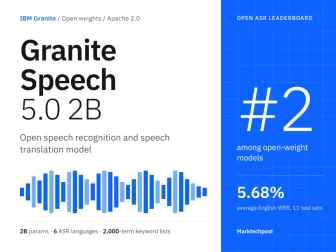
 MarkTechPostIBM AI Released Granite Speech 5.0 2B Open Source Multilingual Speech-to-Text and Translation ModelIBM releases Granite Speech 5.0 2B, an open-source speech language model with 2B parameters, supporting speech-to-text and translation in 6 languages, ranking second on the Open ASR list, with an average WER of 5.68% for English. The model uses YaRN to extend to 16k positions, supports GPU, Apple Silicon, and local CPU deployment, and includes 2000 keyword bias features.