Skip to content
Live
Nov 10Tue
  1. Berkeley AI Research22

    BAIR at CoRL 2026

    BAIR team presented multiple research achievements at the Robot Learning Conference (CoRL) held from November 9 to 12, 2026, in Austin, Texas, including 33 main conference papers, 4 breakthrough posters, 10 oral presentations, and 7 thematic speeches, among which Professor Negar Mehr will deliver an early career keynote speech. The conference covers topics such as robotic vision-language-action models, embodied agents, fine-grained manipulation alignment, and hindsight reward editing.


Nov 7Sat
  1. Baseten Labs65

    Research shows that on-policy self-distillation (OPSD) is biased and has limited effectiveness

    Research indicates that on-policy self-distillation (OPSD) may still be valuable in specific scenarios, but more research resources should not be invested. OPSD trains through the outputs generated by the student model itself with context prompts, but research shows that this intensive supervision may introduce bias, especially for trained models, making it less effective.

Nov 6Fri
  1. Google Research72

    Google Research uses smartwatch sensors to identify signs of hypertension.

    Google Research published a multimodal AI system AI-PPG-ACC-HTN in Nature, which passively identifies hypertension status without wristband calibration, using only PPG and accelerometer data from consumer-grade smartwatches.

    Why it matters: The study passively identifies hypertension using PPG and accelerometer data from smartwatches, providing quantitative results for screening and confirmation in two stages, with 24-hour dynamic blood pressure monitoring as the gold standard.

Nov 5Thu
  1. Epoch AI65

    Epoch Capabilities Index update adopts Bayesian model methodology

    Epoch Capabilities Index (ECI) update adopts Bayesian model methodology, providing more reliable estimates of model capability uncertainty and the probability of comparing capabilities between models. The new method is based on four-parameter logistic (4PL) item response theory (IRT), using Claude 3.5 Sonnet (ECI 130) and GPT-5 (ECI 150) as anchor models, and achieves cross-temporal consistency through linear transformations to fix parameter location and scale.

Nov 4Wed
Oct 15Thu
  1. AI as Normal Technology

    Beyond Automation: New Research Directions in AI

    Beyond Automation: A new research direction in AI argues that AI should not be limited to automating human labor but should explore new directions for enhancing humans and promoting human-machine collaboration. This perspective advocates for AI research to focus on new issues such as transparent agents, process tracking, and human-machine interaction design to push AI beyond pure technological automation and achieve broader applications.

Oct 13Tue
Oct 12Mon
  1. Baseten Labs75

    Base Labs research found: Why does the model forget facts during iterative learning? Experimental analysis based on talkie-1930-13b-it.

    Base Labs research found that iterative learning with the talkie-1930-13b-it model using sports facts from 2011-2019 leads to fact forgetting, with forgotten facts still present in model weights. Experiments show that early learned facts are difficult to recall after 20 writes and merges, and are covered by later facts, but the covered facts can be relearned, primarily occurring in the later MLP weights.

Oct 1Thu
  1. Amazon Science

    Graph Center Agent: How to Utilize Graph Structures for Agent Reasoning

    Amazon Science has released Graph Center Agent technology, which combines a continuous synchronized graph (digital twin) representing the network with device attributes and connections, with cascade graph algorithms (decomposition, aggregation, tracing) and agent orchestration to achieve minute-level root cause analysis of complex network failures, achieving 95% accuracy in a demonstration at NTT DOCOMO's MWC.

Sep 30Wed
  1. Google Developers Blog

    How does Sparse VideoGen (SVG) accelerate temporal and spatial attention computation for video diffusion on TPUs

    Sparse VideoGen (SVG) dynamically routes attention heads to spatial or temporal masks by identifying the spatiotemporal structures of different attention heads in video diffusion models, converting theoretical sparsity into actual end-to-end speedup. On TPU v6e, SVG retains about 38.87% of query-key pairs, achieving 3.5x inference acceleration while maintaining output quality at a given sparsity level. The scheme employs custom JAX and Pallas Splash attention kernels to convert theoretical sparsity into physical sparsity on hardware.

Aug 24Mon
  1. Import AI75

    Import AI 470: Machines without rights; SPADE automated environment generation; Hawkeye building better GPU kernels

    Research shows that AI accelerates the discovery of network vulnerabilities but has a minimal impact on mathematical research, and AI research itself has not shown significant acceleration. The SPADE project generates training data in synthetic environments through self-play, with the Qwen3-30B model achieving the best results, significantly improving performance in both game and tool environment tasks. The Hawkeye tool is used to optimize GPU kernel construction.

May 8Fri
  1. Berkeley AI Research

    Adapting to parallel reasoning: the next paradigm for efficient reasoning extension

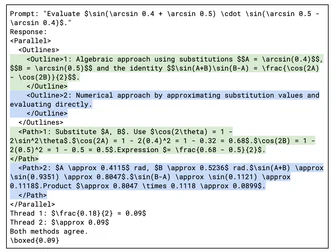
    Adapting to parallel reasoning allows models to decide on their own when to decompose and parallelize independent subtasks, how many threads to start, and how to coordinate. Existing methods such as fixed parallelism, heuristic structured search, and Monte Carlo tree search determine the parallel structure externally. Recent advancements like ParaThinker and GroupThink attempt to let models adaptively select parallel strategies, but decisions are still constrained externally.