Anthropic称AI已削弱英伟达CUDA优势,将AMD芯片切换时间缩短至三天。
Anthropic says AI is eroding Nvidia's CUDA lead, cutting an AMD chip switch from months to three days
Anthropic宣称通过AI将其AI模型Claude迁移到AMD GPU的时间从数月缩短至三天,几乎无需人工干预,以此打破对英伟达的依赖。该公司表示,AI模型Mythos完成了99%的内核迁移或编写工作,使新硬件能在三天内达到可用性能水平,而传统工程方法需要六至十二个月。
同一件事另外 1 家也报道了
- IT之家 · AI··首发
- The Decoder··+2 小时 59 分·当前阅读
Anthropic称AI已削弱英伟达CUDA优势,将AMD芯片切换时间缩短至三天。
新增信息:The Decoder 提到 AI 模型 Mythos 完成了 99% 的内核迁移或编写工作。
按发布时间排列 · 事件后续出现时自动追加 · 由模型根据各家标题与摘要比对
Anthropic claims it has broken free of its Nvidia dependence with a multi-chip strategy. The company says it ported its own AI model, Claude, to AMD GPUs in just three days, with almost no human intervention.
Nvidia's biggest competitive edge is the combination of hardware and software, specifically CUDA, the software ecosystem that locks developers into Nvidia chips. Porting AI models to other chip architectures takes so much effort that many companies won't even try. Anthropic now claims in an investor presentation that it has solved this problem using AI itself.
According to Tom Brown, co-founder and Chief Compute Officer at Anthropic, the company now trains and runs Claude on all four major chip families. Anthropic made an "unconventional bet" on a multi-chip strategy early on, at a time when most of the industry considered the effort not worth it. Each chip needs its own custom software and inference stack, which is expensive and time-consuming. But Anthropic has been investing in this work for years and has since become "incredibly good" at it, Brown says.
Anthropic uses AI to port Claude to AMD
The company's most concrete test came with AMD GPUs. Until now, bringing up a new chip platform kept dozens of engineers busy for months. This year, Anthropic used AMD GPUs for the first time and let its own frontier model, Mythos, do the work. According to Anthropic, Claude was running on AMD after just three days, with almost no human intervention. The model ported or wrote nearly 100 percent of the kernels itself.
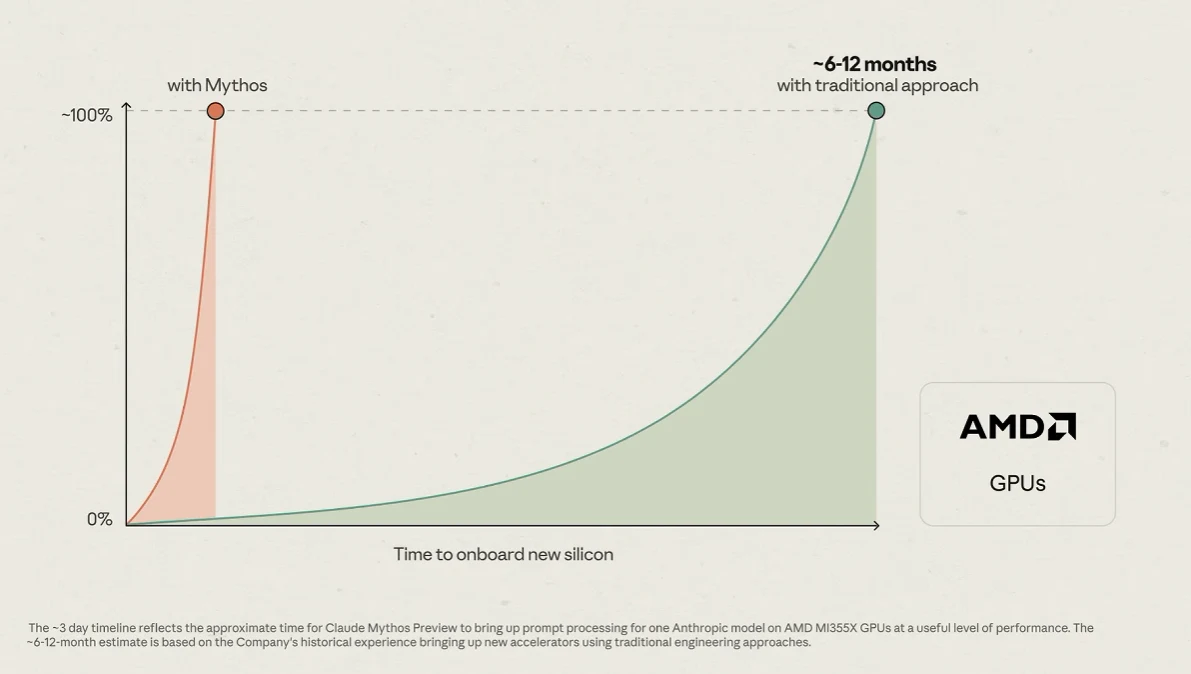
If these figures are accurate, the software overhead, long considered Nvidia's strongest competitive advantage, would shrink dramatically because of AI. Companies could switch more easily between chip providers and pick the most affordable or readily available option.
In a compute market where supply is tight, a multi-chip approach lets companies focus on the best price-performance ratio, regardless of the vendor. Some chips are better for training, while others are better for inference. And because of its dominance in the AI chip market, Nvidia currently enjoys a margin of more than 70 percent, which is unusually high for hardware.
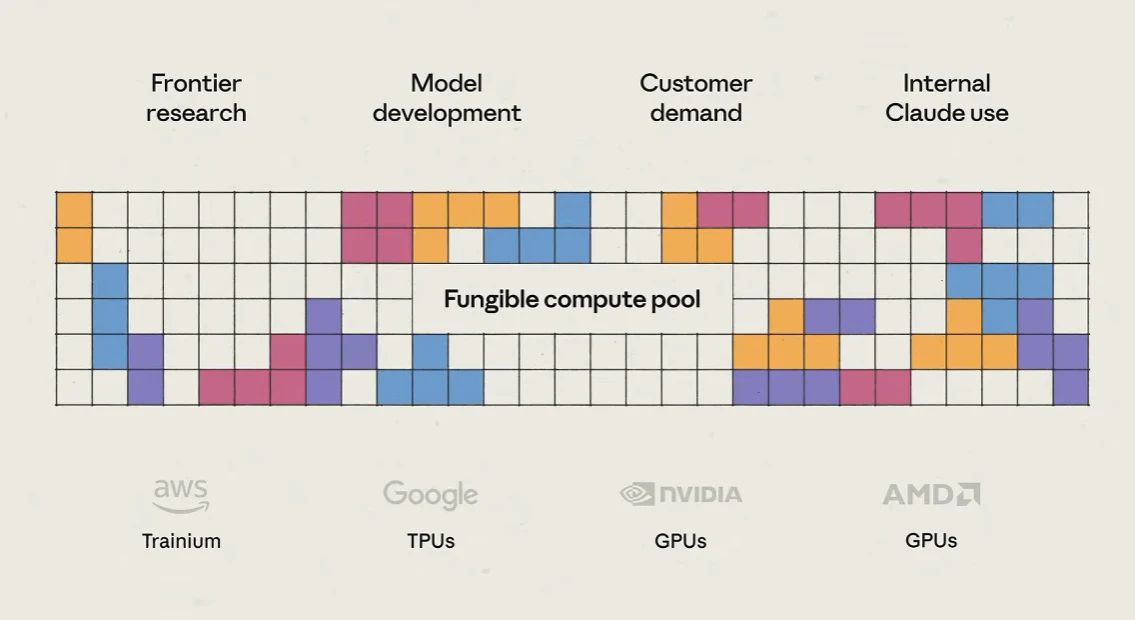
Anthropic treats compute from different vendors, chip architectures, and locations as one interchangeable pool. The company says it gets more out of every dollar of compute than any other frontier AI lab.
Compute multipliers aim to widen the lead
Beyond its multi-chip strategy, Anthropic relies on what it calls compute multipliers, research breakthroughs that squeeze more performance from the same physical computing capacity. According to Anthropic, these multipliers build on one another so that each new breakthrough amplifies the effect of the previous one.
Eventually, Claude should be able to discover such compute multipliers on its own. That would amount to recursive self-improvement, a concept that's intensely debated in AI research but hasn't been proven yet.
Anthropic is also building its own data center capacity through the "Anthropic Direct" program. Instead of buying computing power only as a cloud service, the company leases chips and operates them in purpose-built data centers. The goal is to reduce total cost of ownership.
The figures come from Anthropic's investor presentation and haven't been independently verified. But they show that at least one major AI lab no longer considers Nvidia's CUDA dominance insurmountable and that AI models themselves could become a tool for breaking hardware dependencies.
Both major GPU makers now have deep financial ties to Anthropic. In November 2025, as part of a $45 billion deal with Microsoft, Nvidia committed to investing up to $10 billion in Anthropic. According to Anthropic's S-1/A registration statement filed with the SEC on November 10, 2026, Nvidia is also participating in a conditional private placement totaling $26 billion, in which seven technology companies are subscribing to shares at the IPO price.
AMD announced a strategic investment of up to $5 billion in July 2026; in return, Anthropic plans to deploy up to two gigawatts of AMD Instinct MI455X GPUs in Helios rack-scale systems, with the first gigawatt phase beginning in the first half of 2027.
AI News Without the Hype – Curated by Humans
Subscribe to THE DECODER for ad-free reading, a weekly AI newsletter, our exclusive "AI Radar" frontier report six times a year, full archive access, and access to our comment section.
来源: The Decoder · the-decoder.com