澳大利亚央行发现AI正首先冲击年轻工人,尤其在软件和客服领域
Australia's central bank finds AI hitting young workers first, especially in software and customer service
澳大利亚央行分析显示,ChatGPT推出后,软件开发等高AI暴露度职业的年轻求职者就业率下降,15-24岁及应届毕业生就业状况弱于年长者。自2022年底以来,高暴露度群体岗位招聘降幅最陡,但未证实AI直接因果关系。其他研究如斯坦福(2025年8月)和Anthropic(2026年3月)数据类似,年轻软件开发者就业率分别下降13%和约14%,但经验丰富者稳定或增长。
同一件事另外 1 家也报道了
- The Decoder··首发·当前阅读
澳大利亚央行发现AI正首先冲击年轻工人,尤其在软件和客服领域
- IT之家 · AI··+18 分钟
澳大利亚央行研究:AI 最先冲击年轻劳动者,尤其是软件、客服岗位
新增信息:AI 对澳大利亚整体就业市场冲击有限。
按发布时间排列 · 事件后续出现时自动追加 · 由模型根据各家标题与摘要比对
AI has barely displaced any jobs in Australia so far, but young workers entering highly exposed fields like software development are faring worse.
An analysis by Mike Major for Australia's central bank (RBA) built a monitoring system that focuses on the areas where effects are likely to appear first, namely entry-level workers and highly AI-exposed occupations such as programming, clerical work, and customer service.
According to the analysis, job postings have fallen across all groups since ChatGPT launched in late 2022, with the steepest drop in the highest-exposure group. In that group, workers aged 15 to 24 and young college graduates have weaker employment rates and higher unemployment than older workers.
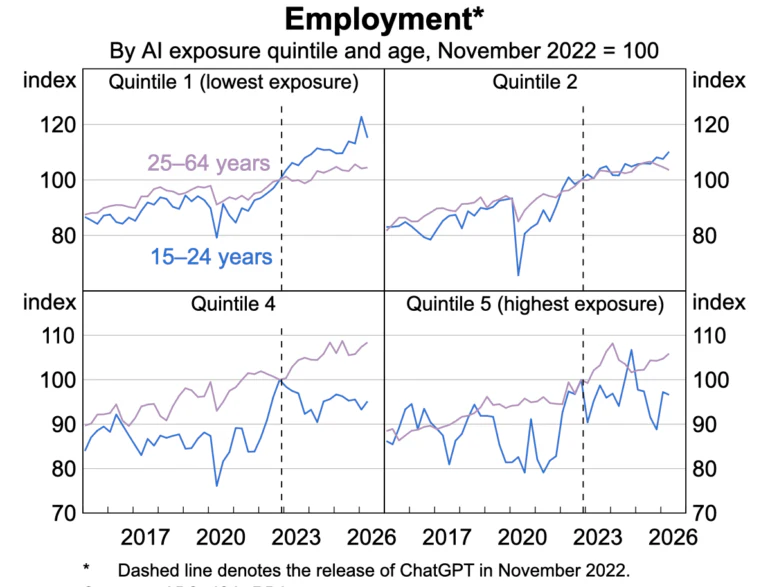
Major cautions against drawing early conclusions, since the study does not establish direct causation and measures only theoretical exposure, not actual use by companies. Post-pandemic shifts in the business cycle or in remote work could also be driving the numbers. According to SEEK data, AI is complementing existing work while also creating new demand for AI skills.
Other studies paint a similar picture, with caveats
An August 2025 Stanford study based on millions of US payroll records found a similar pattern, with employment among 22- to 25-year-olds in AI-exposed occupations down 13 percent in relative terms since late 2022 and nearly 20 percent among young software developers. More experienced workers in the same occupations held steady or gained ground.
A March 2026 Anthropic study also found signs of declining hiring among 22- to 25-year-olds in exposed occupations, with job-finding rates down about 14 percent. It found no systematic rise in overall unemployment, however. Theoretical automation potential and actual AI use are far apart, according to the study.
Anthropic offers a company-level example. According to an internal review, the share of junior hires in technical roles has fallen from 27 percent to 9 percent since early 2025. In August 2026, AI agents across the company were already logging six times as many hours as human employees. Anthropic concedes that, as an extremely AI-intensive software company, it is a special case. Even so, researchers warn of a "tragedy of the cognitive commons", in which disappearing junior roles lead to a future shortage of experienced professionals, assuming those professionals are still needed.
A large study of 25,000 workers in Denmark confirms the lack of economy-wide impact. Despite a 64 percent AI adoption rate, researchers found no measurable changes in wages or hours worked. Workers saved an average of just 2.8 percent of their working time.
A January 2026 analysis of 10.6 million LinkedIn profiles and US unemployment data, however, cautions against blaming the downturn on AI alone. The research team led by Morgan Frank at the University of Pittsburgh found that the problems in exposed occupations started in early 2022, months before ChatGPT launched. Macroeconomic factors like the Fed's shift in interest rate policy or a correction after pandemic-era hiring surges may play a bigger role than previously assumed.
At the same time, AI is creating new demand. According to the World Economic Forum's "Future of Jobs Report 2025", 77 percent of surveyed companies are prioritizing upskilling over job cuts. WEF researchers project a net gain of 78 million jobs by 2030. According to LinkedIn, AI-related job postings grew sixfold in one year.
AI News Without the Hype – Curated by Humans
Subscribe to THE DECODER for ad-free reading, a weekly AI newsletter, our exclusive "AI Radar" frontier report six times a year, full archive access, and access to our comment section.
来源: The Decoder · the-decoder.com