Skip to content
Live
  1. Google Developers Blog78

    Google releases generative UI open protocol A2UI 1.0

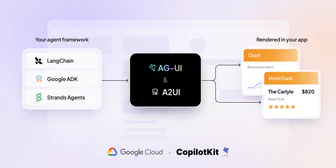
    Google has released the Generative UI Open Protocol A2UI 1.0, which is the first stable version of the protocol, allowing AI agents to respond with interactive interfaces instead of plain text. Version 1.0 adds bidirectional function calls, accessibility support, and extended metadata, and provides open-source rendering SDKs for Web, Android, iOS, as well as agent SDKs for Python, TypeScript, and Dart.
    Why it matters: A2UI 1.0 extends agent output from pure text to native interactive interfaces, providing multi-platform renderers and integration scheme examples, allowing for judgment on the implementation methods of generative UI.

  1. Databricks Blog76

    Databricks upgrades Genie One to an enterprise AI collaboration workspace

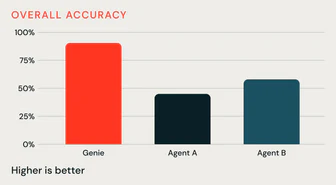
    Databricks announces Genie One as the unified entry point for enterprise AI collaboration, consolidating search, product generation, and cross-tool operations into one place, and providing enterprise context based on Genie Ontology, governed by Unity Gateway.

    Why it matters: The original text provides specific capabilities of Genie One from Q&A to product generation, cross-tool execution, and governance, allowing for judgment on how enterprise AI workbenches can be implemented.

  2. Databricks Blog80

    Databricks releases new Genie: an autonomous AI colleague for complex enterprise work

    Databricks released a new version of Genie, positioning it as an autonomous AI colleague that can continuously track progress, follow up on missing inputs, and take action when new information arrives. Users can set guards and approve critical steps. The new version is paired with Genie Ontology, which provides business definitions and organizational knowledge. Genie Search uses a hybrid search combining indexing and MCP, and continues to use Unity Catalog permissions. Unity Gateway manages access, cost, and auditing uniformly.

    Why it matters: The original text outlines the boundary of Genie's ability to shift from an assistant to autonomously performing long-term tasks and its governance methods, which can be used to determine the context and permission controls needed for enterprise agents to go live.

  1. Google Developers Blog60

    Google AI Studio supports building Google Maps applications with prompt words

    Google AI Studio can now directly build applications driven by Google Maps Platform, where users describe their ideas and AI Studio automatically completes configuration and API key management without a credit card.

    Why it matters: The original text provides daily quotas without a credit card and a complete path from prompt words to a runnable map application, allowing readers to judge the cost of prototype construction based on this.

  1. MarkTechPost71

    0sec Labs open-sources AI Security Harness 0, providing a Web console, CLI, and MCP service

    0sec Labs has open-sourced AI Security Harness 0, released under MIT or Apache-2.0 licenses, as a research preview version, which can be driven from a local browser console, headless CLI, or MCP server, used for vulnerability investigation, code review, penetration testing, reverse engineering, and fix generation.

    Why it matters: The original text provides the architecture of this security harness, its self-reported benchmarks, and a comparison with similar tools, allowing judgment on its position in the vulnerability discovery process.

  2. QbitAI72

    Qianwen Office 2.0 released, introducing the Team Agent feature supporting collaboration between multiple people and Agents.

    Qianwen Office released version 2.0 on November 9, introducing the 'Collaboration' feature supporting multiple people and Agents, and launching capabilities such as 'Human-Machine Co-Creation,' 'Data Space,' 'Auto Tasks,' and 'Tri-Platform Connectivity,' all features are fully launched in the client.

    Why it matters: Qwen Office 2.0 integrates Agents into team collaboration scenarios, providing specific implementation cases like Yintai Department Store, allowing observation of the path from individual assistants to team collaboration for office Agents.

  1. Mistral AI75

    Mistral releases Mistral Large 4 (Le Chonk) and expands Mistral Studio platform

    Mistral releases Mistral Large 4 (codename Le Chonk), featuring coding, defensive cybersecurity, and complex document reasoning, while expanding the enterprise platform Mistral Studio with new capabilities for hosted agents, applications, workflows, as well as enterprise context, agent observability, and evaluation features.

    Why it matters: The original text provides three types of capabilities (hosted agents, workflows, applications) and deployment options, allowing readers to judge the implementation methods of enterprise agents accordingly.

  1. The Verge · AI75

    Apple has opened up Siri AI capabilities to third-party apps in iOS 27.3

    Apple has opened up new Siri AI capabilities to developers with iOS 27.3, allowing third-party apps to access personal context, natural language prompts, and screen awareness to complete tasks. This update was released in Developer Preview form and adds app skills that can be created by developers, combining multiple tasks into a single action.

    Why it matters: The original text listed the specific interaction methods for Siri AI to access third-party applications, and readers can judge which cross-application operations the voice assistant can perform based on this.

  2. Google DeepMind75

    Google Antigravity launches cheminformatics skills, completing drug discovery process in one hour

    Google DeepMind releases a set of cheminformatics skills (Cheminformatics Skills) for Google Antigravity, based on RDKit and integrated with ChEMBL and PubChem, where language models are responsible for process orchestration and scientific reasoning, and deterministic chemical tools perform molecular calculations.

    Why it matters: The original text provides a complete process of cheminformatics skills in real lung cancer drug cases, which can be used to determine the division of labor for intelligent agents in scientific research workflows.

  1. ITHome · AI82

    Alibaba said that users of the China market version of Apple Intelligence can choose whether to enable the Qwen integration or not.

    Alibaba announced that the China market version of Apple Intelligence will integrate with Qwen, allowing users to call Qwen's text and image understanding and content generation capabilities in Siri, writing tools, and visual intelligence, and they can choose whether to enable it or not. Related features will be open for testing with the latest iOS developer Beta version on November 4, and will be officially launched for Chinese users with the iOS 27.3 version in December. Alibaba stated that user requests and generated replies will not be used for model training.

    Why it matters: The original text specifies the specific entry point for Qwen to access Apple Intelligence, the launch time, and the user authorization method, which can be used to judge the actual usable form of Apple Intelligence for China market.

  1. Google Developers Blog62

    Build generative UI applications with A2UI and CopilotKit agents

    Google introduces its framework-agnostic open standard A2UI, allowing agents to describe interfaces declaratively in JSON, rendered by applications using existing components, and integrated with the AG-UI protocol of CopilotKit to connect to agent frameworks like LangChain, Google ADK, Mastra, Strands, etc.

    Why it matters: The original text provides complete integration code and bidirectional interaction examples for A2UI and CopilotKit, which can be used to determine the implementation method for generative UIs.

  1. The Decoder80

    Google announced the integration of third-party AI agents into Android Studio at the Android Dev Summit and released a new Gemini API

    Google announced Android Studio Rabbit 2 at the Android Dev Summit, supporting more than 40 coding agents, including Claude, Codex, and Google Antigravity, to run within the IDE through the open-sourced Agent Client Protocol.

    Why it matters: Android Studio opens third-party intelligent agent access and provides corresponding changes at the CLI and MCP levels, which can be used to judge the changes in mobile development workflows.

  2. Microsoft Official Blog72

    Microsoft opens the Copilot harness through Foundry, supporting the development of multi-model intelligent agents

    Microsoft opens the GitHub team's Copilot harness built by GitHub through Microsoft Foundry, providing a fully managed way to build intelligent agents that can reason, call tools, and complete long tasks.

    Why it matters: Microsoft opens the multi-model harness supporting multiple Copilot products internally to Foundry, allowing readers to judge the trade-offs of building their own orchestration layer based on this.

  1. Anthropic Research62

    Anthropic releases Claude Code best practices for intelligent agent coding

    Anthropic releases Claude Code best practices covering CLAUDE.md configuration, tool permission management, MCP access, common workflows, and multi-Claude parallelism. The article suggests exploring and planning with sub-agents before writing code and provides specific processes such as test-driven development, screenshot iteration, and headless mode automation. This article has been moved to the official documentation, and the original blog is no longer maintained.

    Why it matters: Anthropic's official system has organized the configuration, workflows, and multi-instance parallel methods of Claude Code, which can be used as a reference for setting up intelligent agent coding processes.

You are all caught up