分析英国用户付费使用Claude的情况
🔮 The $22 billion question about AI self-improvement #610
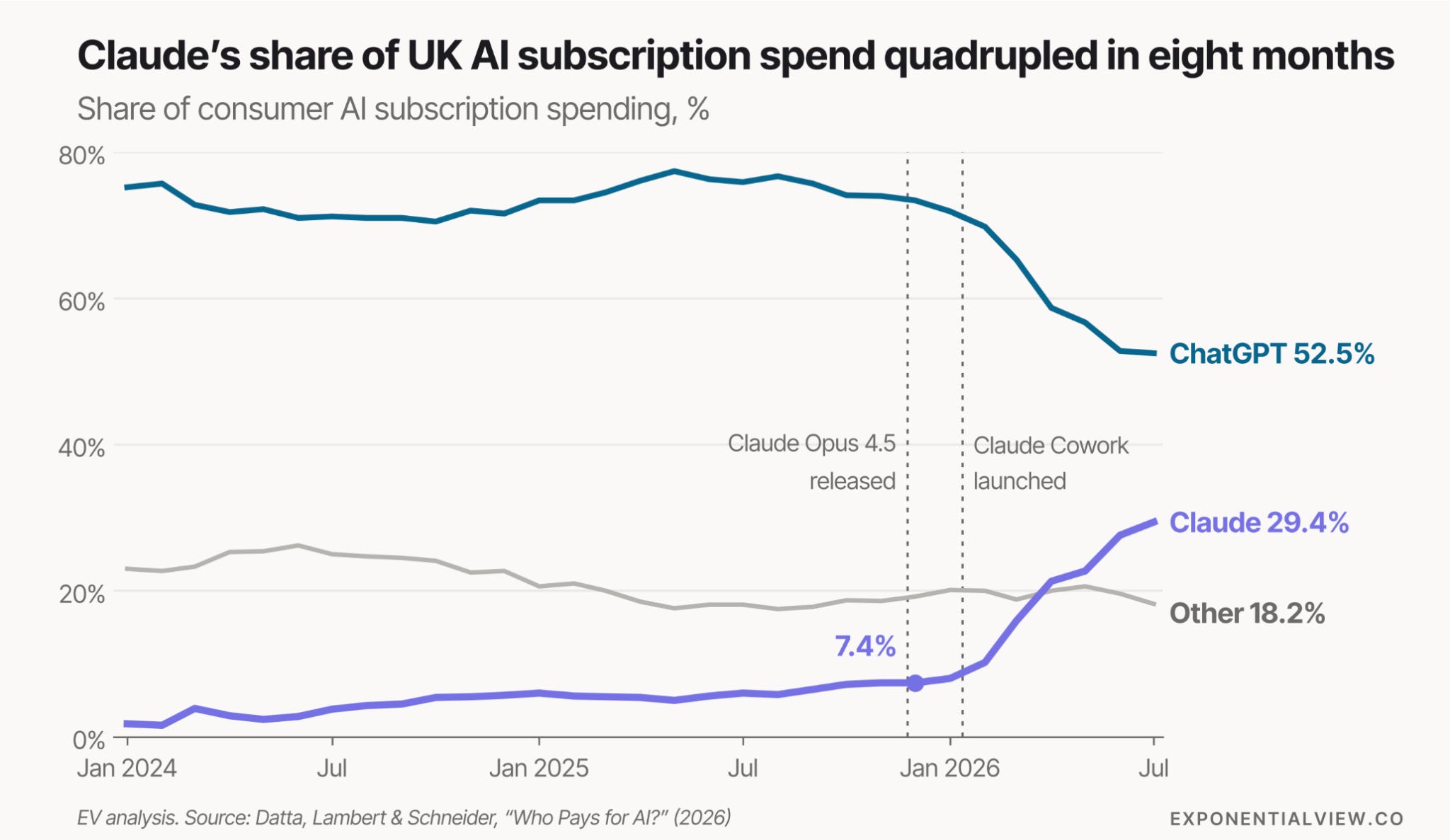
英国每二十名成年人中有一人付费使用Claude,年消费超13亿美元,伦敦地区科技、金融、教育和公关行业用户集中,其市场份额一年内翻四番;同时,AI智能体在购买iPhone Duo、毛衣等复杂商品时表现出色,但整体应用仍处早期阶段
It’s simply the best, data-rich source for the money on how AI is reshaping the economy. — Matt G., a paying member
My AI agent bought an iPhone for me this week. For an Uber, I’d still reach for the app.
That’s where we start today – I look at which jobs are worth handing over to AI, and why more Brits are paying for Claude. We’ll also look at what cheaper renewable power still needs and whether AI self-improvement owes more to intelligence or a massive research budget.
If you’re a member of Exponential View, join me in the subscriber chat:
Claude Britannia
Brits are spending more and more on AI. One in twenty adults in the UK pays for AI, spending more than $1.3 billion a year. Five percent is early days, but it is a fast ramp – it was 1% two years ago, and 2.5% a year ago. London is the hotspot; the professional skew is predictable, with those involved in tech, finance, education, and PR. And we are increasingly falling for Claude. Its share has quadrupled in a year.1 Was the trigger the improved harness on Claude Cowork?
Separately, made his first purchase using his Instinct agent, sweaters for winter. My Instinct agent secured my iPhone Duo for me on Tuesday. ’s agent booked a squash court for a showdown with . We’re playing around with them and finding them quite useful.
But in general, agent-based shopping is still early. Uber says four rides out of 320 million during Halloween week were booked by agents. I’m not sure I’d use an agent to book an Uber yet; hitting the app is easier. But getting an iPhone Duo, which involved checking Apple’s website every few minutes from 7 am, is a perfect job for them. So is finding finicky, complicated products like surge-protected power extensions, medicine pouches, or, in Will’s case, woolly jumpers.
Fair-weather friends
The technology is doing its bit. Adding wind to solar and batteries cuts the median cost from $105 to $86 per MWh. North of Milan and Montreal (yes, they are on the same latitude), it falls from $164 to $99. Based on hourly modeling over ten years, and reckon that sun and wind mostly cover for each other – except for a difficult combined lull for about a week every four.
Ember also finds that 83% of the 750GW of fossil plants being planned sit where reliable renewables (with a bit of gas backup) cost under $100/MWh (which is roughly implied with oil at $60 a barrel).
My take is that technology costs will keep falling, and those that haven’t yet benefited from reductions (like panel installations) will start to yield as robotics improve. But redesigning the grid into a largely renewable-based one also requires more than better technology. It’ll need both a better cost of capital (gas plants still find capital cheaper than solar) and financial instruments that match energy prices to the volatility renewable-based energy brings.
See also:
Our team’s solar supercycle modeling and analysis.
来源: Exponential View · exponentialview.co