美国商务部发布132页出口管制新规,旨在限制中国AI计算资源获取。
BIS (Finally) Takes a Stand
美国商务部发布132页新规,通过要求对新加坡、马来西亚、泰国、印度尼西亚和巴西的芯片出口申请许可、限制中国企业租用AI芯片的计算能力上限、以及再次关闭台积电等外企代工的漏洞等方式,限制中国获取AI计算资源。新规旨在打击AI芯片走私,并首次对远程访问AI芯片进行管制,规定持有大量AI芯片的企业可租用的数量上限约为200颗先进Blackwell芯片或800颗H100芯片,且该限制具有追溯效力。
同一件事另外 2 家也报道了
- TechCrunch · AI··首发
- Ars Technica · AI··+4 小时 8 分
新增信息:印尼、马来西亚、新加坡、泰国和巴西被提及为有数据中心限制的国家。
- ChinaTalk··+20 小时 1 分·当前阅读
美国商务部发布132页出口管制新规,旨在限制中国AI计算资源获取。
新增信息:新规限制中国企业可租用的先进Blackwell和H100芯片数量分别为约200颗和800颗,且具有追溯效力。
按发布时间排列 · 事件后续出现时自动追加 · 由模型根据各家标题与摘要比对
A 132-page export control rule landed Monday morning, and the Commerce Department’s own press release credited Treasury and the NSC with writing it. Days after the Megaspeed scandal ended Jensen Huang’s run at Nvidia, Washington is moving to close the cloud loophole that, by ChinaTalk’s estimate, supplies two-fifths of China’s AI compute.
Two Biden NSC alumni weigh in: Chris McGuire, now senior fellow for China and emerging technologies at the Council on Foreign Relations after a stint as deputy senior director for technology and national security, and Julian Gewirtz, the former senior director for China and Taiwan affairs now a senior research scholar at Columbia SIPA.
We discuss…
Three loopholes closed in 132 pages — license requirements for chips headed to Singapore, Malaysia, Thailand, Indonesia, and Brazil; a cap on compute rented to Chinese firms; and a TSMC backdoor closed for the second time.
The Northern Virginia problem — why a rule that stops at the US border could simply move China’s rented compute from Johor to the Washington suburbs.
Who wrote the rule — what crediting Treasury and the NSC says about Commerce’s credibility, and whether Trump holds firm in Shenzhen.
Does Xi know the numbers — whether Beijing escalates or doubles down on the bet that it can (again) talk Trump into loosening controls.
Jensen’s soup vendor — the customer-concentration fear that pushed Nvidia toward Asian neoclouds and China.
Zero consequences for three million chips — why export controls need their BNP Paribas moment, and what that has to do with AI safety.
Listen now on your favorite podcast platform.

What’s Actually in the Rule
Jordan Schneider: Cloud loophole closed? On a Monday? Chris, how are you doing?
Chris McGuire: A little overwhelmed, but this is progress. It’s the first time in about 18 months that we’ve seen signs of life — an actual recognition that AI and export controls matter. Not perfect, but good.
Jordan Schneider: Let’s start with what’s in the rule. Then we’ll do a little meta on how this rule got made, and then we’ll bring in Julian to talk about what it could mean for US-China relations. Chris, 132 pages. Pangram says it’s all human-written, no AI generation. What’s in the rule?
Chris McGuire: It’s important to note that the details here are the story. We’ve been fixated on these affairs, or on who wrote the rule. But this is a huge rule. It’s going to affect hundreds of billions of dollars of capital flows and really shape how the AI industry functions. Understanding it is the biggest part of the story — not who slept with who, or any of the trivial drama people are focused on.
The rule addresses three categories:
Countering Chinese smuggling of AI chips.
Restricting Chinese companies from renting access to AI chips.
Closing loopholes that let Chinese companies make AI chips at TSMC, Samsung, and elsewhere.
Those are the three ways it tries to cut down China’s access to compute. My top line, as I said at the start, is that this is a good rule that actually moves the ball forward. It closes multiple real loopholes. It is also imperfect. When you close some loopholes, others become more important, so we need to take a few additional actions to tighten things up. But this is real forward progress.
Let me break down those three buckets.
Smuggling
Chris McGuire: This one is straightforward. The rule imposes controls on Singapore, Malaysia, Thailand, Indonesia, and Brazil. Southeast Asia in particular has become a massive smuggling hub for AI chips over the last few years. Relative to the size of their economies, Singapore, Malaysia, Thailand, and Indonesia were the third-, fourth-, fifth-, and eighth-largest importers of AI chips in the world — way, way more than anyone else relative to GDP. They basically displaced China: all the demand that was previously going to China went to these countries. Brazil is also setting up large AI data centers for ByteDance and others, which is presumably why it was added.
This is positive, but it will push smuggling to other countries. Without something broader, smugglers will inevitably move from Malaysia to Bhutan or Nepal or somewhere else. Still, the countries that are currently the biggest hubs now have to get a license from the US government before their companies can buy the chips.
What we need to move toward is a general policy: if you’re buying hundreds of millions of dollars of AI chips anywhere in the world, the US government should at least have visibility into that, if not the ability to veto it. That can and should be done in a follow-up rule.
Remote access
Chris McGuire: Restricting Chinese companies from renting access to AI chips is a notable new development. On smuggling, the Trump administration simply hadn’t been enforcing the anti-smuggling regulations the Biden administration put into effect. But on remote access, regulations like this didn’t exist at all. So this is new, and it’s positive.
The rule says that if you hold large numbers of AI chips, you can rent only a fairly small number to Chinese companies without applying for a license from Commerce — the equivalent of roughly 200 of the most advanced Blackwell chips, or about 800 H100s. That’s a meaningful number of chips, but training or running frontier models takes thousands, tens of thousands, maybe hundreds of thousands of chips. So this would significantly curtail China’s access.
It also applies retroactively. The rule effectively says this has always been the policy: if you were providing at least half of your computing power to Chinese companies, that was itself a violation of the controls. If that’s actually enforced, it means they could go after Megaspeed and say it was violating controls by providing compute to China. We’ll see how enforcement goes, but it’s a very strong signal that they don’t want this to happen.
There’s one huge loophole, though: the rule doesn’t apply inside the United States. Until that’s closed, Chinese companies will divert all their computing power away from Johor, Malaysia, and into Northern Virginia. Northern Virginia is going to become the center of China AI until we fix this. Commerce has the authority to close this right now, and it needs to get done.
Chip design at TSMC
Chris McGuire: The last piece blocks Chinese chip designers from making AI chips at TSMC, which is good and important. The Biden administration put regulations in place requiring any company making an AI chip at TSMC to apply for a license unless it was on a whitelist. Not many companies make these chips, so all the legitimate ones were already on the whitelist. For various arcane regulatory reasons, that rule hadn’t been in effect, and Commerce hadn’t been enforcing it. Now it’s back in effect, and they say they’ll enforce it.
They actually went a step further: any Chinese company making a chip at 14 nanometers or more advanced has to apply for a license, regardless of whether it claims the chip is for AI (there are some technical parameters on that). That means, for example, Xiaomi has to apply for a license to make a three-nanometer smartphone chip at TSMC. So the implications go beyond AI. This is great for Qualcomm and other US companies that would like to sell smartphone chips to China, since China has been designing its own chips at TSMC and US firms may now capture more of that market. But the purpose isn’t to give them an advantage. The purpose is to cut off every avenue for Chinese circumvention, because we know China has illicitly made millions of chips at TSMC.
So those are the three categories. The top line is a very positive step forward, with important work left to do — especially regarding activities inside the United States. That loophole needs to be closed tomorrow. But these are signs of life, and a recognition that export controls are something we’re going to do, and that US advantages in computing power actually matter.
Palace Intrigue and Commerce’s Credibility Problem
Jordan Schneider: Wow. It’s finally here. We have to do the palace intrigue for a little bit before we get into the broader implications. You don’t write a 132-page rule over a long weekend — this was clearly kicked around for a long time. And then there’s this crazy line in the press release saying it was authored by Treasury and the NSC. This is Commerce’s job! I asked ChatGPT for analogies, and it went back to the 1982 Soviet gas pipeline fight between National Security Advisor William Clark and Alexander Haig. It’s been a while since things got this messy in public.
Does this happen if the spy news doesn’t come out and Jensen doesn’t leave? My read is that there was enough pent-up demand for this within the administration that the two things aren’t unconnected. Whoever gave the journalists the breadcrumbs for this story did so at the same time there was a reg that wasn’t moving at Commerce.
Julian, any palace intrigue observations before we get into the rule?
Julian Gewirtz: It’s striking to see that language in the Commerce press release — not because this is the first time in history the NSC has helped draft a Commerce regulation (I’ll refrain from comment, given I’m here with my former NSC colleague), but because it signals one thing above all: the administration knows Commerce is low on credibility, in Washington and more generally. We may read it as palace intrigue about the drafting, but to me it’s also about the credibility of the signal. It’s an attempt to say this regulation can stand up and should be expected to last.
My concern is that when President Trump spoke about these dynamics this morning, he took it right back to the palace intrigue — to Lutnick and Bessent disagreeing on how to approach China policy — and seemed pretty unaware that his administration had just rolled out a major new regulation. That matters because the president is heading to China, where he’s about to sit across the table from people who do not want these regulations on the books. There’s a version of events where we hold fast to this, and there’s a version where he gets wobbly pretty quickly.
Chris McGuire: Commerce has to implement these controls. Whoever writes them, and however they’re written, Commerce ultimately has to implement and enforce them. If that isn’t taken seriously, if Commerce isn’t actually bought in, and if enforcement goes the way it has to date, it won’t matter what’s on the books. We’ll see the same rampant smuggling, undeterred. We need a change in attitude and perspective at Commerce for this to be effective at all, and I’m not convinced the current leadership can make that happen.
Jensen’s Motives, Malaysia’s New Customers, and the Ball in Xi’s Court
Jordan Schneider: Back to the chip balance of power. Back in April, Nick and Aqib did a best-guess breakdown for ChinaTalk of China’s compute — the ratios between domestic, smuggled, legal foreign, and remote access.
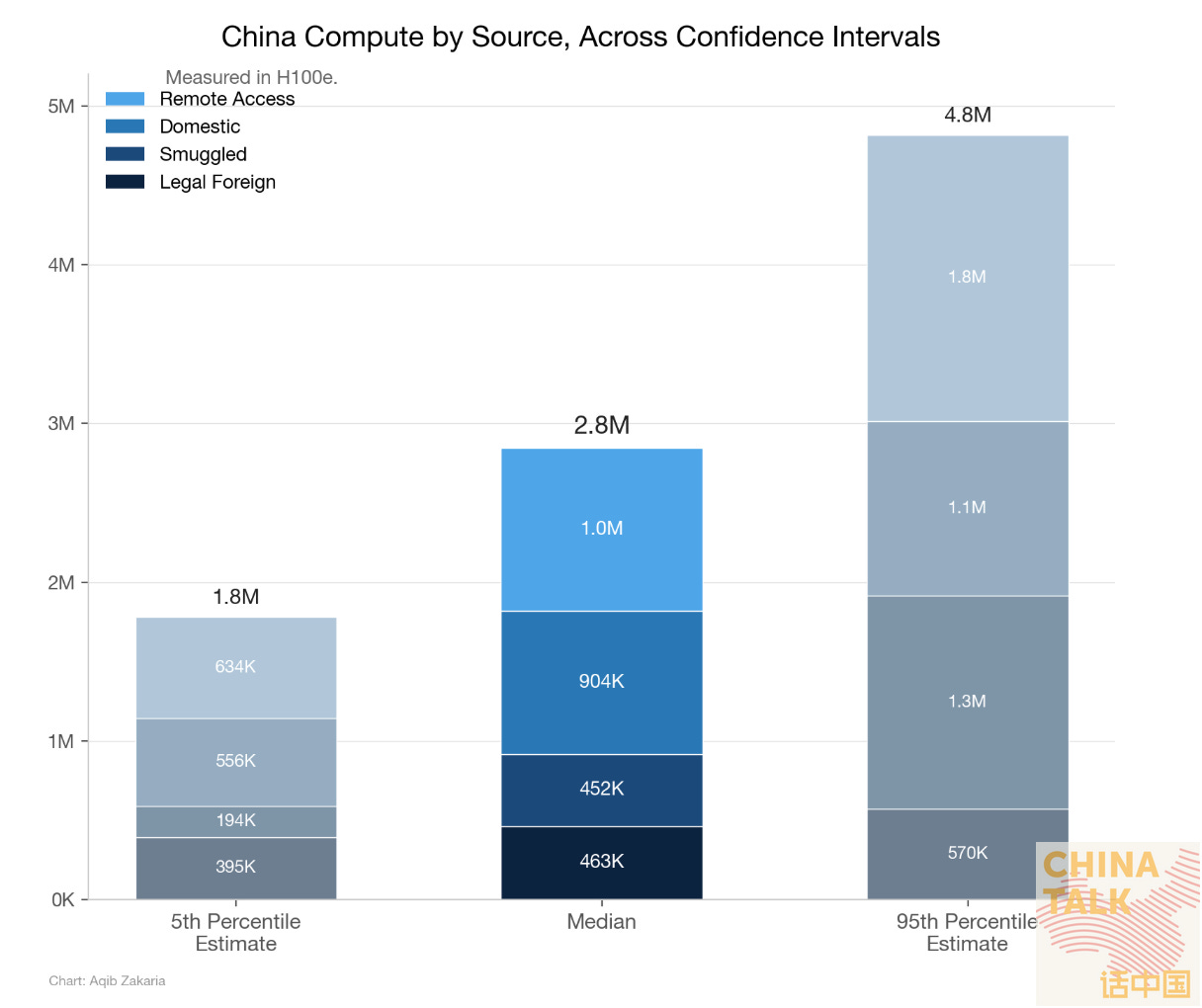
Looking at the chart, about two-fifths of China’s total compute comes from remote access. If that gets cut — or even if they don’t close the America loophole and Chinese firms have to start bidding against everyone else for the most oversubscribed data centers on the planet in the US — we’re talking about a significant hit to the broader Chinese ecosystem for training and inference.
Chris, on Friday’s podcast with Dylan, we were speculating that maybe they’d grandfather existing arrangements, or ratchet things down over three to six months. Instead, this is ostensibly 90 days, after which you can’t serve Chinese clients for anything beyond recommendation engines — telling you what your friends like to buy, offering you mountain bikes, and short-video recommendations.
Let’s stay on that for a second. All these providers now have to find American clients. Are OpenAI and Anthropic salivating at the prospect of getting all this compute in Malaysia on the cheap?
Chris McGuire: They should be. There are big questions about whether the AI ecosystem can absorb this, given how much compute has been flowing to China — illicitly, or through remote access schemes that circumvent the controls by exploiting this loophole. Is there enough demand to absorb it? But keep in mind that every AI company is publicly saying it wants more chips and can’t get them. Andy Jassy is saying that. Elon Musk is saying that. Multiple AI labs contacted me this morning asking who is most affected by this so they can call them and get access to the compute. There’s that much demand.
That’s what makes it all the more perplexing that the US pursued a policy that allowed this compute to flow to China when there’s demand for it here. I’ll say it again: export controls have not negatively impacted a single Nvidia sale so far. Nvidia has sold every chip it has made since the controls went into effect, because demand is so high. That’s good, and it makes this rule more reasonable and effective.
You saw the comments Dylan and others made about wanting to preserve the ability to cut the Chinese off from cloud access. But that’s not where we are. It’s not as if Chinese firms have been accessing compute through AWS or Microsoft, with all the money flowing to American companies and the US holding the lever. They’ve been getting it all through Megaspeed. Megaspeed gives the US government no ability to cut the Chinese off, and it gives us none of the profits. It’s a straight-up shell company China was using to effectively buy chips for itself, legally. However you craft the argument for cloud access, that structure didn’t make sense.
There are big questions about whether we’ll actually be able to ensure Megaspeed doesn’t serve Chinese customers. I’m not sure. It will be really hard to verify. But the regulation says that if it does, that’s illegal, and it will be held to account. At the very least, it’s a strong signal of intent that should create a chilling effect for companies. Going forward, the US government’s expectations are now very clear — with the caveat that we’ll see how it’s enforced.
There’s also a carve-out for recommendation algorithms that looks like the TikTok carve-out. If that’s implemented broadly, it could become a loophole you can drive a Mack truck through. If it’s implemented narrowly, it might be okay.
Jordan Schneider: That brings us back to the question of why Jensen let this happen in the first place — even setting aside the girlfriend angle, since he was doing this before he was with Alice Wong. Was it juicing demand because he wasn’t allowed to sell chips to China directly? Is it his globalist vision that everyone should be on the Nvidia stack? Is he worried about the CUDA moat? The puzzle from the beginning is: if there was enough demand all along, why expose yourself to all of this — to what ended up happening over the past few weeks when the American national security state bit back? Maybe it was a long-term demand play. Maybe the chips weren’t actually wanted. I don’t know. Julian, Chris, what are your best theories for why Jensen pushed this?
Julian Gewirtz: There are several theories, and they’re all mutually compatible. One is a core long-term business theory, as you alluded to: even if the dynamic Chris describes holds today, over the long term you want to serve what is clearly a major AI ecosystem.
But I can’t get out of my head that there’s a strong ideological dimension too — a vision of what an “international technology ecosystem” ought to look like, one in which the world-leading US companies are needed by everybody. For years, I’ve felt that vision is out of step with where Beijing sees the future going. Beijing’s ideal version of this transitional period is one in which it publicly asserts that it’s pursuing self-reliance and making breakthrough after breakthrough on an indigenous tech stack, while in fact getting the benefit of world-leading American technology through third-country remote access, smuggling, and all the other channels Chris has described. That two-track model isn’t designed to last. It’s designed to be something Beijing outgrows as quickly as possible — but they’re not there yet.
Jordan Schneider: Let’s talk about the response function. You can calculate how many months or years of AI lead you’d get from implementing the MATCH Act, closing the remote access loophole, or cracking down on TSMC fabbing chips. But there’s also the looming rare earths issue, plus our dependencies on packaging and optics that we discussed with Dylan on Friday. Julian, how do you think Xi takes this if it doesn’t just disappear in a week — if the US actually sticks to this rule and implements it seriously?
Julian Gewirtz: I’m very interested in Chris’s view too, but my reaction is that a lot turns on a basic question we can’t answer: does Xi Jinping know the numbers you quoted earlier, Jordan, about how reliant Chinese AI companies are on Nvidia chips and on compute from abroad? I can imagine a version of events in which he does, and one in which he doesn’t. This past week’s crazy saga may be one of the first times his lieutenants have had to go to him and say, “Boss, there’s some stuff you need to know. We’re learning about it from the labs,” or “We didn’t realize it was this big.” We don’t know. But if he understands how significantly this could rein in China’s AI progress, that points toward a more escalatory tit-for-tat.
My base case, though, is this: the timing is obviously driven in part by the Megaspeed and Nvidia revelations, but I also think the Trump administration believes it can release this right before Trump goes to China and use the diplomacy to manage the fallout. Beijing’s approach will likely be to explore what it can get — maybe threaten retaliation, maybe negotiate exemptions or a weakening. At a minimum, it will run the playbook it ran last year in response to the Biden administration’s AI diffusion rule: bet on Trump, and bet that it can use the leader-level relationship to loosen the regime.
So as these meetings unfold in Shenzhen, the questions are: How personally bought into this regime is Trump? How much do his advisors constrain what might be his impulse to make deals? How much does political blowback in the US constrain him? If they’re able to hold the line, as I hope they do, there may be a window in which Beijing only slowly realizes how important this policy is — and that could reduce the degree of retaliation we get.
Jordan Schneider: Maybe the right reading of Trump’s comments at the helicopter today is the move he makes when something embarrassing happens and he just pretends it never did: “Oh, that thing? Never heard of it. I don’t know what you’re talking about.” He’ll do the same with Xi.
Julian Gewirtz: Right — he’d have to use that same line with Xi Jinping. One other point: because this is a licensing regime, the executive branch retains a lot of discretion, as Chris said earlier. So Beijing wouldn’t be wrong to conclude that rather than retaliating, it should work to blunt the rule’s impact in implementation.
Chris McGuire: I completely agree that a lot hinges on these conversations — how much we actually stick to this, who in the administration is pushing it, and whether the president is committed. But credit where credit’s due: there was very good messaging from a senior administration official on background, in a publicly reported press call ahead of the China trip. They were asked how talk of closing export control loopholes factored into the trip, and the official said, essentially, “We don’t see these things as connected.”
First, on license requirements for Malaysia and other countries to counter smuggling: the Chinese are telling us they’re not smuggling chips, so why should they care? Second, the Chinese are telling us they’re not massively accessing chips remotely — so again, why should they care? And if they really cared, they wouldn’t be leaving hundreds of thousands of H200s sitting in the port of Hong Kong without letting them in. In other words, the way the Chinese are acting suggests this isn’t something they’re very concerned about, and if they are, they could let those chips through.
Of course, there are lots of disconnects in their system, and part of the reason they’re not letting the H200s through is that they’re trying to get the administration to approve Blackwell chips — which is what they’re getting through these channels. But that was very smart, astute messaging from the administration to tamp this down. They explicitly said, “We don’t negotiate on export controls.” Whether that holds is a separate question, but at least the messaging is right. The question is whether leadership sticks to it at the highest level.
And I want to reiterate: we can applaud all this, but we have to finish the job. Until the loopholes relating to activity in the United States are closed, this won’t really work. I appreciate the effort to crack down on remote access compute, but as long as China can legally access compute in the US, the policy won’t be fully implemented. This is hard, and we’ve done follow-up rules before, so let’s give them some grace to do it in the next month or two. But for this to have an effect, we need to see it right away.
Jordan Schneider: I think Julian’s point — that Xi needs to be the one to harmonize this as a policy — is right, because the Chinese side has been so messy. Will we or won’t we? What do we want? What don’t we want? There are clearly people of many different minds at very senior levels of the Chinese system, which is why we get weird anomalies like those chips stuck in Hong Kong.
Julian Gewirtz: It’s also important to remember that the incentives of Chinese AI model companies and the Chinese government may be quite different. One thing we haven’t understood about the political economy on the Chinese side is how much of this remote access activity is driven by companies while the government looks away, versus directed by the government, versus a fully joint initiative. My hunch is that a large share has been the companies themselves finding compute — in some cases following what they perceive to be the letter of the law, and in others, as DeepSeek founder Liang Wenfeng said on his investor call, getting access to some unlicensed cards. So it’s a mix. And as you say, Jordan, if this is the moment when all of that starts to get rectified on the Chinese side, it could amplify the slowdown in China’s AI progress beyond what the compute restrictions alone would cause.
Jordan Schneider: From the beginning, who have been the political economy darlings in China? Chipmakers and hardware providers. Who are the ugly stepchildren? Software, broadly defined — Tencent, Alibaba, and the new companies that have shown up over the past two or three years. For them to win bureaucratic knife fights… does DeepSeek even have a government affairs person? Probably now, but certainly not a team as sharp as Huawei’s or SMIC’s. Those conflicts and power struggles don’t go away just because model makers are facing a potentially existential threat of having half their compute evaporate. Chris?
Chris McGuire: I want to go back for a second to the question of why Nvidia wanted to sell. A recent Wall Street Journal piece really illustrates it. It described remarks Jensen Huang gave to a group of neocloud CEOs. He told them a story about a soup vendor he found in Japan. The vendor had a really long line of customers. Jensen waited in line and had one of the best bowls of soup of his life. When he asked for another serving, the vendor said no — he had too many customers waiting and not enough soup for all of them. Then Jensen told the cloud CEOs that the soup man is a better businessperson than all of them: he doesn’t sell out his inventory to one or two customers, but keeps his prices high and his customer base diverse.
That’s a very telling story. It explains why Nvidia wanted to sell to all these neoclouds in Asia, and potentially even to China. They’re worried about the concentration of their customer base among a very small number of US hyperscalers and providers. There aren’t many companies that can buy $100 or $200 billion of AI chips a year. Nvidia’s revenues are crazy high, and it makes extremely expensive products that everyone wants, but there are only so many companies it can sell to. If any of them decided to go with AMD, or to make its own chips, Nvidia could face a huge revenue drop-off right away. So it wants a more diverse customer base.
The problem is that, given the scale Nvidia needs to sustain its market cap, the only place those customers exist is China. If you want a more diverse customer base, you basically have to sell to China. The only other option is the Middle East, and the US government has separate security concerns there too. That’s what drives this.
I can see how that’s a rational business decision. But that’s Nvidia’s problem, not America’s. The response shouldn’t be to diversify away from America into China. It should be to make better chips. If you’re worried about US companies switching suppliers or making their own chips, make sure your product is always the best — and Nvidia has been great at that. Nobody has moved away from them because they make the best chips. As long as they stay on top, that’s how capitalism works. If you’re frustrated with the rules of the game, don’t flip the board — just play better.
Jordan Schneider: The analogy I’d use is taxes. You can complain all you want about how high your taxes are, but if you don’t pay them, the government is going to come after you. Jensen is more than welcome to have a deep philosophical disagreement about the future of this technology and who should or shouldn’t be able to use it. But these regulations have been on the books for a very long time. The negligence that has come out over the past week — and that will keep coming out in the weeks and months ahead through discovery, shareholder lawsuits, and congressional investigations — is going to make incredibly clear how little he gave a shit about smuggling.
Chris McGuire: That’s going to be the lasting impact of this whole story. Not the affairs, not the spy stuff — the smuggling question. How much did people know, whether inside Nvidia or inside the Department of Commerce? We have information indicating Commerce knew about this for months. We’ve talked about this before, Jordan, but we have to hit it again: it’s egregious. How can you not act as a company? How can you not act as a government? And how could the government defer to a company it knows isn’t acting? There are a million questions that need answers. We need to figure out how bad the damage was and what happened, to make sure it doesn’t happen again.
Julian Gewirtz: The big-picture question you two were just discussing is what happens when the US government farms out policy areas to companies whose corporate interests differ from the US national interest. That’s a very old story. But in this moment of extraordinary concentration of wealth and power driven by AI, it’s particularly acute. The smuggling story is emblematic because it reminds us that the US government itself has to act to enforce the law. There’s no passive state in which a law, just by existing, gets actively upheld and enforced. In this case, the root of the problem is a degree of coziness between the government and private-sector interests, and I hope that’s seen not just as an Nvidia story but as a broader one.
Jordan Schneider: It was the same with the banks in the 2000s. There are all these emails from Standard Chartered and Wells Fargo saying, essentially, “These laws don’t seem so great; I don’t really care about them.” Sorry — that’s not how this shit works. You want to play with the US dollar? You have to listen to what Treasury says. Over the course of the Bush, Obama, and Biden administrations, the government made it incredibly clear that you can’t fuck with these sanctions laws. That has not been the case over the past five years when it comes to chips and export controls. Here’s hoping this whole discussion really starts to find Jesus on enforcement.
Chris McGuire: It was the huge action against BNP Paribas that actually changed the banks’ minds. You get hit with a $9 billion fine, and all of a sudden you wake up. Meanwhile, we haven’t seen any big fines here. I won’t name names, but there’s evidence of — or at least suspicion of — very significant violations involving numerous companies, and we haven’t seen any fines. DOJ is indicting significant smugglers and naming companies, but companies themselves need to be held accountable. That’s how you build the corporate culture of accountability that Secretary Bessent has been talking about with respect to Nvidia.
Jordan Schneider: Companies and executives.
Chris McGuire: Yes. Every chip company, every chip fabricator, every server company — everyone in this supply chain has to take the rules seriously. It’s the only way this is going to work.
Jordan Schneider: Do you want to talk about Applied Materials for a second, Chris?
Chris McGuire: We’ve seen some of this with the toolmakers. There was an enforcement action fining Applied Materials $500 million for selling banned equipment to China, and I think it even said their CEO was aware of it. That’s significant, but frankly, it’s probably a drop in the bucket compared to their China sales. It’s not on the level of the $9 billion BNP Paribas action, given the national security damage at stake.
I don’t know what people knew, but the amount of smuggling over the last few years runs to tens of billions of dollars. It’s stunning. Here’s one example. There are debates about exactly what happened with Huawei and TSMC, but one way or another, Huawei was able to make 3 million AI chips at TSMC. Three million AI chips — say they sell for $15,000 each — that’s $45 billion worth of product. What’s been the consequence? Nothing so far. The loophole Huawei exploited only got closed today. The Biden administration closed it, the Trump administration reopened it, and it finally got closed again today. It’s crazy.
Julian Gewirtz: If I can make one more point about accountability and why it matters, building on what Chris just said: this isn’t only about export controls and that part of the AI supply chain. It’s also about AI safety over the longer term. You can think of Jensen as a kind of double dove — a dove on China, and also a dove on AI safety, saying the risks are overblown and don’t matter. This culture of impunity, this lack of accountability across the AI sector, obviously matters for AI risk and safety as well.
So as we look for silver linings, if this empowers not just a tougher, more accountable approach to the AI supply chain and smuggling, but also a more serious effort to govern this entire ecosystem — including the safety concerns that were on the front burner a few weeks ago and have receded only because this other story popped up — that could be a very good thing. That’s another area where you need structures to hold accountable the companies at the tip of the spear.
ChinaTalk is a reader-supported publication. If you already subscribe, you can support us by rating our show on your favorite podcast platform.
来源: ChinaTalk · chinatalk.media