13 Videos from CVAI: Igor Babuschkin, Ryan Daniels, Guillermo Rauch & More
13 Videos from CVAI: Igor Babuschkin, Ryan Daniels, Guillermo Rauch & More
During the CVAI conference, industry leaders shared their views on the future of AI. Nikesh Arora emphasized that defending against AI agent attacks requires multi-model collaboration. Guillermo Rauch pointed out that companies are turning to hybrid use of multiple models to reduce costs. Igor Babuschkin called for diversifying AI model concentration risks, with his River AI product allowing companies to build and use their own models.
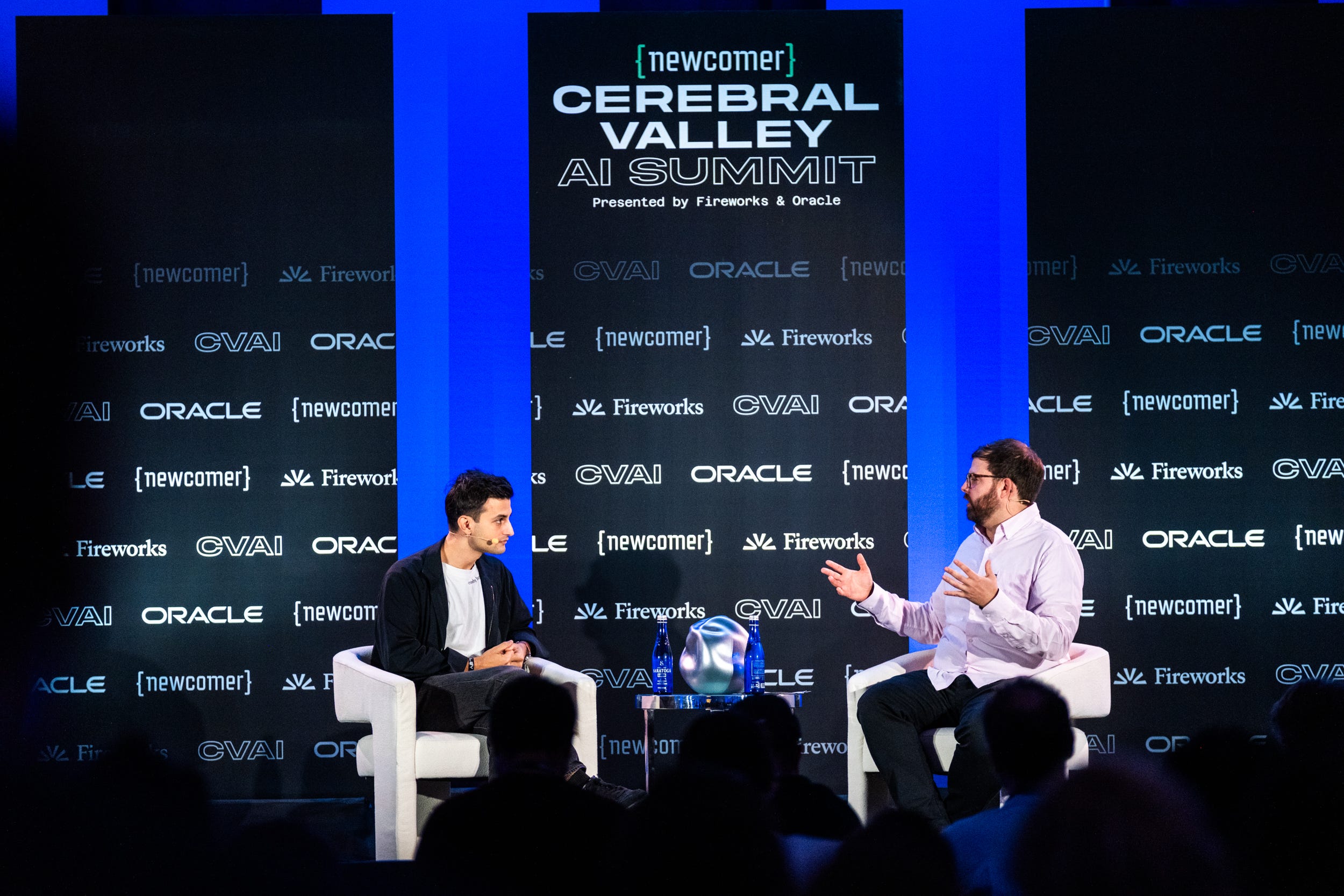
Last week, top founders and investors gathered for the Cerebral Valley AI Summit during one of the most turbulent weeks the industry has seen, marked by global cyberattacks and Jensen Huang’s forced resignation.
Leaders like River AI’s Igor Babuschkin, Vercel’s Guillermo Rauch, Databricks’ Ali Ghodsi, Palo Alto Networks’ Nikesh Arora, Crosby’s Ryan Daniels, Etched’s Robert Wachen, Mercor’s Brendan Foody, Fireworks’ Lin Qiao, and more told us their thoughts about where AI is headed next.
We’re publishing all 13 onstage conversations here in the newsletter and on our Newcomer AI Summits YouTube channel.
Many thanks to our sponsors: Fireworks, Oracle, IREN, Index Ventures, Exa, Nebius, WorkOS, ElevenLabs, Higgsfield, Felicis, SambaNova, BessemerVenturePartners, Weekend, LiquidAI, QuantumBlack, SapphireVentures, OutshiftbyCisco, and OnePay.
Nikesh Arora (Palo Alto Networks)
Palo Alto Networks CEO Nikesh Arora said that defending against AI agent attackers will take many models, not one. The best defense is to train security systems on how data normally moves through a given industry, then tailor them to each customer, one at a time, he said.
Arora wouldn’t say whether he’d take Huang’s spot at Nvidia, as some tech leaders have suggested. He expects Huang’s resignation to cause short-term instability but doesn’t think it will seriously hurt the company.
AI 100 with Byron Deeter & Talia Goldberg (Bessemer Venture Partners)
Bessemer’s Byron Deeter and Talia Goldberg gave a rundown on the AI 100, made in partnership with Newcomer, onstage at the Cerebral Valley AI Summit. The companies on the list are worth a combined $3.6 trillion, 36 times the value of the first Cloud 100 in 2016.
A lot of this value is concentrated in the largest foundation model labs. However, most companies that are customers of the big labs aren’t sticking to a single model type, but are mixing and matching different models for different tasks, Deeter said.
Afterward, Deeter joined Eric Newcomer to discuss why Anthropic ranks ahead of OpenAI, how Databricks and Stripe fit into the AI economy, and why 2027 could bring a wave of AI IPOs.
Hemant Taneja (General Catalyst)
General Catalyst CEO Hemant Taneja said the Nvidia shakeup raises “huge concerns” about continuity in AI leadership, but could also open the door for more chip startups.
Taneja called China a serious risk because of its energy and manufacturing capacity, but said America’s “bottom-up entrepreneurial ecosystem” is still far ahead. To win public support, he argued the industry should talk less about job losses and more about the “abundance” and “agency” AI can bring.
Guillermo Rauch (Vercel)
Vercel CEO Guillermo Rauch said that companies are moving past expensive “token-maxxing” and mixing small, large, fine-tuned, and open-weight models to cut costs.
To stay competitive, businesses will have to give AI agents access to proprietary data, with identity protocols on top so agents can act for users with secure permissions, he said.
Igor Babuschkin (River AI)
xAI co-founder Igor Babuschkin argued that concentrating AI in a few labs is the biggest risk in the industry today. His new company, River AI, wants to give businesses, and eventually individuals, models they can own and improve themselves. Its first product lets companies post-train and run models on their own hardware.
Babuschkin said a world with many moderately capable models handling work like insurance claims and accounting is also safer, because no single company or person could do outsized harm.
Robert Wachen (Etched)
Robert Wachen, co-founder and president of AI chip and rack maker Etched, said Huang’s resignation hit hard at a company that employs more than 100 former Nvidia workers.
Wachen is still optimistic about AI infrastructure and predicted the largest growth in white-collar work in history, driven not by people but by agentic workers. He expects highly capable agents to make chip design less valuable, while physical problems, like integrating chips and interconnects into data center racks, stay hard to solve.
Ryan Daniels (Crosby)
Crosby CEO Ryan Daniels has described his startup as an “agentic law firm”: it has lawyers, liability insurance, and a law firm entity, but it’s the first company he knows of that sells legal AI directly to people who aren’t lawyers.
He considered buying law firms but decided to work on getting rid of the billable hour instead, by hiring lawyers who want to hand their work off to AI agents.
Lin Qiao (Fireworks) & Matan Grinberg (Factory)
Factory CEO Matan Grinberg and Fireworks CEO Lin Qiao discussed open-weight models, security, and AI agents. Grinberg said open models have grown from almost nothing at the start of 2026 to well over 10% of the tokens running through Factory, with some customers using them more than half of the time.
Qiao discussed the security incident Fireworks disclosed recently, describing it as an attack aimed at stealing compute and tokens to resell. Fireworks worked with Palo Alto Networks on forensics and used detection tools from CrowdStrike and Wiz.
Qasar Younis (Applied Intuition)
Applied Intuition founder Qasar Younis told the crowd that America is the most anti-AI country he’s seen so far — a sentiment he attributed to inequality and stagnant wages.
Younis said he’s seeing more demand for his company’s autonomous technology from drone manufacturers than from self-driving carmakers. He’s skeptical of humanoid robots, saying no one has figured out how to make money from them yet and that scale alone won’t solve robotics.
Brendan Foody (Mercor)
Mercor CEO Brendan Foody explained how AI agents have changed who trains the models. Early chatbots relied on large numbers of workers writing clean sentences, but today’s agents need top engineers, lawyers, doctors, and bankers to design evaluations and reinforcement learning environments.
Foody said the market for this work is limited by how many tasks humans can still do better than models.
Asher Spector (Flapping Airplanes)
Flapping Airplanes co-founder Asher Spector explained how he’s running a research lab focused on making AI more efficient. He isn’t worried about frontier labs like OpenAI and Anthropic moving into the same space. He said the lab’s edge isn’t being smarter or working harder, but having different incentives and no innovator’s dilemma.
Spector said the lab works across the stack and focuses most on training. Its framework makes chips both more efficient and more capable. Nvidia is an investor, and the team plans to keep working with the company after Huang’s resignation.
Ali Ghodsi (Databricks)
Databricks CEO Ali Ghodsi said Huang’s exit removes a financial backstop for the AI industry, since Huang was quick to support companies whenever investors hesitated. Ghodsi expects that loss to start hurting many companies, though not right away. He still thinks 2026 is a bad year to go public, but said Databricks won’t stay private forever.
Ghodsi said companies are focused on cutting costs to make AI pay off. Databricks routes more than four quadrillion tokens across OpenAI, Anthropic, Google, and open-source models, and its new router sends simpler requests to cheaper models.
Aravind Srinivas (Perplexity)
Last year, the Cerebral Valley audience voted Perplexity the company they’d most like to short. This year, CEO Aravind Srinivas said those critics were wrong, and that anyone who bets against Perplexity now will lose money again.
His company has shifted to serving mostly enterprise customers who can afford the token costs, he said, and has leaned into becoming more of a harness and infrastructure play than a chatbot.
Source: Newcomer · newcomer.co