Skip to content
Live
Nov 12Thu
Nov 11Wed
Nov 9Mon
  1. Latent Space42

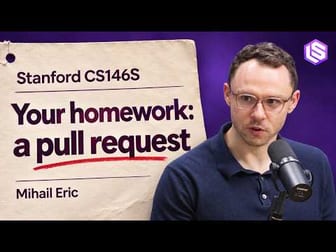
    How Stanford University Teaches AI Native Engineering - Mihail Eric and Monaco's Practice

    Stanford University's CS146S course has changed assignments to contributing to open-source projects, letting students use AI code review tools and learn collaboration; Monaco company adopts Devin code review tool, while building its own Agent workspace to maintain technical autonomy, and develops Hal system, allowing engineers and salespeople to solve problems through Agents.

Nov 3Tue
Oct 30Fri
  1. Latent Space65

    AIE CODE 2026 Highlights: Three Themes Focus on AI Programming Agent Development

    AIE CODE 2026 will explore three themes: redundant-free expansion, system-one model, and raising ambition, focusing on AI programming agent development, attracting 1000 top smart agent engineers globally. The conference will showcase the practical application of the System One model and focus on software rewrite cases from browser to Adobe Photoshop Suite.

Oct 29Thu
  1. AWS Machine Learning Blog58

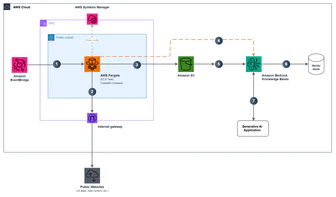
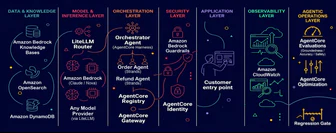
    Build an enterprise-grade agent platform based on Amazon Bedrock AgentCore

    Amazon Bedrock AgentCore provides modular services such as runtime, gateway, identity, memory, policy, registration, and evaluation, supporting large-scale agent construction, deployment, and operation. The enterprise-grade agent platform blueprint based on AgentCore adds enterprise-level constraints such as ownership, account boundaries, software delivery, observability, cost governance, and retirement, achieving controlled access through inference gateway and tool gateway, and including an evaluation process to ensure agents are validated before production deployment.

Oct 28Wed
  1. Pragmatic Engineer

    OpenAI Sevbot and AI SRE are developing a status analysis

    OpenAI is developing the Sevbot AI SRE tool, while ING Bank is building its own AI SRE system. AI SRE primarily investigates incidents through Slack, but there is controversy over whether code should be modified directly. Enterprises generally adopt a multi-agent architecture, combining knowledge graphs with memory layers to improve investigation effectiveness. At the same time, it is necessary to verify accuracy through adversarial agents and multi-model combinations, and optimize model routing and prompts to balance speed and cost.

Oct 23Fri
  1. AWS Machine Learning Blog34

    How Rescale uses Strands Agents and AI-DLC to build intelligent AI routing agents

    Rescale utilizes Strands Agents and the AI-DLC framework to set up intelligent routing agents on AWS in five days and deploy them in production within weeks. The agent classifies end-to-end test failures at night by calling Claude Opus 4.8, retrieves historical failure patterns from the knowledge base, queries MCP logs for runtime evidence, and generates remediation reports containing file references, function names, and recommended fixes for engineers to review.

Oct 22Thu
  1. MarkTechPost55

    Cactus Whistle 16.9 MB Speech Model Performance Evaluation on CPU: Comparison Results with Whisper Base

    The Cactus Whistle speech model transcribes seven languages on the CPU with a 16.9 MB file size and returns word timestamps and probabilities. Tests show it outperforms Whisper Base on its test-other dataset, but there is no significant difference from beam search, with the speed advantage shrinking as audio length increases. Additionally, it tested 30-second window audio processing, streaming latency, timestamps, keyword bias, other languages, noise, embedding, and speech-to-tool calling features.

Oct 21Wed
Oct 20Tue
Oct 17Sat
  1. AWS Machine Learning Blog

    Amazon Bedrock AgentCore: Building Trustworthy AI Agents with a Production-Ready Evaluation Framework

    Amazon Bedrock AgentCore Evaluation Framework helps AWS internal sales team handle business problems with multi-agent systems, identifying differences in agent performance between demonstrations and actual production; through services like Amazon Bedrock Guardrails and Amazon CloudWatch, the framework verifies answer accuracy before release and during ongoing production, tracing errors back to data, prompts, or code, avoiding user trust breakdown due to agents answering confidently yet incorrectly.

Jan 1Thu