Skip to content
Live
  1. The Decoder78

    Claroc claims over 35,000 Grok generative applications can be accessed without login, including patient data and plaintext passwords

    Security company Claroc reported that out of 37,571 Grok-generated applications still online, 35,578 (94.7%) were accessible without login. The leaked content included ICU patient lab values, a list of over 3,500 employees from a hospital group, and 18 sets of plaintext account passwords from a time-tracking application source code; another 24 applications from SpaceXSI and X employees exposed internal sales area maps and advertising proposals.
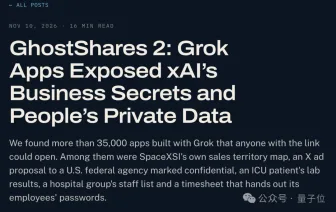
    Why it matters: Security company finds Grok-generated apps default to public, revealing specific cases of corporate internal documents and patient data leakage.


  1. Ars Technica · AI80

    Several measures restricting AI and data centers were passed in the U.S. midterm elections, with the tech industry calling it anti-Trump rather than anti-technology.

    In the U.S. midterm elections, 38 out of 44 measures restricting data centers in 10 states were passed, including multiple moratoriums and bans; Democrat Gina Hinojosa won the Texas gubernatorial election, planning to delay projects until legislation involving water, electricity, air, and property rights is passed.

    Why it matters: The election results and industry statements create a contrast, allowing readers to judge the policy resistance faced by U.S. AI infrastructure expansion.

  1. The Decoder70

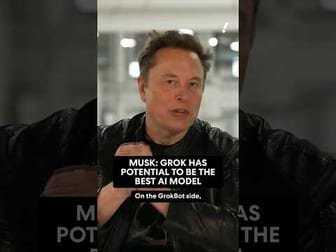
    SpaceX is said to have reduced Grok Bot quotas, Musk claims the running costs are relatively too high compared to revenue

    The Daily Telegraph reports that SpaceX is said to have reduced the usage quotas for Grok Bot, with multiple users finding their quotas halved over the weekend. Musk responded to complaints on X over the weekend, saying the running costs of Grok Bot are too high relative to revenue to be sustainable, but did not directly confirm the cuts. Grok Bot can browse websites, reply to emails, and log into accounts, with its quotas shared with Grok and the coding platform Cursor; less than two weeks ago, Musk called it his fastest-growing product.

    Why it matters: From user quotas being halved to Musk admitting the running costs are too high, this message shows the cost pressure on subscription pricing for agent-like products.

  1. ITHome · AI70

    Elon Musk responds to the rapid consumption of Grok Bot credits: The service cost is too high to sustain.

    On X, Elon Musk responds to user feedback about the rapid consumption of Grok Bot credits, stating that the service cost of the AI agent is too high relative to revenue to be sustainable, and that reducing credits and informing users is a rational approach. Grok Bot was launched in August, offering plans from free to $200 per month, each with a weekly reset limit; last month's financial report revealed it had 800,000 paying weekly active users.

    Why it matters: Elon Musk responds to the rapid consumption of Grok Bot credits, revealing that the cost of the AI agent service exceeds revenue, providing an example of the business model of AI agents.

  1. The Decoder71

    Alibaba and other teams released Co-Design Bench: coding intelligence agents only fully solve 26.4% of real tasks.

    Researchers from Alibaba and several Asian universities used real user change requests to build the coding intelligence agent benchmark Co-Design Bench. Among the ten tested models, the best-performing GPT-6 Astra only meets about 70% of the task requirements, but only 26.4% of the tasks are completely correct.

    Why it matters: A benchmark display composed of real user requests shows that the strongest model can only fully solve about one-quarter of the tasks, and the score difference for the same model in different environments is nearly 20 percentage points.

  1. TechCrunch · AI74

    Study: When forced to choose, Grok 4.7 selected Republicans nine out of ten times, while GPT-6.1 Sol selected Democrats nine out of ten times.

    A study by Convovo posed forced binary choice voting questions to Grok 4.7 and GPT-6.1 Sol via API, finding that Grok recommended Republican candidates in 92% of responses, while GPT recommended Democratic candidates in 97% of responses, with an agreement rate of less than 10% in nearly 500 elections.

    Why it matters: The study used a forced binary choice questioning method via API to compare the recommendation tendencies and source citations of the two models in nearly 500 elections.

You are all caught up