Skip to content
Live
  1. AWS Machine Learning Blog60

    AWS open-sources UAEF: cross-framework closed-loop evaluation AI agents

    AWS releases open-source framework UAEF, using adapters to unify the execution traces of LangGraph, LangChain, Strands Agents, Amazon Bedrock AgentCore, and Langfuse into AgentTrace, then scoring with 7 dimensions and 36 built-in metrics.

    Why it matters: The original text provides an adapter and metric design for cross-framework unified evaluation, allowing readers to judge the implementation method for comparing multi-framework agent versions.

  1. OpenRouter Blog70

    OpenRouter tutorial: How to fix OpenAI and Claude's 429 rate limit error

    OpenRouter published a tutorial explaining how to read the 429 response header and determine the rate limit source based on limit_source, providing three repair methods: retry, model fallback, and vendor failover.

    Why it matters: The author used the same batch of 60 requests to test three 429 handling methods, providing a comparison of time consumption and cost, which can be directly migrated to your own retry logic.

  1. Hacker News · 300+78

    llama-modchip enables the 284B DeepSeek-V4-Flash to run on a 64GB memory without GPU

    llama-modchip releases a set of ggml/llama.cpp core patches and quantization transcoding tools, compressing the 284.33B DeepSeek-V4-Flash to 56.56 GiB (1.71 bpw), which can run on a pure CPU machine with 64 GB memory, with a peak memory of 57.61 GiB under 256K context and no need for swap.

    Why it matters: The project provides a quantization scheme and core patches for running 284B MoE on 64 GB memory, along with measured data for each hardware, which can be used to determine the feasible boundary for pure CPU deployment.

  1. AWS Machine Learning Blog60

    The four-layer context engineering of production-level AI agents: The practice of Deep Insight in runnable code.

    The AWS team, referencing the open-source multi-agent data analysis solution Deep Insight, has broken down the context engineering of production-level AI agents into four layers: multi-agent architecture isolation of context, using prompts to limit output, externalizing heavy content to the file system, and using a validation agent with a fallback mechanism.

    Why it matters: The AWS team has broken down the context engineering into four layers and provided specific code and token-saving data from the open-source reference implementation, which can be directly used to modify your own Agent.

  1. OpenHands Blog71

    OpenHands and Snowflake introduce a workflow for training models using their own Agent harness

    OpenHands partnered with Snowflake AI Research, allowing developers to directly use the existing OpenHands Agent harness for reinforcement learning and training without rebuilding the harness in the training framework.

    Why it matters: The original text provides specific configuration methods and code locations for directly using the existing Agent harness for RL training, allowing readers to judge whether training and deployment can share a single harness.

  1. Google Developers Blog62

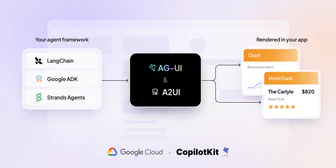
    Build generative UI applications with A2UI and CopilotKit agents

    Google introduces its framework-agnostic open standard A2UI, allowing agents to describe interfaces declaratively in JSON, rendered by applications using existing components, and integrated with the AG-UI protocol of CopilotKit to connect to agent frameworks like LangChain, Google ADK, Mastra, Strands, etc.

    Why it matters: The original text provides complete integration code and bidirectional interaction examples for A2UI and CopilotKit, which can be used to determine the implementation method for generative UIs.

  1. LangChain Blog71

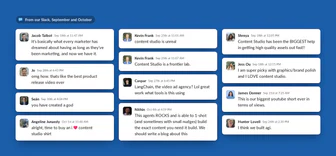
    How to Set Up Design Intelligent Agents with LangChain Content Studio

    LangChain introduces the internal design of its intelligent agent Content Studio, which can generate videos, social media graphics, UI diagrams, and presentations in Slack with a single prompt word, with all materials generated by code.

    Why it matters: LangChain has disclosed the complete setup process of its design agent Content Studio, including skills, wiki, inspection gates, and the division of labor between asynchronous sub-agents, which can serve as a reference for building vertical agents.

  1. vLLM Blog60

    vLLM serves DeepSeek-V4.1-Flash on GB300 NVL72: performance matches DeepInfer and extends to the entire rack

    The vLLM team used P/D separation and Wide-EP to serve DeepSeek-V4.1-Flash on a single NVIDIA GB300 NVL72 rack, achieving 954K tokens/s per GPU and 196 tokens/s for single-user P90 on SemiAnalysis AgentX, which is 7.9 times the early single-node results.

    Why it matters: The vLLM team has released per-item optimization and measured data for serving DeepSeek-V4.1-Flash on GB300 NVL72, which can be compared with DeepSeek's own engine DeepInfer.

  1. vLLM Blog62

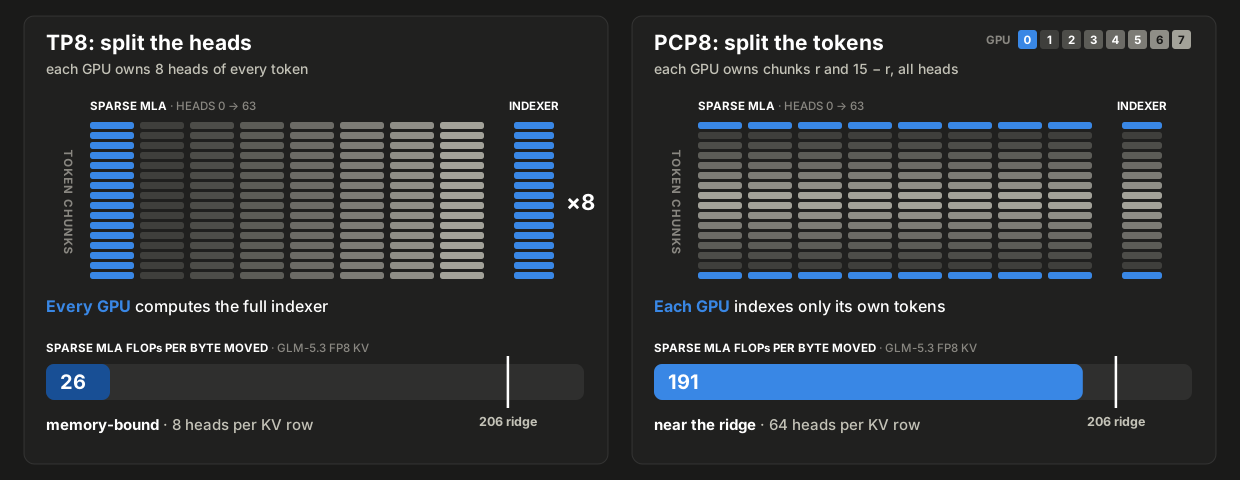
    vLLM provides an in-depth explanation of the optimization of PCP, DCP, and Hybrid HiSparse for GLM-5.3 on 16 H200s

    vLLM team releases the second part of GLM-5.3 optimization, deploying on 16 H200s with 1 pre-filled node and 1 decoding node, using PCP to split pre-fill by token and DCP to split KV cache by token, allowing 1M context to fit into the pre-fill node

    Why it matters: The vLLM team has dissected how PCP, DCP, and Hybrid HiSparse can be combined on 16 H200s, allowing readers to understand the memory and pre-fetch bottlenecks of long-context deployment.

  1. Databricks Blog60

    Databricks Talks AI Billing: How to Reduce the Unit Cost of Coding Agents by 90%

    Databricks executive Patrick reviews the process where the cost of AI coding agents increased exponentially after the company fully adopted them, and then reduced the unit cost by up to 90% by controlling the layer. He mentions that shifting traffic to cheaper new models contributed to more than 50% of the reduction, and Smart Router reduced the average task cost by more than 30% while maintaining near the quality of the most expensive model. This internal solution was later productized as Unity Gateway, which is now used by thousands of customers.

    Why it matters: Databricks executive reviews the process of its own AI coding costs from out of control to reducing the unit cost by 90%, providing migratable practices for gateways, routing, and self-built evaluations.

  1. LangChain Blog71

    How to build paid media agents with LangChain

    LangChain publicly shares its construction method for paid media intelligence agents, which run on Slack, summarize ad platform and warehouse data weekly, and generate reports. Paid media increased from contributing 0 to 20% of the marketing pipeline within 6 months, and the cost per qualified lead decreased by 30% from June to August.

    Why it matters: LangChain publicly shares the complete engineering details of its paid media intelligence agents, including context hierarchy, on-demand tool discovery, and sub-agent isolation, which can serve as a reference for building long-running intelligent agents.

  1. Anthropic Research62

    Anthropic releases Claude Code best practices for intelligent agent coding

    Anthropic releases Claude Code best practices covering CLAUDE.md configuration, tool permission management, MCP access, common workflows, and multi-Claude parallelism. The article suggests exploring and planning with sub-agents before writing code and provides specific processes such as test-driven development, screenshot iteration, and headless mode automation. This article has been moved to the official documentation, and the original blog is no longer maintained.

    Why it matters: Anthropic's official system has organized the configuration, workflows, and multi-instance parallel methods of Claude Code, which can be used as a reference for setting up intelligent agent coding processes.

You are all caught up