Skip to content
Live
  1. QbitAI80

    DeepSeek has opened the entire suite of application APIs, with voice interfaces included for the first time.

    DeepSeek has officially opened the entire suite of application APIs, including online search, deep thinking search, file upload, and link reading features within the app, all providing independent interfaces that can be called separately and billed individually. Voice capabilities have been included in the open list for the first time, including ASR and TTS interfaces. The original price for speech recognition is 0.78 yuan per hour, now half off at 0.39 yuan per hour, and speech synthesis is 1.5 yuan per 10,000 characters.
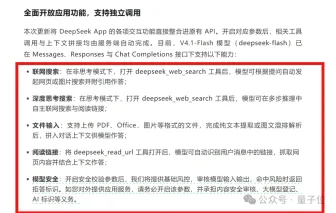
    Why it matters: The original text lists the tool interfaces opened by DeepSeek and the half-price voice pricing, allowing readers to estimate the call costs for voice assistant and document processing applications.


  2. Hacker News · AI hot posts80

    Unemployment Labs reports that the models DeepSeek, Kimi, MiniMax, and Ant have weights with a Blackwell hardware fingerprint.

    Unemployment Labs, by analyzing the random number initialization layout in public model weights, discovered DeepSeek-V4-Flash, DeepSeek-V4-Pro, Kimi K3.

    Why it matters: By reversing the random number layout in the model weights to train the hardware, it provides a reproducible technical evidence path for export control disputes.

  1. Hacker News · 300+78

    llama-modchip enables the 284B DeepSeek-V4-Flash to run on a 64GB memory without GPU

    llama-modchip releases a set of ggml/llama.cpp core patches and quantization transcoding tools, compressing the 284.33B DeepSeek-V4-Flash to 56.56 GiB (1.71 bpw), which can run on a pure CPU machine with 64 GB memory, with a peak memory of 57.61 GiB under 256K context and no need for swap.

    Why it matters: The project provides a quantization scheme and core patches for running 284B MoE on 64 GB memory, along with measured data for each hardware, which can be used to determine the feasible boundary for pure CPU deployment.

  1. vLLM Blog72

    REINFORCE Zero: Aligned kernel allows asynchronous RL to train stably under lag 64.

    NVIDIA Research and Inferact's REINFORCE Zero proposes to first align rollout with training kernel, then use unclipped token-level importance sampling to correct weight lag, achieving a training step throughput 2.40 times that of synchronous training under 16 GPUs and 12K updates.

    Why it matters: The paper breaks down the gap between asynchronous RL's rollout and training into two items: weight lag and kernel inconsistency, and proposes an alignment-free, no-trimming importance sampling method after alignment.

  1. QbitAI78

    DeepSeek has open-sourced the Super-agent architecture, disclosing the underlying concept of Personal Agent.

    DeepSeek has open-sourced the Super-agent prototype, disclosing the dual architecture concept for Personal Agent, where the upper-layer Router handles message reception and task coordination, and the lower-layer Worker executes tasks in parallel.

    Why it matters: DeepSeek has publicly disclosed the dual architecture of Personal Agent and actual test data, showing how multi-session collaboration can bypass human attention bottlenecks.

  1. The Decoder70

    OpenAI competes for Anthropic's major clients with discounts up to 90%

    The Information reports that OpenAI is luring major clients from Anthropic with significant discounts, as Rippling, Replit, and DataCamp are shifting more AI spending to OpenAI

    Why it matters: The specific market shares and discount figures of three clients present the competitive landscape where OpenAI trades prices for market share and Anthropic's growth slows down.

  2. vLLM Blog60

    vLLM serves DeepSeek-V4.1-Flash on GB300 NVL72: performance matches DeepInfer and extends to the entire rack

    The vLLM team used P/D separation and Wide-EP to serve DeepSeek-V4.1-Flash on a single NVIDIA GB300 NVL72 rack, achieving 954K tokens/s per GPU and 196 tokens/s for single-user P90 on SemiAnalysis AgentX, which is 7.9 times the early single-node results.

    Why it matters: The vLLM team has released per-item optimization and measured data for serving DeepSeek-V4.1-Flash on GB300 NVL72, which can be compared with DeepSeek's own engine DeepInfer.

You are all caught up


