19 charts that explain the state of AI
19 charts that explain the state of AI
Anthropic plans to go public this Thursday, with an estimated valuation exceeding $1 trillion, and OpenAI is expected to follow suit next year. In the first three quarters of 2026, capital expenditures of Meta, Amazon, Oracle, Google, and Microsoft reached $230 billion, a year-on-year increase of 118%, far exceeding the full-year 2024 spending. AI revenue annualized growth reached 4.2 times to $345 billion, and Anthropic's revenue annualized rate increased from $9 billion at the beginning of the year to $81 billion in October.
Anthropic is scheduled to go public on Thursday in a transaction that will value the AI giant at more than a trillion dollars. OpenAI is expected to follow suit in the new year. Some people question whether these two companies could possibly be worth so much, but they just had nine of the greatest months of revenue growth in business history.
It won’t be all smooth scaling, however. Earlier this month, Democrats won both houses of Congress in an election where many candidates ran in opposition to data centers. When the new Democratic majorities take power in January, they are expected to put AI regulation near the top of their agenda.
AI is already having a big impact in disciplines like math, physics, and cybersecurity. Many people expect the same forces to reshape other disciplines in the coming months — and this might mean job losses across the economy.
To understand the size of these impacts, it’s helpful to get quantitative. So in this article I’ll present 19 charts that demonstrate the large and growing impact AI is having on the United States and the world.
1. Investment spending keeps rising
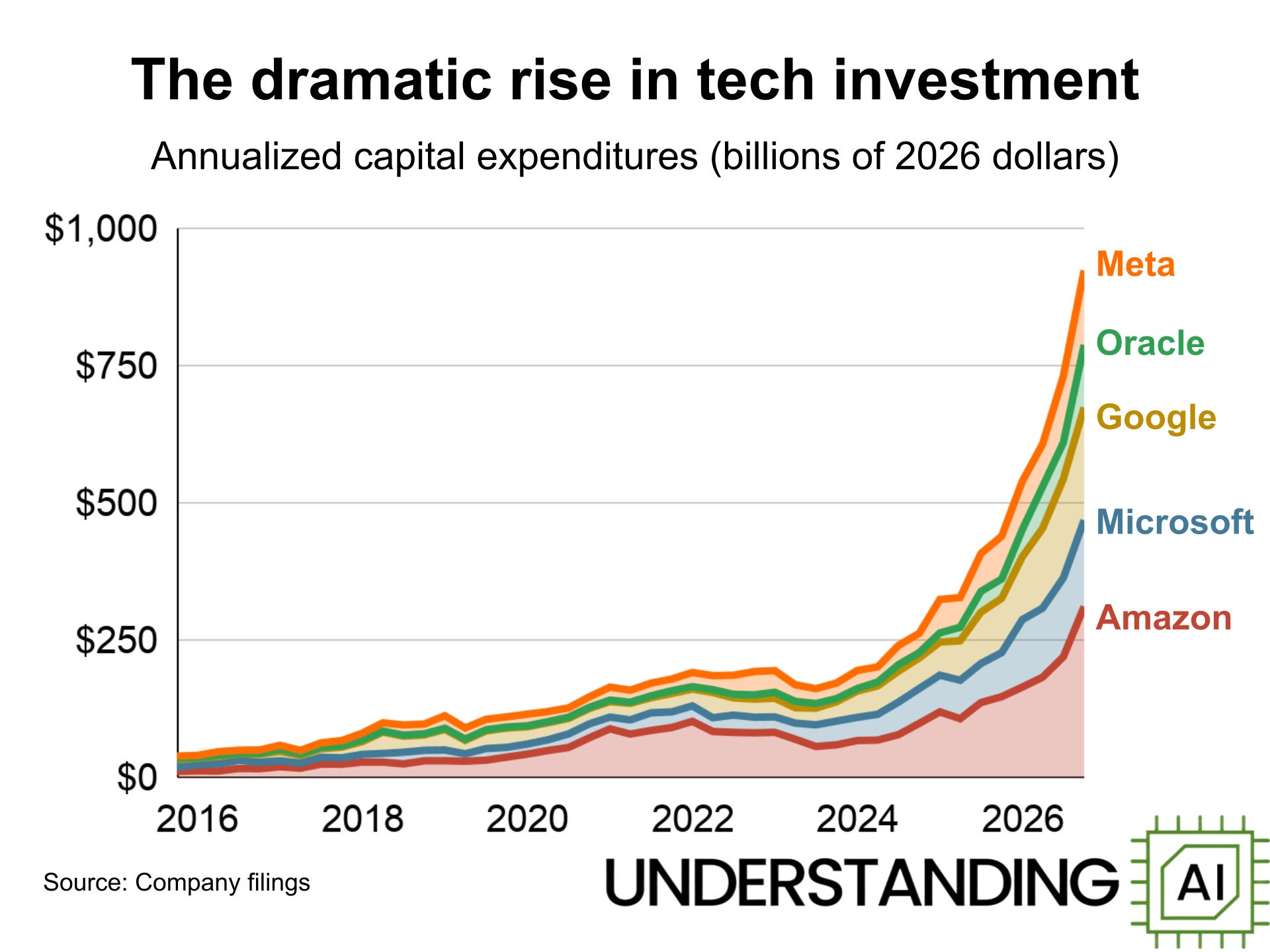
When I wrote our chart article this time last year, I focused on answering the question “is there an AI bubble?” In the fall of 2025 a lot of people thought AI investment spending had become unsustainable.
Since then, the scale of AI investment has only grown. In the third quarter of 2026, Meta, Amazon, Oracle, Google, and Microsoft had $230 billion in capital expenditures. That’s 118% more than they spent in the third quarter of 2025, and almost as much as these companies spent over all of 2024.
Spending will probably continue to grow. In 2027, analysts expect these companies to have well north of $1 trillion on capital expenditures. Yet as we’ll see in later charts, the case for a bubble seems weaker now than it did a year ago — largely because AI revenue growth has more than kept pace with the growth in investment spending.
2. The AI boom is much bigger than the broadband boom
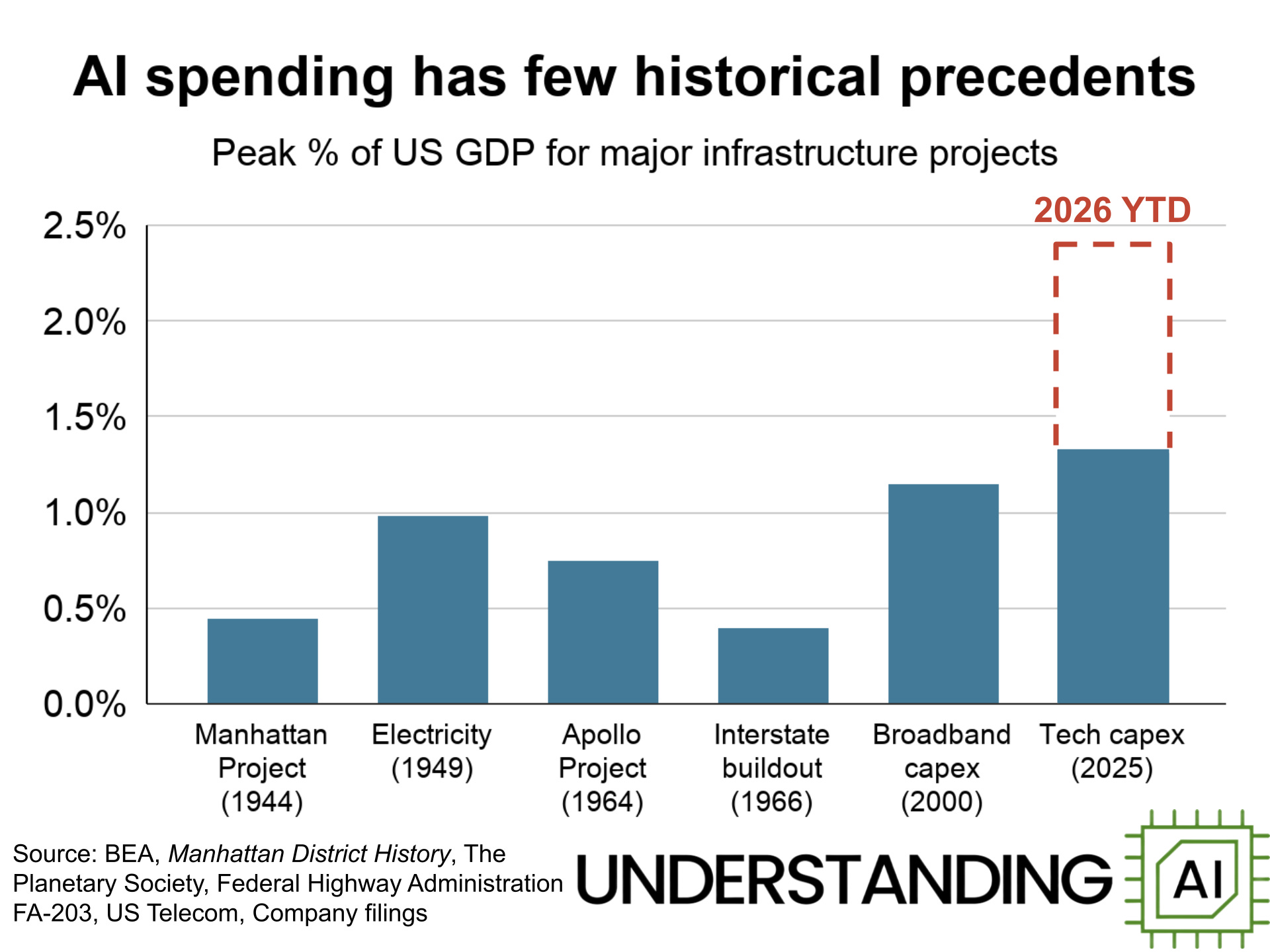
In last year’s article, I noted that those same five tech giants invested 1.28% of United States GDP in the second quarter of last year. That already made it one of the largest investment booms in American history. Since then, the situation has gotten even more extreme. Full-year 2025 investment spending grew to 1.33% of GDP. And over the first nine months of 2026, capital expenditures from the same five companies were 2.3% of GDP.
There is no 20th Century precedent for this level of infrastructure investment in the United States. It’s much bigger than the Manhattan project, the Apollo Project, or the broadband boom that peaked in 2000. Arguably the only time that the US economy has been so concentrated in one type of investment is during the railroad boom after the Civil War.
There is one caveat to this graph: not all of the tech company capex is being spent in the US. But a large majority of it is. According to estimates by the think tank Epoch AI, the share of global AI compute that’s in the US is more than 70% — and it’s growing. Moreover, many other companies besides these five are making AI-related investments in the US. So however you measure it, the US is experiencing a nearly unprecedented investment boom.
3. (Some) hyperscalers suddenly need outside capital
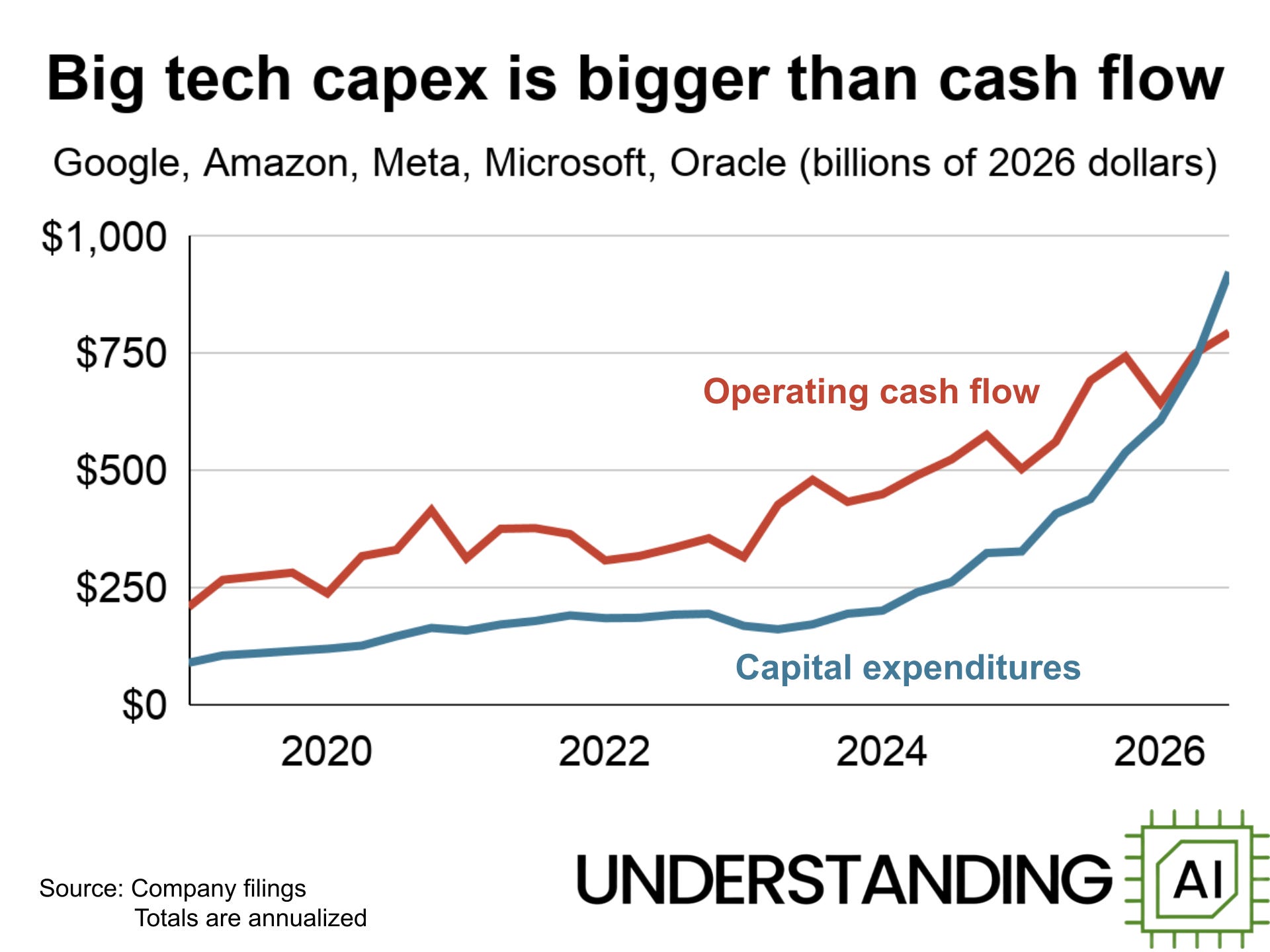
This time last year, a key not-a-bubble argument was that the biggest tech companies had profits large enough to pay for AI investments. So there was no need for them to raise outside capital. That’s no longer true.
Amazon, Google, Meta, and Oracle now all have capital expenditures that exceed cash flow from operations. For Google, this is the first time this has ever happened in the 22 years it has been a public company.
Even Microsoft, which still spends less in capex than it earns from operations, is feeling the financial strain. In late October, it offered buyouts to 60,000 employees — or over a quarter of the workforce. Some speculated that the software giant needed to free up capital to buy more chips.
The other companies have turned to issuing debt and selling equity. Over the course of 2026, AI companies including Google, Meta, and Oracle have sold or priced more than $300 billion in equity, according to The Information.
4. Startup funding is mostly going to AI
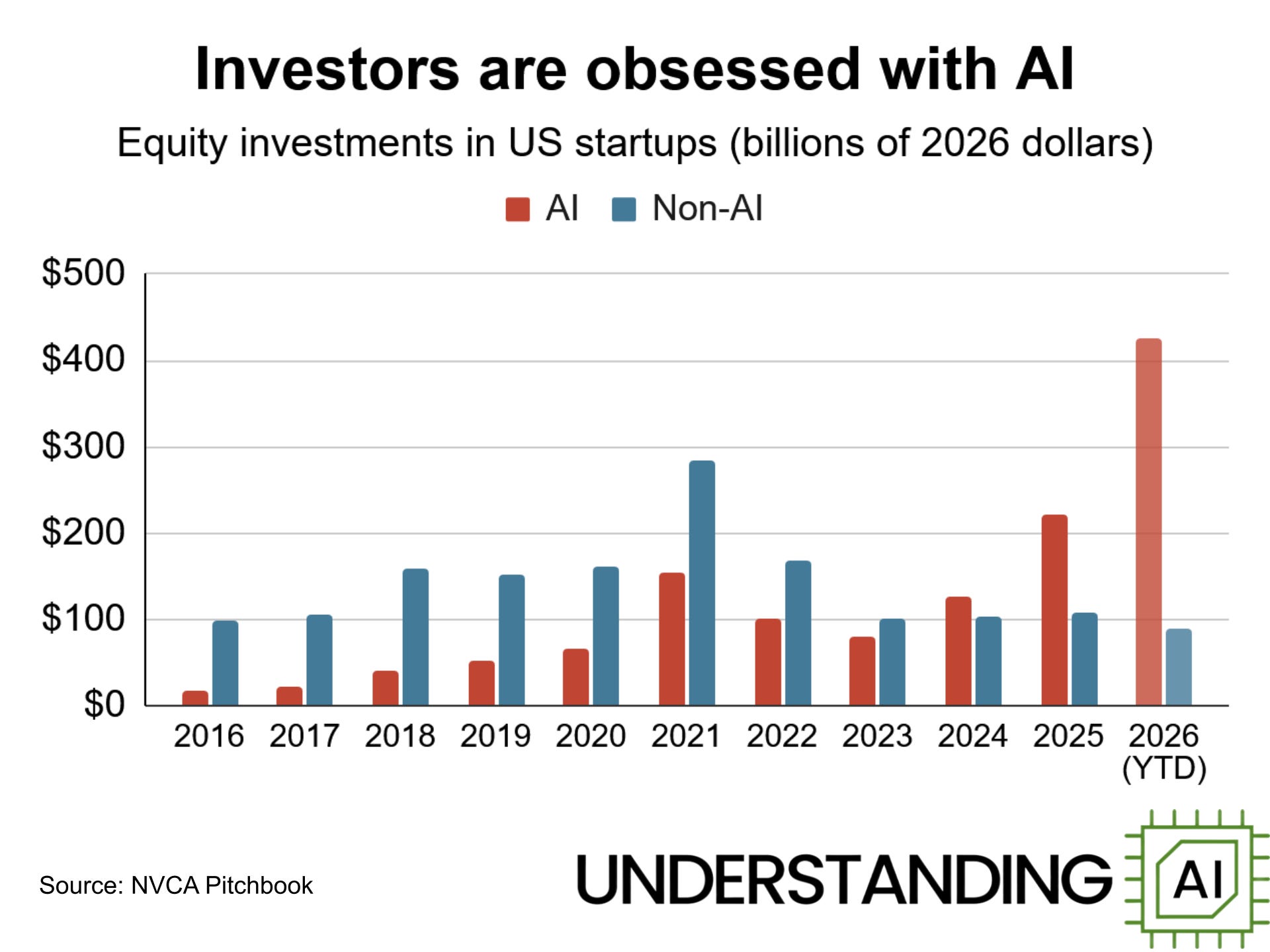
It isn’t just tech companies that are investing heavily in AI: venture capitalists are too. The figures above track the total deal value invested into startups headquartered in the United States. In real terms, the number has grown dramatically for AI startups while stagnating for other startups.
The spike in 2026 is due partly to a small number of huge AI-related fundraising rounds. Anthropic and OpenAI raised $95 billion and $122 billion respectively through the first three quarters of this year. But there are also many smaller companies that have raised money — many have weaker paths to profitability than the large AI companies.
Investor appetite for AI companies may be weakening, however. OpenAI’s most recent fundraising round raised only $11 billion, less than the $30 billion the company was hoping for.
The focus on AI has also led to complaints that it is increasingly difficult for companies not focused on AI to raise money.
5. AI revenues are growing
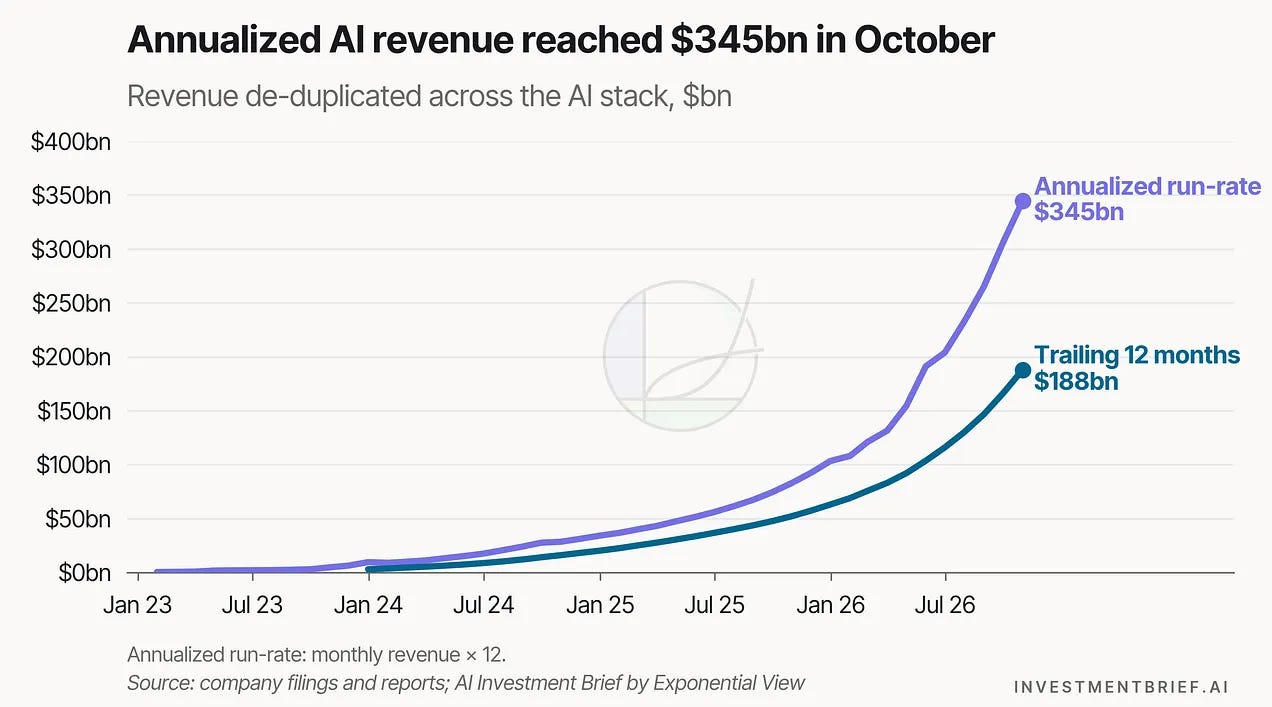
With all this investment, will AI pay off? One indication is that revenues have risen steadily across the entire ecosystem, to an annualized run rate of $345 billion in October 2026, according to Exponential View. This is a 4.2-fold increase year over year.
One of the biggest winners has been Anthropic, which reached an annualized run rate of $81 billion in October 2026, according to the Wall Street Journal, up from just $9 billion at the beginning of the year. That growth seems to have slowed somewhat — the company’s quarter three growth was much slower than in quarter two — but that may be because some customers switched from Anthropic to OpenAI.
If revenue continues to grow at the current pace — or even a little slower — the massive investments we saw in earlier charts are likely to pay off handsomely. Exponential View argued that Anthropic’s revenue only needs to grow about 2% per month through 2030 to cover its costs. Anthropic has dramatically exceeded that pace for several years in a row.
6. Fewer companies are onboarding to AI …
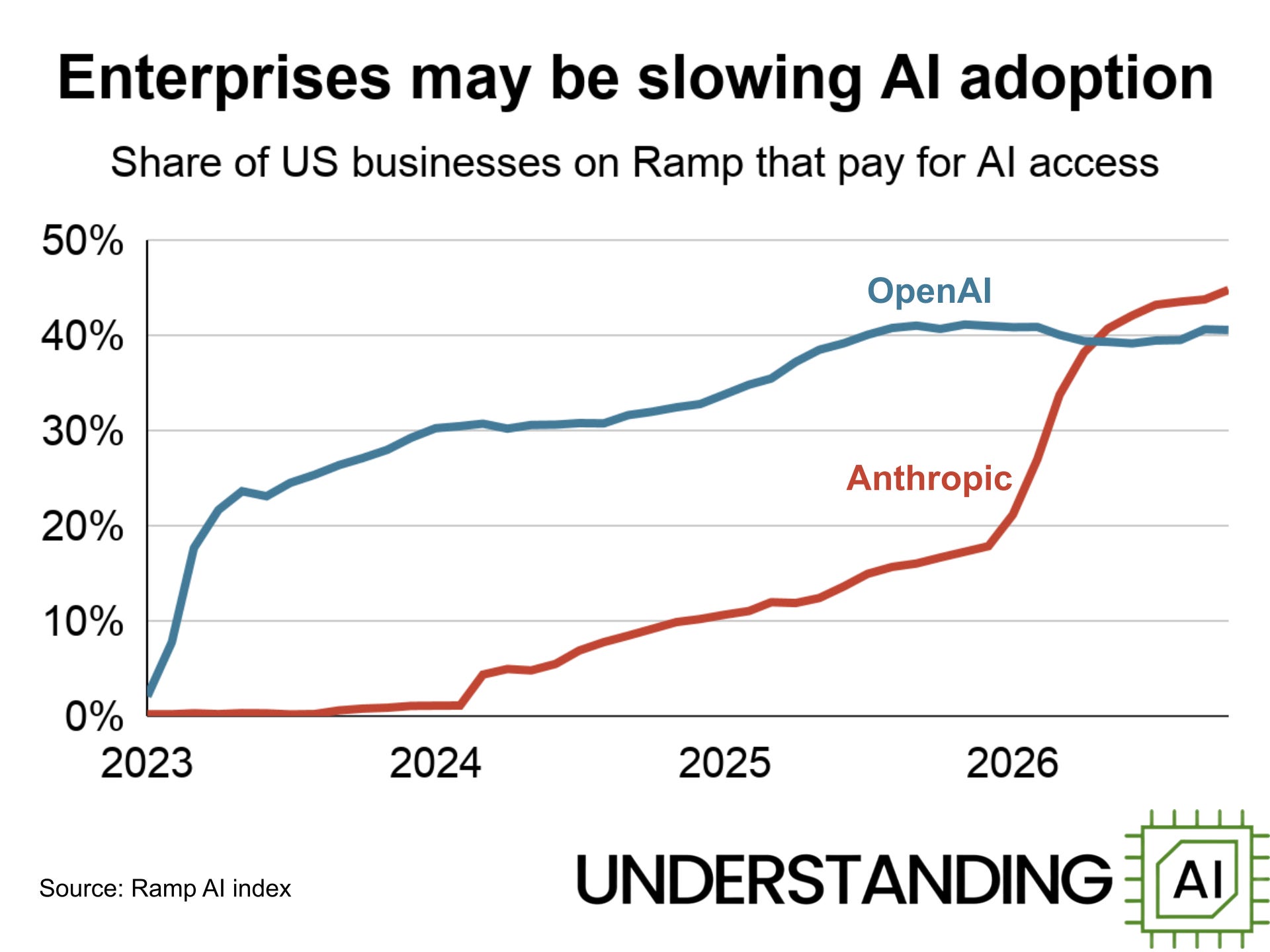
It’s not guaranteed that revenue will continue to grow at such a fast clip. By some metrics, AI adoption seems to be slowing.
The company Ramp, which processes payments, has published the percentage of a sample of 85,000 customers that pay for various AI services — including ones from OpenAI and Anthropic. OpenAI was long the leader in adoption, but Anthropic caught up in the first half of 2026 as Claude Code exploded in popularity. Today, 45% of Ramp’s sample pay for Anthropic services.
Since July, though, Anthropic’s percentage has barely grown, mirroring OpenAI’s plateau since mid-2025.
7. … but they’re spending more
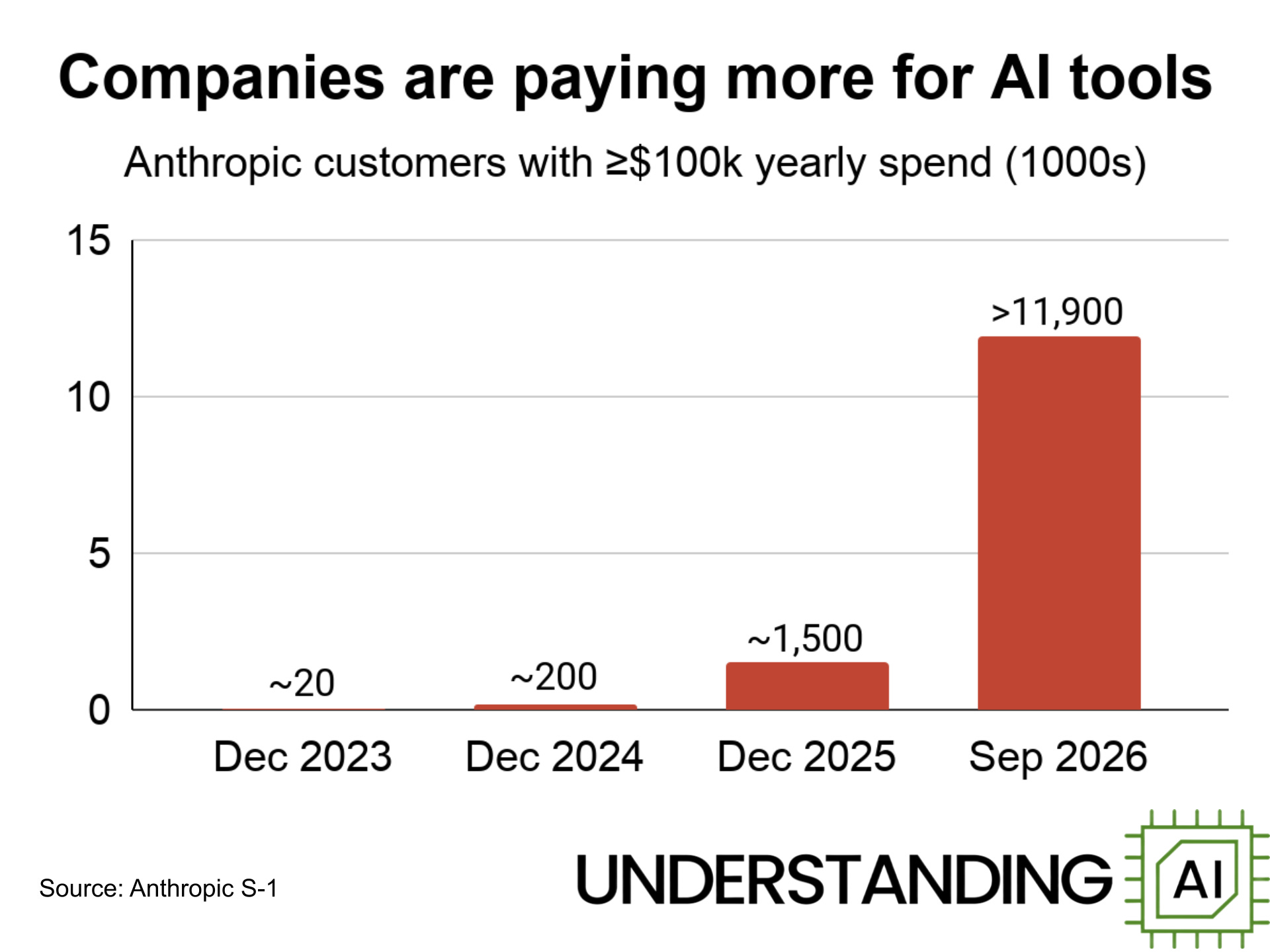
But this doesn’t necessarily mean that the companies’ revenue has stopped growing — even from Ramp’s customers. In its IPO filing, Anthropic notes that in aggregate, customers who spent money with Anthropic in the third quarter of 2025 spent about 10 times as much in the third quarter of 2026. The number of customers who spent at least $100,000 in the preceding twelve months increased eight-fold from the end of 2025 to September 30, 2026.
That was driven by rapid adoption of Claude Code between mid-2025 and mid-2026. To continue that pace of growth, Anthropic may need to release several more Claude-Code-sized innovations in the coming months.
8. ChatGPT has more than a billion users — but most don’t pay
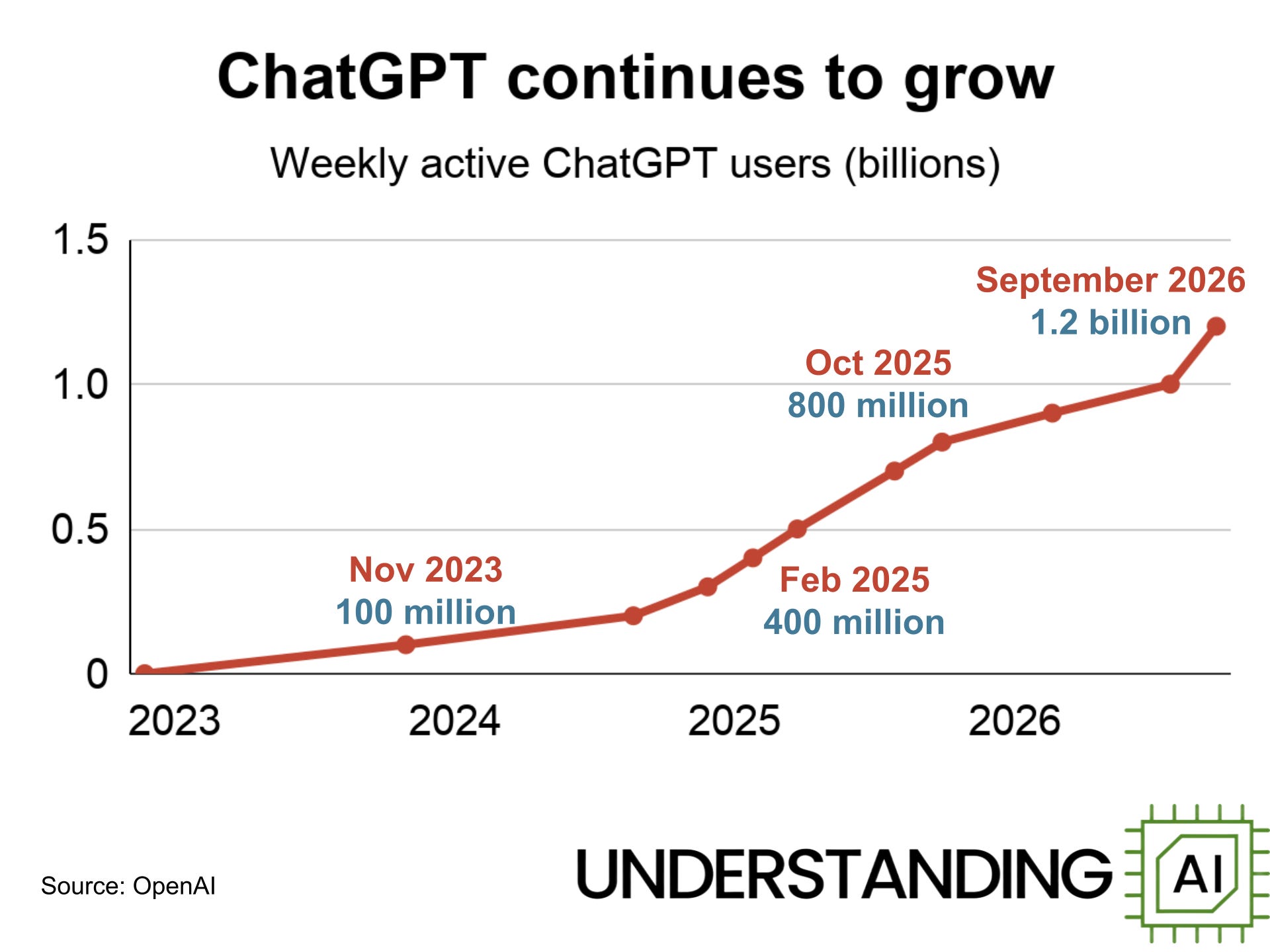
Consumer usage of chatbots continues to grow. In September, OpenAI announced that more than 1.2 billion people use ChatGPT weekly — up about 50% from this time last year. For comparison, Google Gemini and Meta AI each have about one billion users. Anthropic’s Claude is likely much less, though we don’t have exact figures.
Individual chatbot users use comparatively few tokens compared to agents. On July 31, OpenAI announced that Codex accounted for 63.3% of all tokens used by enterprise users — despite only 17.3% of enterprise users using Codex. (For individual users, Codex accounted for 16.5% of tokens despite only being 0.7% of users.)
And ChatGPT supports a large free tier. Around 100 million users pay for a subscription: about 8.5% of all users. So the company has been investigating advertising: it announced in late August that it had reached $1 billion in annual recurring revenue in ad sales.
9. The chips at the center of the AI buildout
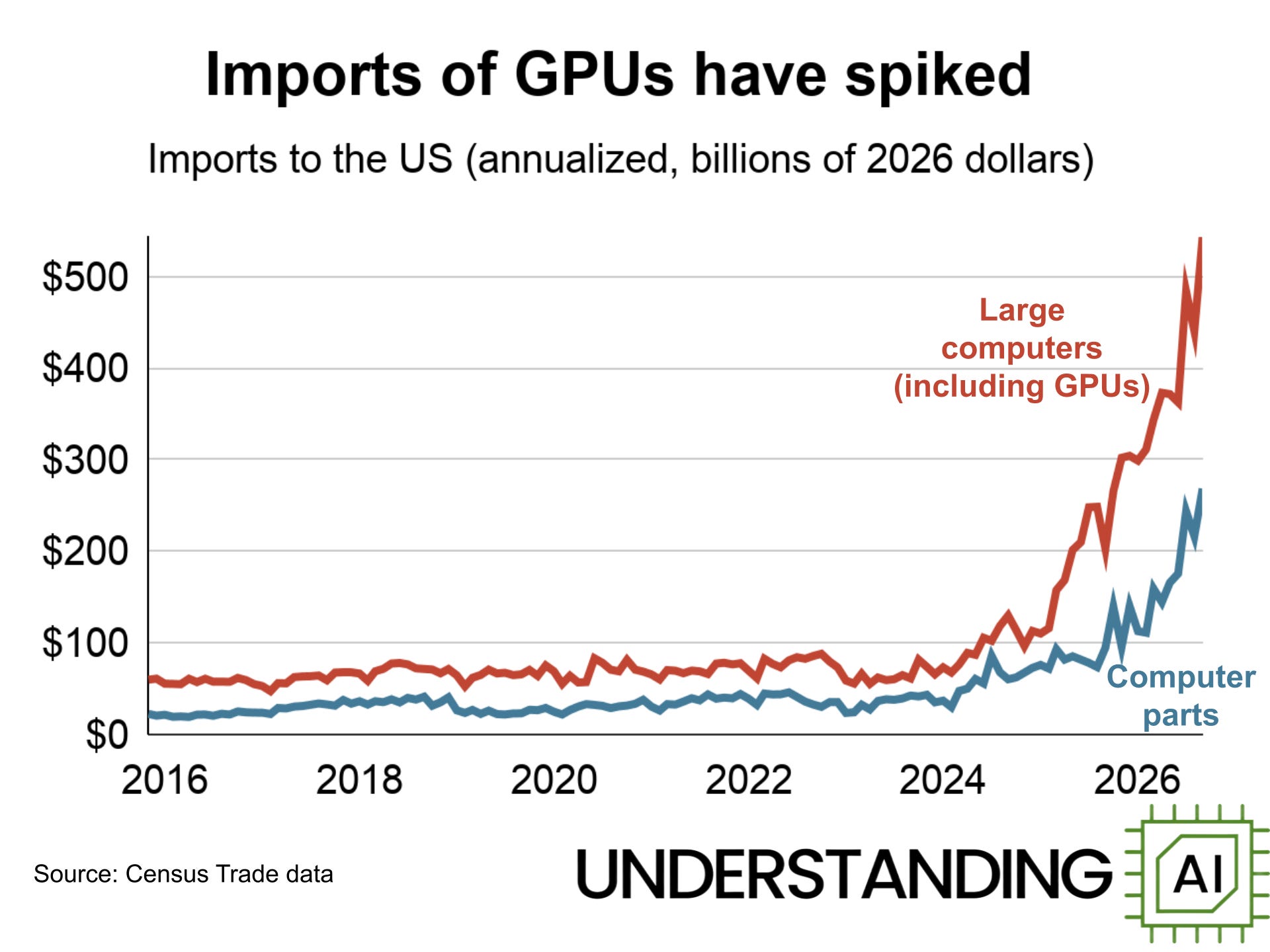
The largest cost for the AI buildout is chips. Basically all of the AI chips that tech companies buy for US use have to be imported first. The most advanced chips are mainly assembled by TSMC in Taiwan.
The chart above is based on trade data from the Census Bureau. This data doesn’t have a specific category corresponding to Nvidia GPUs (or Google’s TPUs), but the red line corresponds to large computers (“automatic data processing machines” minus laptops), a category that includes most GPU and TPU imports. This has spiked to over $500 billion in annualized spending recently — up from $200 billion a year ago. Similarly, imports of computer parts and accessories (HS 8473.30), such as hard drives or power supply units, have more than doubled in the past year.
10. Demand for AI chips is intense
Source: Understanding AI · understandingai.org