The NVIDIA Bubble
The NVIDIA Bubble
NVIDIA's board allowed CEO Huang Renxun to leave without taking retention measures, believed to be because the ongoing investigation by the board has discovered serious illegalities, such as large-scale illegal chip smuggling. Culper Research's report indicates that 20% or more of NVIDIA's sales in fiscal year 2026 (over $43 billion) will come from sales to China.
If you liked this piece, you should subscribe to my premium newsletter, and you can subscribe on the following links: $70 a year, $18 a quarter, or $7 a month.
In return, you get a weekly premium newsletter that dives deep into the finances of the AI bubble. Over the past few months, I’ve published a two part guide to the world of AI debt, an analysis of the (dubious) impact of generative AI on the global economy, deep analyses of the biggest players in the AI infrastructure space like NVIDIA (part one and two) and Oracle (part one and two), and the role private credit is playing in funding AI data centers, and how private equity, reeling from years of successive failed software acquisitions, is doubling down on the AI bubble.
Last week’s piece was a 13,000-word deep dive into Megaspeed — the shady firm at the heart of Jensen’s downfall, which somehow bought billions of GPUs despite being, just a few years ago, an unsuccessful developer of free-to-play mobile games. It’s all very weird, and I spent a lot of time making sense of it all.
On Friday, I’m going to share how we fix the tech industry, and how we stop the next bubble before it even starts.
If you want to get in touch — and especially if you have any juicy information about Anthropic, OpenAI, or any other companies in the AI bubble — hit me up on Signal at ezitron.76. I’m also on IB on your Bloomberg Terminal.
This weekend, thousands of horrible little men cried out for the return of their pervert emperor, demanding that NVIDIA restore disgraced CEO Jensen Huang, who resigned after it leaked that he’d had multiple affairs, one of which (as described in my free newsletter last week) was with a woman called Alice Huang who may or may not have been a Chinese spy, but was most certainly selling restricted AI chips to Chinese companies through a company called Megaspeed (covered in depth in my premium last week).
Within the space of a week, illegal chip sales routed through Alice Huang’s empire went from $4.8 billion to “at least” $7.5 billion, to $12 billion between March 2024 and June 2025 according to the Wall Street Journal.
The Information also reported that companies connected to Alice Huang invested in DeepSeek, the famed Chinese AI lab that spooked the world back in Q1 2025 for, ironically, suggesting that we didn’t need to buy as many NVIDIA GPUs.
Let’s be clear about something: Jensen Huang resigned and is not coming back. To paraphrase Semafor’s Rohan Goswami, NVIDIA’s board was packed with allies, deliberated at length about what to do (and didn’t really want to do it), and has both let him walk and done nothing to retain him, I’d personally guess because the probe the board is running already has some idea of wrongdoing such as, I dunno, the giant illegal smuggling ring that has been covered at length by basically every media outlet. NVIDIA has also said it was not considering bringing him back.
Even now, a week into this bizarre crisis, few are truly reconciling with the allegations raised in May 2026 by Culper Research’s short report, namely that 20% or more ($43bn+) of NVIDIA’s FY 2026 sales came from selling through China. Even two profiles of Culper in the New York Times and Wall Street Journal fail to substantively discuss the material of the guy they’re god damn profiling.
That’s because, to paraphrase Culper’s own work, Megaspeed is just the tip of the iceberg. As I covered last week, Culper directly connects Megaspeed to popular AI server manufacturer Supermicro, whose co-founder and board member Wally Liaw was arrested with several co-conspirators back in March for trying to sell over $2.5 billion in chips to a Chinese passthrough entity Culper believes is a Megaspeed affiliate. Liaw had previously resigned in 2018 due to an accounting scandal (per short seller Hindenburg), only to be rehired in 2021 as a consultant and reinstated to the board in 2023.
Let me spell it out for you: a co-founder and member of the board of one of the largest manufacturers of AI servers was arrested for selling chips to China, specifically to a company affiliated with the very same smuggling operation that Alice Huang ran.
Supermicro is a huge, publicly-listed company with a history of accounting scandals. 70% or more of its revenues come from selling AI servers powered by NVIDIA GPUs, and back in August 2024 — months into Megaspeed’s $12 billion purchases of eventually-smuggled GPUs — Supermicro was NVIDIA’s third-largest customer, around that it was facing allegations of accounting manipulation and sanction evasion by Hindenburg that never went anywhere because our markets are broken and our SEC is trash.
Anyway, my point is that this story is just getting started, and that those in the Copium dens are trying to reframe this as a “guy who made a mistake” rather than a philanderer that appears to have overseen the GPU equivalent of Iran Contra. Whatever rumors you may have read about a potential Jensen comeback appear to be peddled by the most desperate of AI boosters who, based on reports on CNBC, do not appear to be aligned with what Huang himself has said.
And really, why do they want Jensen back so bad?
It’s simple: Jensen Huang’s value has nothing to do with GPUs or AI, and everything to do with keeping the AI bubble inflated.
Perhaps it’s more appropriate to call it the NVIDIA Bubble, because without it, the AI industry doesn’t really make much sense.
As I’ll make clear later in this piece, NVIDIA played an active role in keeping the wheels of the AI bubble turning — funding model labs, buying startups, and backstopping compute for Neoclouds, thereby allowing them to raise debt. Its interventions didn’t merely sustain the industry-wide spending spree, but amplified it. In the process, NVIDIA transformed the AI bubble to something that attached itself to the personal wealth of ordinary people — often without them realizing it.
As the stock prices of NVIDIA (and the rest of the Magnificent Seven) became engorged on AI-related hysteria, the exposure of ordinary (and unwitting) savers to the AI bubble grew. Investors who followed the mantra of “don’t buy individual stocks, just buy index funds” ended up in a position where, due to the top-heavy nature of the S&P 500, and the predominance of mega-cap tech stocks, a significant chunk of their wealth is gambled on the question of whether AI is a bubble or not. And that’s without mentioning other factors — like how insurers and pension funds are exposed to the AI bubble (and, in particular, the AI infrastructure buildout), either directly or indirectly through their investments in private credit.
Or, put succinctly, if NVIDIA sneezes, the retirement savings and personal investments of ordinary retail investors will catch a cold. And if NVIDIA catches the flu, we’ll see the wealth of retail investors contract the fiscal equivalent of pneumonic plague — the type that Soviet scientists cooked up in a Siberian lab during the Cold War, and that gives Annie Jacobsen nightmares.
Despite many saying “NVIDIA isn’t NVIDIA without Jensen,” in truth it’s still selling the same chips, has the same fab space and supplier agreements, and outside of his horrible personality (and cult of personality) seems virtually identical.
Back in August, NVIDIA said that it expected 70% year-over-year growth in Fiscal Year 2028 (starting February 2027), which suggests — unless something has materially changed! — that NVIDIA had clear expectations and agreements to hit those targets. CEO Colette Kress should, if you believe everything that’s been said over the last few years about “insatiable demand,” have absolutely no problem selling just as many GPUs at just as fast a rate…
…unless, of course, there’s another reason that “NVIDIA isn’t NVIDIA without Jensen.”
The truth is that what people actually mean is that “NVIDIA isn’t NVIDIA without Jensen using its balance sheet to grow at a high pace involving constant, quasi-legal-to-illegal dealmaking involving channel stuffing and illegal smuggling.”
The Wall Street Journal reports that Jensen Huang had told his finance team (in August, the very same month it raised guidance) that the company was facing a glut of GPUs and had over-ordered capacity at TSMC and with memory manufacturers, necessitating further circular financing:
When Nvidia used its creditworthy balance sheet to help OpenAI sign a massive data center lease in Piketon, Ohio, with SoftBank’s SB Energy, it cut the scale of its commitment in August during negotiations. Kress had become skeptical of the scale of the deal.
Huang told his finance team in August that the company was under pressure, The Wall Street Journal previously reported. Major cloud providers were making plans to use alternative chips and lessen their reliance on the firm, and Nvidia was staring at a glut of chip wafers and memory it had committed to buying, he told them.
The then-CEO pressed staff to develop a way to decide whether guarantees were worthwhile. Later that month, it paused some deals in that initiative, the Journal reported.
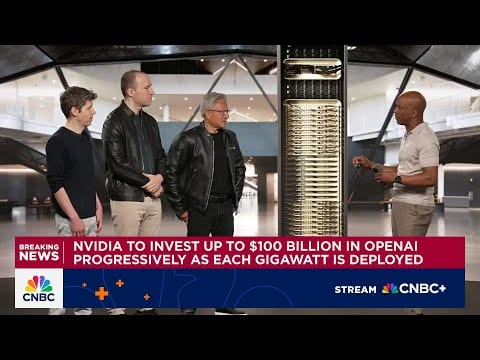
I dunno man, I’m no securities lawyer, but I feel like worrying that you have an oversupply of chips and then telling investors that you actually expect to sell more chips than ever feels like some sort of stock manipulation, and it wouldn’t be the first time NVIDIA’s done it in the last year. Back in September 2025, it announced it would invest $100 billion in OpenAI to build 10GW of data center capacity, with Jensen Huang saying live on CNBC that there had “never been an engineering project of this complexity and this scale ever,” referring to a deal that he would dismiss as “never a commitment” five months later, because it was only ever a “letter of intent.”
The truth is that Jensen Huang lied. You can dress it up in terms of “memoranda of understanding” or “letters of intent” not actually meaning “a contract has been signed,” but Jensen Huang went on CNBC and did everything he could to convince you that NVIDIA was investing $100 billion in OpenAI to build 10GW of data centers, much like he went on CNBC a few months ago to convince you that (and I quote the headline) “NVIDIA [had lined] up $500 billion in financing” despite these being A) memoranda of understanding and B) no money ever changing hands or being raised by anybody to do anything and, to quote Bloomberg, said $500 billion figure having “no obvious provenance.”
There is no other way to interpret this other than intentional manipulation of the markets perpetuated by the mainstream business and technology press, all because nobody would ever push back on Jensen Huang.
And that’s because everybody knows, deep down, that we’re all living in an NVIDIA Bubble — a financial mania manufactured, maintained and sustained using NVIDIA’s credit rating and cash to brute-force the markets and the media into believing in anything.
How Jensen Huang Created A One-Man Financial Mania Using NVIDIA’s Balance Sheet
My name is Jen-Hsun Huang, and for the last thirty-three years, I thought I was the one and only CEO of NVIDIA. I bought an Israeli networking company, sold some GPUs, got my buddy Satya to build a cluster, I saved the stock market, I made some circular deals — never invest in a former cryptocurrency miner — I tried to sell some GPUs to the Chinese, I helped out some of my buddies, all to keep the AI bubble alive…
While the AI bubble is relatively young, the NVIDIA bubble has been inflating for over a decade.
I don’t even mean that derisively! Jensen Huang and NVIDIA were formative to the entire AI bubble, both in creating the infrastructure, demand, and even the underlying research that eventually led to the LLM boom.
Way back in August 2016, Jensen Huang delivered “the world’s first AI supercomputer” — the DGX-1 — to a small AI lab called OpenAI that had recently raised money from yCombinator’s Sam Altman and Tesla/SpaceX’s Elon Musk. Three months later, OpenAI announced it was moving to Microsoft Azure, training on NVIDIA Pascal GPUs in the earliest days of AI compute.
A few years later, NVIDIA found itself in flux, with a beat on earnings in February 2019 clouded by a decline in both hyperscale and cloud sales, but Jensen Huang was already working on an acquisition that would change everything, agreeing to buy Israeli high-speed networking firm Mellanox that March for $6.9 billion in cash, outbidding both Microsoft (which was already using its tech at Azure) and Intel for the InfiniBand technology that would eventually allow NVIDIA to network together clusters of AI servers.
Four months later in July 2019, Microsoft would invest a billion dollars into OpenAI “...to build “new Azure AI supercomputing technologies.” Four months later in November 2019, NVIDIA and Microsoft would announce that Azure would now offer a “a new kind of GPU-accelerated supercomputer in the cloud on Microsoft Azure,” networking together up to 800 NVIDIA V100 GPUs using Mellanox’s InfiniBand tech, and the first time I can find where you could rent out massive clusters of AI GPUs. Microsoft and NVIDIA engineers even trained their own conversational AI model called BERT.
The deal itself wouldn’t close until April 2020, and a month later in May, Microsoft and OpenAI would announce that they had built a 10,000 GPU “supercomputer” together, with sources telling The Register that it was likely made up of AMD CPUs and NVIDIA V100 GPUs.
The same month, NVIDIA would release its A100 GPUs, which remain somewhat of a workhorse for AI Compute, and were a huge commercial success. Another significant milestone came two months later in July 2020, when NVIDIA would publish a blog about how OpenAI researchers had released a paper describing how they’d trained GPT-3 using its Volta-era V100 GPUs (released in 2017).
In August 2020, NVIDIA’s data center revenue would outpace its gaming revenue for the first time in the company’s history, “aided largely by the Mellanox acquisition” per Holger Mueller of Constellation Research.
In other words, Jensen Huang and NVIDIA were far more foundational to the AI bubble than Sam Altman or Elon Musk, quite literally buying and building the company and the infrastructure necessary to build large language models.
While June 2017’s Attention Is All You Need paper absolutely kicked off the transformer-based model boom, NVIDIA and Baidu’s late 2017 research into mixed precision training that allowed model developers to use nearly half as much memory during training without losing accuracy, and also train faster on NVIDIA’s newer chips, a technique that became the standard in the early days of LLMs, shouldn’t be overlooked.
In August 2021, OpenAI would launch Triton, a Python-esque coding language specifically built to make it easy to write code that ran on GPUs that would become foundational to the entire AI boom. Three months later, Microsoft announced that OpenAI’s GPT-3 was now available on an invite-only basis to customers via its new Azure OpenAI Service.
Then came 2022 — a rough year for everybody, per my second Hater’s Guide To NVIDIA:
Microsoft’s FY2023 revenues only grew 6.9% year-over-year. NVIDIA’s FY2023 (which ran February 2022 to January 2023) was effectively flat, sitting at 0.2% as the post-pandemic surge of demand for gaming GPUs and networking gear puttered out, with Q4 2023 revenues dropping by 21% year-over-year.
Meta, Google, and Amazon, all of which have fiscal years that align with the calendar year, saw growth deteriorate:
* Google went from 41.6% year-over-year growth in 2021 to 10.3% and 9.7% in 2022 and 2023.
* Meta went from 37.2% year-over-year growth in 2021 to negative 1.1% in 2022 and 15.7% in 2023.
* Amazon went from 37.6% year-over-year growth in 2020, to 21.7% in 2021, to 9.4% in 2022, to 1.8% in 2023 (and has really never recovered.)
NVIDIA’s Q3 FY23 (November 2022) earnings were rough, missing on analyst expectations, though not as rough as Q2 FY23, when it had to pre-announce that it had missed on guidance by a little under $2 billion.
While NVIDIA had started shipping its H100 GPUs with data center sales eclipsing its gaming revenue by about $2.2 billion, it had yet to fill the hole caused by the post-pandemic dropoff of PC and graphics card sales or, more aptly, the hole left by the collapse of cryptocurrency mining.
And then a mere two weeks later, Sam Altman announced the launch of ChatGPT, creating the greatest sense of FOMO in the tech industry’s history. Per the New York Times, “...the entire agenda of [Google] had changed” as a result of ChatGPT, and Satya Nadella was “gleefully” ordering billions of dollars of NVIDIA GPUs.
By March 2023, every major hyperscaler was now offering NVIDIA H100 chips, and a month later in April 2023, NVIDIA would invest in the Series B round of CoreWeave, a former Ethereum miner backed by Magnetar Capital, which was famous for backing dodgy CDOs during the Great Financial Crisis.
Somewhere in early 2023, CoreWeave got a new customer — NVIDIA itself, according to The Information. This deal was part of a wider strategy dubbed “Project Osprey,” wherein NVIDIA would spend $1.3 billion over four years to rent back its own GPUs for whatever reason, making it the second largest customer behind Microsoft, who was renting capacity for OpenAI.
That Microsoft deal would eventually lead to the creation, per The Information, of the first GPU-backed financing led by private equity firm Blackstone, emphasis mine:
The investment was part of a $2.3 billion financing for data center developer CoreWeave, which had signed a lease with Microsoft. Before Blackstone advanced the money, a team of executives from its tactical opportunities team, including Khaira, flew out to the Santa Clara, Calif., headquarters of Nvidia, whose chips go into CoreWeave facilities, according to a person with direct knowledge of the diligence. Over several weeks, the team studied GPUs and other parts of the business.
Then as now, a big question was whether the chips would have a useful life once the initial Microsoft lease ended. In the end, Blackstone executives avoided the issue altogether by basing their investment decision on Microsoft’s creditworthiness and the terms of its lease payments. They looked at CoreWeave’s contract with the tech giant and thought it offered greater protection to a potential lender than similar deals they’d seen, the person said.
This deal would, as The Information notes, become the template for basically all data center financing, rationalizing the notion of lending unprofitable, debt-filled neoclouds like CoreWeave billions of dollars to build data centers as long as some sort of other counterparty agreed to rent capacity in the future. And when lenders needed further justification — by which I mean proof of cashflows — they’d happily tick the box because NVIDIA had agreed to pay its customers to rent back the GPUs that all that debt was being raised to buy.
In September 2023, Bernstein analyst and alleged professional Stacy Rasgon attacked “Twitter randos” for suggesting, and I quote, that it was a conspiracy theory to believe the following:
Since Nvidia is an investor in Coreweave, Rasgon said “internet innuendo has effectively implied Nvidia used this to stuff the channel (pointing to it as driving their data-center beat in the quarter) as well as accusing Nvidia of other nefarious intents given their investment in Coreweave.”
“Nvidia did not need help from Coreweave (or anyone) to juice the quarter (their products are all on allocation), and the debt facility was announced Aug. 3 (after the quarter was completed) with the release suggesting deployment has likely not happened yet."
Rasgon noted that Nvidia not only invests in Coreweave but other AI startups like Hugging Face Inc., Activ Surgical Inc., AI21 Labs Ltd., Skydio Inc., and Superluminal Medicines Inc.
Three years later, Rasgon has now downgraded NVIDIA, and worries about the following:
For the AI supply chain, “we wonder what will happen to the company’s myriad of investments in the space, various backstops and residual guarantees,” Rasgon said.
Stacy was, of course, talking about Jack Gamble (AKA JG_Nuke) who had repeatedly critiqued CoreWeave as a pump and dump inflated by NVIDIA in its earliest days in 2023.
I mention this because I believe analysts and the mainstream media have been critical to inflating the NVIDIA Bubble, and in laundering the reputations and rationalizing the inherent lunacy of the AI bubble. As long as NVIDIA “beat and raised” — as in beat analyst expectations and raised guidance — everybody was happy and looked away from the many, many things wrong with this picture.
And 2023 was the year that NVIDIA’s circular financing took off, with the company investing in Cohere, Synthesia, Runway, Hugging Face (which it would eventually acquire), Perplexity, Together (an inference company that also buys GPUs), and Mistral.
At this point, NVIDIA’s bubble had begun to inflate, with a landgrab to invest in anything AI related and to buy as many GPUs as possible, per me in Part 2 of my Hater’s Guide To NVIDIA:
ChatGPT immediately gave executives AI psychosis. In January 2023, Microsoft would invest another $10 billion, and a few weeks later, Google would sign a partnership with early-stage AI firm Anthropic (founded by former OpenAI executives) to use its TPUs and GPUs as its “preferred cloud provider,” only for Amazon to barge in and invest $4 billion a few months later in September 2023, making AWS “Anthropic’s primary cloud provider,” which forced Google to invest up to $2 billion in October 2023. By the third quarter of 2023, NVIDIA would be selling half a million H100 GPUs, primarily to Microsoft, Amazon, Google and Meta, which had just farted out its own open source ChatGPT “competitor,” Llama.
NVIDIA was saved. Q1 FY24 (May 2023) revenues blew estimates out of the water, and by Q2 FY24 (August 2023), data center demand caused revenues to jump 170% year-over-year. Microsoft, ever helpful to its good friend and collaborator, would sign a multi-billion dollar deal with CoreWeave to rent capacity in June 2023, allowing it to raise $2.3 billion in debt a few months later, taking advantage of the “ChatGPT moment” that was when “things got real” to quote CTO Brian Venturo.
By the end of FY24, NVIDIA’s revenue had jumped 125.9% year-over-year. Everybody went AI crazy. The media would fall over itself claiming that AI could do basically anything, and justify one of the largest expenditures in history. This was partially helped by a media-driven hype campaign around the availability of GPUs, which was mostly caused by NVIDIA being the only vendor and selling the vast majority of them to hyperscalers who were yet to really show any return on their investment.
What was missing, of course, were revenues. But none of that mattered!
In 2023, Microsoft, Google, Apple and NVIDIA added trillions in market capitalization, with the media actively encouraging them to spend more money on capex. It didn’t matter that Microsoft missed on cloud revenues in Q4 FY2025, much like how Amazon’s Q3 2024 earnings — which specifically missed expectations for cloud, the only place that Amazon was making any money from AI — caused its stock to pop because overall revenues were higher than expected.
A captured media ecosystem and a brainless market credited AI with basically any related revenue growth for anybody who bought NVIDIA GPUs.
Jensen Huang Created Artificial Scarcity Through Circular Financing, Illegal Smuggling and Channel Stuffing
Behind the scenes, Jensen was doing everything he could to keep growth going, making sure CoreWeave was able to raise more than $10 billion in debt from a handful of very specific bankers that he’d conned into believing the idea that building endless AI data centers would create infinite cash.
By February 2024, the sudden influx of demand led to Jensen ruefully discussing the “fairest” way to decide who gets its GPUs, and a month later he’d announce Blackwell, the next-generation NVIDIA GPUs that cost tens of thousands of dollars more depending on the configuration, specialist cooling and entirely new racks, massively increasing the cost of data centers and, in turn, increasing NVIDIA’s revenues.
In June 2024, Jensen would claim that “the more you buy, the more you save” under what he called “CEO Math,” but I would call “complete bullshit”, per Business Insider:
Huang explained the concept by describing why companies should invest in both graphics processing units (GPUs) and central processing units (CPUs). The two processors can work autonomously, reducing the time it takes to carry out a task from "100 units of time down to 1," he said.
So, the more you buy, the more you save. Sounds like a good sales pitch for a CEO who sells processors.
That, by the way, is about as much “skepticism” as you’ll find in this era, and why the bubble was allowed to inflate. At no point can I find any substantive conversation about the actual benefits of buying NVIDIA GPUs, or any of the financial returns, or really anything other than…well…fluff.
You see, everybody loved the AI bubble. Liking AI allowed you to talk about something new and exciting, and nobody would argue with you if you said you thought it was going to make everybody a bazillion dollars. They would, however, attack you viciously if you dared to suggest anything was wrong — something they still do to this day! — because, as Jensen realized, AI had become load-bearing for the entire stock market, even though the only people making money on AI were NVIDIA and other semiconductor companies.
And somewhere between 2023 and 2024, Jensen met Alice Huang (no relation), and between March 2024 and June 2025, per the Wall Street Journal, Megaspeed would buy “nearly $12 billion worth of top-of-the-line NVIDIA chips” and send them to Chinese firms, including Blackwell chips that it claimed had demand that was “well above supply” in August 2024 and by October 2024 was “sold out for the next 12 months,” partially as a result of Jensen Huang creating that demand via CoreWeave and in his dealings with Megaspeed.
In 2024 alone, NVIDIA would invest in data center firm Applied Digital (CoreWeave’s landlord), as well as neocloud Nebius and Stargate Abilene data center builder Crusoe. In 2025, it would anchor CoreWeave’s IPO (which couldn’t have proceeded without NVIDIA’s help), agree to pay neocloud Lambda $1.3 billion over four years to rent back its GPUs, invested twice in British neocloud Nscale, invested in Crusoe again, and extended its deal with CoreWeave to pay it $6.3 billion.
In August 2025, CFO Colette Kress would sing the praises of “extraordinary” and “soaring global demand,” and in October 2025, Jensen would claim (and Reuters would report) that there were “$500 billion in bookings for its AI chips.” What did that mean? Who knows. Nobody asked. Nobody dared harsh the flow. Would NVIDIA make $500 billion in that period? No.
Huang would claim in NVIDIA’s Q3 Fiscal Year 2026 earnings (November 2025) that “compute demand keeps accelerating and compounding across training and inference — each growing exponentially.”
All of this was part of the kabuki theater of NVIDIA — claims that there was “astonishing demand” for AI GPUs at a time when it was doing everything it could to inflate that demand by funding companies explicitly to raise debt and buy GPUs.
The first sign of desperation began in September 2025, when Jensen Huang would go on CNBC and announce that non-existent deal with OpenAI. Per the Wall Street Journal, talks never progressed past their earliest stages. This did not stop anyone from reporting the deal as done for literally months — its intention was entirely to create the imaginary sense of “demand” that would mean you have to do whatever Jensen needs to get his GPUs.
And, of course, to continue fooling the media into believing that there was “incredible demand for AI.”
In a December 2025 piece, TIME would mention that Jensen Huang was “unhappy,” because NVIDIA “had to publicly declare that its China revenue had shrunk to $0,” leading to him lobbying the Trump administration to change chip export rules that NVIDIA was at the time vigorously violating.
Sidenote: Throughout this whole period, the vast majority of NVIDIA’s revenues — 50% to 60% — came from hyperscalers, with the rest coming from its neoclouds. Chinese smuggling, and its increasingly marginalized gaming business. Yet if you suggested that there was anything other than massive, diverse, and ever-growing demand for NVIDIA GPUs, you’d be outright attacked, your allegiances questioned, tarred and feathered as a “hater” or “skeptic,” at times from supposed journalists.
It’s a disgrace to society, and everybody involved should be ashamed of themselves.
By the end of 2025, NVIDIA had also agreed to around $27 billion worth of cloud compute agreements in total — literally agreeing to rent back its GPUs from its customers — and as of its last earnings report, these agreements had grown to a remarkable $36 billion.
Not once during these three years did we ever learn what revenues Microsoft, Google, Amazon, or Meta made from renting out NVIDIA GPUs, but we didn’t need to, because the media was all too happy to claim that Microsoft and Google’s bets on AI had paid off as early as 2024. It didn’t matter that OpenAI or Anthropic lost billions, it didn’t matter that CoreWeave was a time bomb, it didn’t matter that NVIDIA was literally paying its customers to buy its GPUs, it didn’t matter that NVIDIA was effectively stepping in whenever anyone had any doubts about the AI bubble, as long as hyperscalers — and most importantly NVIDIA — kept beating on estimates and raising guidance.
Even though, as I’ve mentioned, the actual revenues from AI are nowhere to be seen. Thanks to Bloomberg, we eventually found out that Microsoft’s Fiscal Year 2026 AI revenues were around $34 billion, with $24.1 billion coming from OpenAI, meaning that $265 billion in capital expenditures since 2022 (at the time) had bought Microsoft a single-digit AI business outside of feeding itself money by investing in OpenAI.
As we can see in hindsight, it’s clear that there never was “insatiable demand” for AI chips outside of Jensen Huang’s pressure tactics, some of which involved claiming there was “limited availability” of chips that he himself made sure were in limited supply, mostly by making sure that NVIDIA-incubated customers bought them using either NVIDIA’s investment or debt raised using that investment, like when NVIDIA put in at least a billion dollars into an SPV that raised money for Elon Musk to buy NVIDIA GPUs in January 2026.
And the most-damning proof we’ve had of there being no real “demand shortage” is that NVIDIA has been forcing customers like Amazon to take billions of dollars of GPUs months in advance of when they’d need them as part of an “early rack receipt program,” with Business Insider revealing one crucial piece of information:
Usually, Amazon doesn't pay for racks until the gear is put into a data center, leaving suppliers to carry the cost of the equipment in transit, according to the internal documents obtained by Business Insider. This helps the company conserve cash.
However, the intensity of the AI data center building boom has made this type of coordination harder. Amazon has to compete more for scarce resources as it jockeys with rivals for access to Nvidia GPUs and other AI components.
In other words, Jensen Huang said that if you don’t buy the chips now — even though you have “no clear forecasted path” to install them — you won’t get them when you “need” them. As I’ve said recently, based on analyses of earnings statements and documents viewed by this publication, I believe there are over $200 billion worth of NVIDIA GPUs that are sitting in warehouses waiting to be installed as a result of artificial demand pressures created by Jensen Huang and NVIDIA.
This is how NVIDIA has beaten expectations and raised guidance basically every fucking quarter for the past two years — circular financing, illegal chip smuggling and channel-stuffing.
The most important rule of living in the NVIDIA Bubble was that everybody kept in line, saying there was always more demand for GPUs, always more demand for AI, and that everybody was making lots of money…even though none of that was actually true.
Back in August, I used analyst notes to prove that the vast majority of AI demand — 70%+ of revenue and 80%+ of compute demand — was from Anthropic and OpenAI buying compute, and the sheer power of the NVIDIA Bubble was such that people simply ignored it because it was uncomfortable to think about.
Last week, Sam Altman said the quiet part out loud at a Samsung conference, emphasis mine:
Altman cited the bubble controversy surrounding "neoclouds"—emerging cloud companies that rent out infrastructure specialized for AI computing such as GPUs—and said there had been "double counting of demand." He added, "Only two places, OpenAI and Anthropic, are actually driving large-scale demand growth, so a supply shock and a period of instability could come." A look at actual AI infrastructure investment announcements shows many cases in which the same project is counted multiple times across different tallies, which is seen as the structure his bubble critique was aimed at.
Nobody Can Inflate The NVIDIA Bubble Without Its Balance Sheet — And NVIDIA Might Have Been Tapped Out Anyway
One particularly-childish view that I’ve heard is that if NVIDIA falters, AMD or Broadcom could potentially “pick up the slack” and “capture the demand,” as if said demand was not entirely a result of Huang’s dealmaking and his aggressive use of NVIDIA’s balance sheet.
Your open source model company fails to close a financing round? NVIDIA will pay $6 billion to “license” its tech and take some of its employees. A shitty AI search company that nevertheless buys hundreds of millions of dollars’ worth of compute starts running out of money? No problem, NVIDIA’s got billions to make sure Perplexity keeps chugging. CoreWeave’s landlords get worried about it not making its lease payments? No problem, NVIDIA has backstopped the leases. Anthropic needs another $10 billion to make prepayments on its compute? No problem, NVIDIA is kicking $10 billion into its IPO.
There’re also very few other companies out there like NVIDIA, which had twelve-month trailing free cash flows of $127 billion through its latest quarter, second only to Apple, which had $136 billion.
As of its latest quarter, NVIDIA also had about $99.4 billion in total liquidity — more than AMD ($15.8 billion) and Broadcom ($24 billion) combined, with better credit (AA versus A and A- respectively), lower net debt, and an interest coverage ratio (IE: how many times it could pay its interest expenses with its operating income) of 435x compared to Broadcom’s 17x and AMD’s 65x. Additionally, NVIDIA has significantly more capacity booked with TSMC and the memory cartel, largely as a result of being able to afford it and justify it with upcoming revenues, even if said revenues were artificially inflated with circular deals.
In other words, NVIDIA has more cash, better credit, a better balance sheet, and spent three fucking years building hype, FOMO and funding its own customers so that by 2025 there were entire companies that existed functionally to either buy or rent NVIDIA GPUs.
This is a plan that took years — or a decade, depending on how you think about it — to execute, and its collapse was inevitable, because it’s clear that despite his bravado and confidence, Jensen Huang was desperate and would do literally anything to keep the beat-and-raise machine alive.
The Chinese smuggling was and is one of the single-most brazen acts I’ve seen in the history of capitalism — a flagrant, well-documented campaign of export control violations perpetuated at times in broad daylight, ignored by much of the press, to this day referred to by some as a “conspiracy theory” despite GamersNexus’ smuggling report from August 2025, the New York Times reporting in October 2025, Bloomberg’s reporting in December 2025, Wally Liaw of Supermicro’s arrest in March 2026, and Culper’s massive short report in May 2026 proving in vast detail that NVIDIA is absolutely involved in illegal smuggling of GPUs to China.
Yet the most-damning part of all of this is how willing everybody was to ignore the circular financing, and no, I’m afraid that all the grab-bag articles saying “wow, NVIDIA sure has invested in a lot of its partners!” don’t count.
The media rubber-stamped every single circular deal throughout the AI bubble because there were hundreds of millions or billions of dollars attached — even if they weren’t real! — from NVIDIA or one of NVIDIA’s customers, all without any consideration or discussion of how unstable it was or, more importantly, how NVIDIA was inflating its revenues by creating these circular relationships.
NVIDIA’s Load-Bearing “Central Bank of AI” Is Closed After Accounting For 27% Of Global Venture Capital Funding In 2026
While the cries to restore Jensen Huang have fallen on deaf ears, even if he were to return, it’s clear that the circular financing era was coming to an end regardless of who was wearing the leather jacket.
And it’s important to measure how incredibly large a loss that is.
In addition to its extensive backstopping, the chip maker also made a string of equity investments in AI startups. In total, Nvidia has participated in a record 129 venture-capital deals this year, as of Nov. 10, accounting for 27% of global VC deal value, according to PitchBook, up from a total of 49 such deals in 2023.
That means 27% of all venture capital funding in 2026 flowed from NVIDIA, and those that didn’t lock down their funding are incredibly worried, including Nscale, which, per the FT, needs more money to complete its massive contract with Anthropic:
“As a result of these new purchase orders, our short-term forecast capital expenditure commitments have increased significantly,” the company said in SEC filings. “Accordingly, we will be required to obtain additional financing to meet our forecast obligations in 2027.”
Bloomberg also reports that NVIDIA invested $2 billion in Nscale in September — a billion more than we knew — but apparently said billions weren’t sufficient, and it’s unclear what’ll happen next, much like it’s unclear what happened to NVIDIA’s supposed offer to buy Reflection AI, per the WSJ, or its investment in Thinking Machines:
Nvidia recently made an offer to Reflection AI, an open-source model developer valued at $25 billion, to license its technology and hire away some of its talent, according to people familiar with the matter. Huang had publicly praised the company. An agreement hadn’t been reached before he left, the people said.
Nvidia has also been finalizing a massive investment in Thinking Machines Lab, another provider of open-source models, valuing the company at $40 billion, according to people familiar with the matter. Thinking Machines is confident the deal will be completed, according to a person familiar with the matter.
Huh, that’s weird. Why would NVIDIA invest in or buy AI labs?
Reflection and Thinking Machines are burning huge amounts of capital each month to pay for the computing power to develop their AI models, but haven’t yet developed a way to generate substantial revenue.
Ohhh. Right. The NVIDIA Bubble might get pricked if anyone buying AI compute — even those who quite literally can’t afford it! — blinks for even a second about the prospect of buying more.
And that’s been the core of the Jensen Huang hustle — NVIDIA invests, NVIDIA rents, NVIDIA backstops, or NVIDIA introduces you to Microsoft, Anthropic, OpenAI, or Meta, one of whom is a customer of basically every single AI lab, which should tell you about how much demand for AI there really is.
The Journal’s piece ends with a gutpunch that tells the entire story of the AI bubble:
Some founders and venture-capital backers of companies with little to no sales said that if Nvidia did pull back from future equity investments, they could struggle to find capital to keep their cash-hungry businesses going, let alone secure a lucrative exit.
Without Jensen, there is no AI bubble, because if anybody else acted like Jensen they’d look like a fucking lunatic, mostly because the NVIDIA Bubble’s purpose was to rationalize the irrational and provide justifications for basically anything. If you worried that your customer couldn’t pay you, Jensen would invest. If you worried that you couldn’t pay your vendors, Jensen would backstop your leases.
And despite the constant threat of demand outstripping supply, Jensen could always get you more GPUs — and, per Elon Musk, many of his deals were “a handshake” rather than a “written contract,” with a “purchase order coming together at some point later.”
One has to wonder how many of the “deals” announced by NVIDIA in the last few months — or any of that egregious forward guidance — was based on Jensen’s “handshakes,” or his ability to mobilize suppliers and vendors and financing under the banner of “insatiable demand for AI.”
Except…it’s very clear that era is over. Per the WSJ, Jensen was warning as much at a conference in October, emphasis mine:
Just last month, the CEOs of emerging cloud companies that buy Nvidia chips and rent out computing power gathered in Berlin for Nvidia’s premier European artificial-intelligence conference. In a talk that surprised some, Huang’s message was clear: Nvidia’s days as an open checkbook were over.
Huang told his partners that if their companies wanted allocations of Nvidia’s prized GPUs, they would need to secure upfront payments from customers, people in attendance said. That would make their projects easier to finance and ensure that Nvidia wasn’t alone in being a source of financial support.
This is three very specific warnings baked into one:
- You’re gonna need customer prepayments to buy GPUs, which will require cash up front from your customers, who are for the most part functionally in default.
- You’re not going to be able to raise debt without being able to do so, if at all.
- Bring me cash or I’m not going to guarantee I can sell your GPUs, which are in tight supply, honest.
While the third point is obviously bollocks, the first two suggest both tightening financing conditions and NVIDIA’s unwillingness to bankroll its own bubble, and a suggestion that with or without Huang, the end was already approaching at high speed.
And without Jensen — and the central bank of AI — there’s very little keeping this entire thing afloat.
While hyperscalers might have been afraid of pissing off Jensen and getting put in Jensen Jail, I don’t see Amy Hood (CFO of Microsoft) being intimidated by the meager presence of Colette Kress demanding that she (and other hyperscalers) take billions of GPUs in advance.
Without Jensen, NVIDIA loses its don (credit to Michael Burry for that one) and its ability to use mob-like tactics to push around its customers or constantly provide, per the New York Times, questionable deals that nevertheless made bankers billions of fees:
As Mr. Huang built Nvidia from a regional chipmaker into the world’s largest company, he dispensed with the usual careful, corporate hand-wringing. He personally directed splashy deals and complicated financing structures that pumped hundreds of billions of dollars into would-be competitors, suppliers and customers.
If that made him, in the public eye, a face of the global A.I. build out, on Wall Street he represented something else: manna. His deals produced billions of dollars in fees for banks, asset managers and advisers, and Nvidia was, up until this week, spending or promising money at a speed and magnitude of little precedence.
Now Wall Street bankers, traders and even some of Nvidia’s competitors are wondering and worrying about whether Mr. Huang’s departure will slow the breakneck pace of Nvidia’s investments.
Huang’s cachet was so significant that he was able to bully the CEOs of effectively every major private equity firm into lying on television about a non-existent $500 billion deal to fund data centers, emphasis mine:
In one illustrative deal, Mr. Huang rang up David M. Solomon, Goldman Sachs’ chief executive, and others, with the idea that the bank and rivals assemble a joint consortium to lend to companies in need of expensive chips. Not a dime had been raised and even some inside the companies were unaware of it when Mr. Huang nonetheless corralled the firms’ top brass in August to appear on CNBC and announce a half-trillion dollar target. Wall Street’s titans said they would do practically anything to help Mr. Huang keep the money rolling into A.I.
Jensen’s presence was not just finding the deals, but calling up the right bankers at the right time and giving them explicit or implicit guarantees that NVIDIA’s balance sheet would hold up the other end of the deal.
And without Jensen, the NVIDIA Bubble bursts, leaving behind an industry that must reconcile with the consequences of its destructive mania.
The AI “Boom” Only Made Sense As Long As We Lived in The NVIDIA Bubble
Whatever value you may or may not think AI has, it is not paying for itself. It is a continual drain on the debt markets and the venture capital industry.
Anthropic has $141 billion in cash, wants to raise another $70 to $90 billion, and will not be cash-flow positive before 2030 according to underwriter Goldman Sachs. It also has $895 billion in compute commitments, which is the real reason NVIDIA is investing $10 billion at its IPO — Jensen doesn’t care if the chips ever get rented, he cares that somebody has a reason to buy them, or issue debt to the company doing so.
In reality, the “demand” for AI GPUs was manufactured by Jensen Huang and the hype cycle he created through exploiting the desperation of a flailing tech industry.
The industry’s lead cheerleader and House Whip was also its central bank, an evil Michael Clayton figure that loved profiting off of bullying, monopolization, and legal cons that only made sense because he was going to do anything he could to keep you from not paying for AI, which required keeping as many companies alive as possible.
Anyone else doing this in literally any context would be considered a lunatic. Perhaps Jensen was one too.
In any case, nobody else has the balance sheet, credit rating, assets, cashflow and psychopathy to do the same. Jensen spent 33 years inflating the NVIDIA Bubble, and it took less than a week for it to collapse.
I want you to think deeply about why you think there’s “demand” for AI, and how much of that belief is built upon a fantasy concocted by Jensen Huang:
- There’s massive demand for AI GPUs. Is there? Jensen Huang pushed customers to take billions of dollars’ worth of chips months in advance, with $200 billion or more of them sitting in warehouses thanks to a lack of capacity or power to install them. That “demand” appears to be a result of channel-stuffing, and if it’s not, why the fuck did they have to pay for the chips and take them earlier than they need them?
- There’s massive demand for AI compute. Is there? The vast majority of AI compute is sold to either Anthropic or OpenAI. The vast majority of Microsoft, Google, Oracle, CoreWeave, Nscale, Lambda, Amazon and Firmus’ backlogs come from OpenAI, Anthropic, Meta, or a hyperscaler buying capacity for OpenAI and Anthropic.
- There’s massive demand for AI tokens. Is there? 80% of Anthropic and OpenAI’s revenues come from 1% of their customers, the vast majority of which are unprofitable AI startups, with the largest purchasers of these tokens — like Perplexity, Cursor, and Reflection AI — all funded by NVIDIA.
Even Anthropic’s demand appears to be slowing, with growth (per Ramp) trending to around 15% to 25% quarter-over-quarter in Q4 2026, down from 47% in the quarter before and over 140% in the quarter before that.
One has to wonder how Anthropic — or OpenAI’s — customers will be able to afford those tokens if there’s a generalized sense that the money has run out.
Remember: it’s not just that Jensen invested, but that everybody ultimately relied on the idea that Jensen would always be there if somebody else couldn’t invest. There was always the sense that NVIDIA had everybody’s back, mostly because, well, NVIDIA has, up until recently, had everybody’s backs as part of a giant, quasi-legal circular financing operation that the media applauded right up until it sputtered.
Jensen’s Loss Is Good For Technology, But The Worst Case Scenario For The Tech Industry
As I’ve explained for years, the entire tech industry has become obsessed with growth-at-all-costs thinking — or what I call The Rot Economy — which inevitably dragged it into an era that was defined not by delivered value but by speculation on what might happen if we all put another few trillion dollars into something.
In reality, buying NVIDIA’s GPUs was always a shitty deal, though nowhere near as bad a deal as renting them.
Hyperscalers won’t share their AI revenues because their AI revenues suck, and they’ve spent $1.4 trillion or more on what appears to be less than $100 billion worth of revenues, with the future theoretical hundreds of billions contingent on hyperscalers spending hundreds of billions more. OpenAI made up 11% of Microsoft’s total revenues in Q1 Fiscal Year 2026, which suggests that Microsoft’s overall revenues are in decline and that its AI revenues aren’t filling the gap outside of an AI lab that lost $10.9 billion in Q3 2026 and raised only $11 billion of the $30 billion it wanted in its latest funding round at $1.25 trillion, which was also lower than expected.
CoreWeave, Nebius, IREN, and every neocloud is woefully unprofitable, with the justification being that if they just stopped raising money and finished all of these data centers they might one day have positive margins, somehow. Braindead analysts are now suggesting that “customer prepayments will help instead of debt,” which is contingent on companies that rent AI compute making prepayments, most of whom are unprofitable.
While hyperscalers could fill the gap, hyperscalers are already in an overbuild situation, mostly driven by Jensen Huang’s pressure campaign.
Demand for AI services has never, ever made sense, with Anthropic and OpenAI making up 89% of all AI startup revenues and both of them being both unprofitable and agreeing to spend over $1.3 trillion in the next seven years, most of which is contingent on continual funding and debt. We do not know the revenues of effectively any other AI startup, only annualized run rates that tell us very little about the actual financial conditions of the company and the occasional reporting that tell us a dog like Cognition would burn $800 million in 2026 alone.
Even with the best possible read of those annualized run rates, these startups raise hundreds of millions or billions of dollars’ worth of funding to make tens or hundreds of millions of dollars in revenue, and need to do so every few months due to the remarkable cost of renting NVIDIA GPUs, which despite being multiple generations in do not seem to be getting more efficient for the end customer.
In many ways Jensen Huang created the perfected form of Jack Welch’s GE Capital, manipulating the markets, the media and the banking system into affirming his every decision by making sure that everybody had somebody else to pay or get paid by, even if the entire system was terrifyingly brittle.
And the worst part is that Jensen never really cared about whether there was demand for AI outside of its ability to justify further debt or cash for buying AI GPUs. The majority of the backstops that NVIDIA has provided — like its leases for Oracle, Anthropic, and OpenAI — require the data center capacity to be built before NVIDIA pays a dime, punting any theoretical time at which he or his heir would have to “backstop” anything into a time so far in the future that it doesn’t really matter.
Every CoreWeave or neocloud debt deal follows the same path — a customer agrees to buy unbuilt capacity, the debt is raised, the GPUs are bought, and then nothing happens until the data center is actually finished, which may take years, but none of that matters as long as NVIDIA got paid.
Who knows what happens in NVIDIA’s earnings today. Perhaps they beat and raise again, with Colette Kress coasting off of the previous three months’ worth of circular financing deals that kept the machine alive.
Then again, the amount of stories in the past week that have said something to the effect of “Colette Kress and NVIDIA do not want to do circular financing anymore” suggest that the company may be getting ahead of something — such as pulling or lowering revenue guidance, perhaps blaming everything on the “challenging transition” rather than “the collapse of the circular financing economy.”
In any case, the NVIDIA Bubble has popped. Jensen Huang is done. NVIDIA is no longer the circular financing titan, and anybody depending on its theoretical backing for future financing or funding is shit out of luck. There is no longer a well-funded boob-signing billionaire playboy left to beguile the press, con financiers, and pump the most wretched of bags in an endless conga-line of dodgy deals with goal of goosing NVIDIA’s revenues by any means necessary, even if the eventual data centers never actually get bought.
Sidenote: fair warning to anybody who attempts to retcon their (or their publication’s) coverage of circular financing, NVIDIA or the AI bubble in general: I have been saving stuff for years. Any attempts by boosters to backtrack will be met with force.
The NVIDIA Bubble inflated at the perfect time, with Jensen capitalizing on the industry-wide knowledge (as I wrote back in the Rot-Com Bubble) that tech was flat out of hypergrowth ideas. NVIDIA offered hyperscalers and their brainless executives a panacea — a magical chip that allowed them to monopolize both the software layer and the infrastructure underpinning it, if only they’d just buy enough GPUs and build enough data centers to house them. All that mattered to Jensen was keeping them believing in the dream.
Unfortunately, the vast majority of people do not want to pay for AI, and the vast majority of those who pay for AI compute can’t afford to do so. Those buying NVIDIA GPUs refuse to explain how much money they’re making from renting them out, or what it costs to do so. We do not know how many active AI GPUs there are in the world, and hyperscalers like Microsoft have taken great pains to mislead us into believing they have gigawatts more in capacity than they actually have.
There’s a reason that NVIDIA has $36 billion in compute commitments — because the actual demand for AI compute is much, much smaller than the demand he created for his GPUs.
None of this mattered because Jensen Huang always made sure that nobody thought about it too much.
The moment NVIDIA’s growth slows, it’ll be all that anybody can think about.
If you liked this piece, you should subscribe to my premium newsletter, and you can subscribe on the following links: $70 a year, $18 a quarter, or $7 a month.
If you want to get in touch — and especially if you have any juicy information about Anthropic, OpenAI, or any other companies in the AI bubble — hit me up on Signal at ezitron.76. I’m also on IB on your Bloomberg Terminal.
Source: Where's Your Ed At · wheresyoured.at