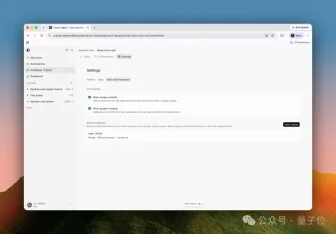
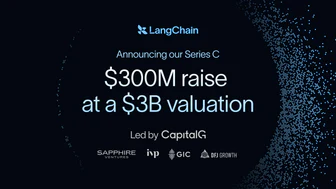
Why it matters: LangChain announced $300 million in Series C funding and outlined the product structure of LangSmith in three layers: runtime, improvement, and governance, which can be used to determine the positioning of its Agent platform.
#Engineering
The day's essential AI stories, from the labs, startups and researchers shaping it.
LangChain BlogFeatured6060
QbitAIFeatured7272Why it matters: Starting from GitHub outages, this connects the motivations and actions of OpenAI, Cursor, and Anthropic in building their own code infrastructure, revealing the actual pressure AI coding puts on the development tool chain.
ITHome · AIFeatured8080Marvell acquires Lumentum for nearly 1030 billion USD with support from Huang Renxun
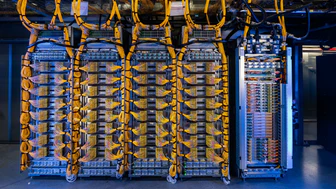
Marvell agrees to acquire Lumentum through a full-stock transaction, including debt, with a total transaction size of 1150 billion USD, of which the equity portion is nearly 1030 billion USD, making it the second-largest merger in the tech industry history
Why it matters: This $100 billion merger combines custom chips and optical devices, allowing readers to understand the integration logic of high-speed interconnection in AI data centers.
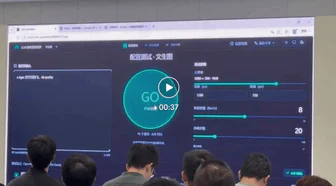
QbitAIFeatured7878FaceWall AI's ForgeKernel live stream generated an operator from scratch, 9.8% faster than DeepSeek FlashMLA and announced open-source.
FaceWall AI's operator generation system ForgeKernel generated the DeepSeek-V4.1 FlashMLA Prefill operator from scratch on an NVIDIA B200, with a final time of 472 microseconds, 9.8% faster than FlashMLA's 518 microseconds. The entire process took 22.5 hours, 42 iterations, and 32 versions, using 1 B200 and 22 GPU hours.
Why it matters: The original provided live stream iteration data and Ascend 3 benchmark results can be used to judge the path of operator generation shifting from manual tuning to intelligent agent self-evolution.
QbitAIFeatured7272Tenstorrent releases Tianhe 300 and Tongyang TY1200, on-site actual test targets NVIDIA H200 and Thor T5000.
Tenstorrent releases cloud-based general-purpose GPU Tianhe 300 and edge product Tongyang TY1200 based on the Tianshu architecture, and compares them with NVIDIA H200, Jetson Thor T5000 on-site with random questions.
Why it matters: On-site random tests, dual-track comparison of cloud and edge against NVIDIA, and providing reproducible test numbers and software stack implementation methods.
The DecoderFeatured8080Google announced the integration of third-party AI agents into Android Studio at the Android Dev Summit and released a new Gemini API
Google announced Android Studio Rabbit 2 at the Android Dev Summit, supporting more than 40 coding agents, including Claude, Codex, and Google Antigravity, to run within the IDE through the open-sourced Agent Client Protocol.
Why it matters: Android Studio opens third-party intelligent agent access and provides corresponding changes at the CLI and MCP levels, which can be used to judge the changes in mobile development workflows.
ITHome · AIFeatured7272Days Smart Chip Tianya 300 runs its first prototype, claims single-card throughput reaches 1.05 times that of NVIDIA H200
Days Technology Core first publicly demonstrates Tianji 300 general GPU prototype running on October 28th Shanghai media open day, claiming it as the first general GPU in China with actual performance reaching NVIDIA H200 level. Third-party actual testing converts single card overall throughput to 1.05 times that of H200, but specific testing methods, model loads, and workload conditions have not been announced.
Why it matters: Days Technology Core first publicly demonstrates Tianji 300 prototype running, providing throughput comparison with H200 and super-node cost estimation, allowing observation of domestic GPU's ground progress.
The Verge · AIFeatured7878Anthropic's S-1 filing impacts its IPO, with Wall Street being asked to believe in AGI.
Anthropic has filed an S-1 registration with the Nasdaq, aiming to list as soon as next month with a valuation range of 1.5 trillion to 2 trillion U.S. dollars. Analyst Joey Brookhart from SemiAnalysis dissected the filing on the Decoder podcast, noting the company's ARR has exceeded 70 billion U.S. dollars, with an approximate 85% reasoning gross margin, but revenue is highly concentrated in programming scenarios, with the top 1% of customers contributing most of the spending.
Why it matters: Decoding Anthropic's S-1 through the lens of SemiAnalysis analyst, showcasing the revenue structure and computing power commitments of the cutting-edge lab.
Google ResearchFeatured6262Google Research is advancing tuberculosis screening implementation with foundational models.
Google Research introduced the path of its tuberculosis screening AI from research to clinical use at IDWeek 2026: publishing a benchmark in Radiology in 2019, completing multi-center prospective validation in NEJM AI in 2024, and then converting it into a clinical tool certified by CE MDR Class IIb through Nexus AI.
Why it matters: Google Research outlined the complete path from imaging benchmark to CE certification tool to open-source MedGemma, allowing readers to understand the stages medical AI needs to cross to move from papers to clinical use.
OpenAI NewsFeatured6262OpenAI models will go live on Google Cloud
OpenAI Collaborates with Google Cloud, Integrating OpenAI Frontline Models and Codex Workflows into Gemini's Model Garden and Offering Through Google Cloud Marketplace
Why it matters: OpenAI's cutting-edge models and Codex workflow enter Google Cloud's Model Garden, providing a new entry point for cross-cloud distribution for readers to explore.
NVIDIA BlogFeatured7272Google Cloud and NVIDIA announce Vera Rubin infrastructure now available
Google Cloud and NVIDIA announce A5X instances based on NVIDIA Vera Rubin now available, opening next month and planned to expand to Europe.
Why it matters: The original text provides the availability time of A5X instances, customer testing, and confidential computing support, allowing readers to judge the implementation rhythm of large-scale reinforcement learning infrastructure.
NVIDIA BlogFeatured6767NVIDIA GTC Berlin 2026: Huang Renxun announces multiple updates including DSX POD, OpenShell, and Nemotron.
NVIDIA CEO Huang Renxun announced multiple updates at the GTC Berlin 2026 keynote speech, including the Vera Rubin AI factory reference design DSX POD delivered in modular container format, reducing on-site deployment time from six months to 14 days.
Why it matters: Huang Renxun's keynote speech at GTC Berlin revealed the latest developments in three product lines: AI factories, secure runtime for agents, and open-source models, providing insights into NVIDIA's focus in Europe.